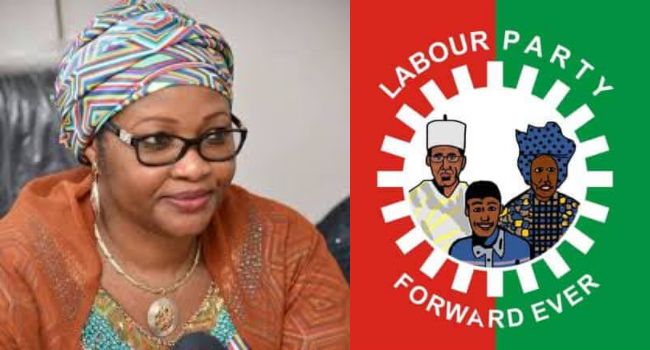
The interim Chairman of the Labour Party (LP), Sen. Nenadi Usman, has challenged the Nigerian political elite to move beyond rhetoric and dismantle the systemic barriers hindering women’s ascent to political power.
Speaking at the weekend at a High-Level Democracy Dialogue organized by the Goodluck Jonathan Foundation (GJF) in Abuja to mark 2026 International Women’s Day (IWD), Sen. Usman called for an end to the “Big money” politics that disenfranchises female aspirants.
Sen. Usman further advocated for strategic cross-party collaboration among women.
A statement issued by the Wealth Dickson Ominabo, Communications Officer, Goodluck Jonathan Foundation, reads:”I don’t see the reason why you must spend so much to seek an elective position. It is not right.
“As a leader in the Labour Party, I have taken it upon myself to make it easier for women to contest. You cannot be talking from outside; you must talk from inside.
“We need to get to the point where women contesting a single seat can step down for one another to ensure victory. Otherwise, our voices will never be heard.”
The keynote speaker, Ms. Ene Obi, former Country Director of Action Aid Nigeria, noted that excluding women who constitute half of the population is “Like running a race with one leg tied.”
She cited patriarchy, expensive campaigns, and political violence as deep-rooted barriers.
“In Nigeria, where challenges like insecurity, poverty, and inequality hit women hardest, excluding half the population from power is like running a race with one leg tied.
“Patriarchy runs strong in our culture, politics, and even party structures. Women face financial barriers because campaigns are expensive, and funding often flows to men.
“Political violence, harassment, and godfatherism intimidate many from stepping up. Religion and tradition sometimes get weaponized to justify exclusion.”
Ms Obi noted that most political parties pay lip service to gender inclusion but nominate few women or place them in unwinnable positions.
She added, “True democracy thrives only when every voice counts, including voices of persons with disability. From voice to power is not a dream; it is a necessity for our nation’s future.”
Earlier, Executive Director of the GJF, Ms. Ann Iyonu, explained that the dialogue aimed to shift the conversation from a “talk shop” to meaningful political influence.
“We need to move beyond placing women in positions where they must constantly struggle. It is time to enact laws that dismantle the structural and systemic barriers limiting women’s participation in governance,” Iyonu said.
The dialogue, themed “Democracy and the Voice of Women: From Voice to Power,” brought together the political class, civil society, and the diplomatic community to interrogate the hurdles preventing women from transitioning from political mobilizers to institutional power brokers.