Corruption has remained one of the greatest challenges confronting Nigeria’s democratic development. Over the years, successive administrations have pledged to tackle the menace, yet its impact continues to affect governance, economic growth, public service delivery and citizens’ trust in government institutions.
For Nigeria’s democracy to truly thrive, the fight against corruption must remain a central agenda of every democratic government. Corruption manifests in various forms in Nigeria, including bribery, embezzlement of public funds, abuse of office, contract inflation and electoral malpractice.
These practices weaken institutions, undermine the rule of law and deprive citizens of essential services such as healthcare, education, infrastructure and security. One of the major consequences of corruption is the erosion of public confidence in government. When citizens perceive that public officials misuse state resources for personal gain, they become disillusioned with the democratic system.
This loss of trust often leads to voter apathy, weak civic participation and growing dissatisfaction with political leadership. To effectively tackle corruption, democratic governments must strengthen institutions responsible for accountability and transparency. Agencies such as anti-corruption bodies, law enforcement institutions and the judiciary must be empowered to operate independently and professionally.
Ensuring that these institutions are free from political interference is critical to sustaining the anti-corruption fight. Transparency in public finance is another key strategy in combating corruption. Governments must ensure that public budgets, procurement processes and financial transactions are open to scrutiny. The adoption of digital governance systems can also help reduce opportunities for corruption by limiting human interference in public transactions.
Equally important is the role of the legislature and the judiciary in ensuring checks and balances. A vibrant legislature must provide effective oversight of the executive arm of government, while the judiciary must ensure that corruption cases are handled fairly and promptly. Delays in the prosecution of corruption cases often weaken public confidence in the justice system. Civil society organisations and the media also play vital roles in the fight against corruption.
Investigative journalism, public advocacy and civic education can expose corrupt practices and promote accountability. When citizens are well informed and actively engaged, they are better positioned to demand transparency and good gov- ernance. Furthermore, ethical leadership is essential in addressing corruption. Political leaders must demonstrate integrity, accountability and commitment to public service. When leaders set the right example, it encourages a culture of honesty and responsibility within public institutions.
Ultimately, the fight against corruption in Nigeria requires a collective effort involving government institutions, civil society, the private sector and citizens. Democratic governance thrives when transparency, accountability and the rule of law are upheld. By making the fight against corruption a priority, Nigeria can strengthen its democratic institutions, promote sustainable development and restore public confidence in governance.
Prominent Nigerians speak
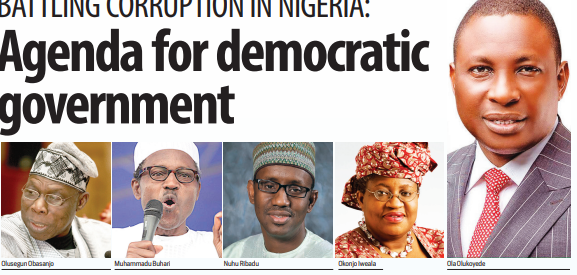
The fight against corruption has continued to dominate national discourse, with several prominent Nigerians stressing the need for stronger institutions, ethical leadership and public accountability to curb the menace. The late president Muhammadu Buhari repeatedly emphasised that corruption remains one of the greatest obstacles to Nigeria’s development. According to him, corruption weakens institutions, diverts public resources meant for development and undermines citizens’ trust in government.
Buhari maintained that government must continue to strengthen anti-corruption institutions such as the Economic and Financial Crimes Commission (EFCC) and the Independent Corrupt Practices and Other Related Offences Commission (ICPC) to ensure transparency and accountability in public service. Similarly, the National Security Ad- viser, Nuhu Ribadu, said that corruption fuels insecurity, poverty and weak governance.
Ribadu, a former chairman of the EFCC, argued that public officials must be held accountable for their actions if Nigeria is to overcome the challenges confronting it. According to him, the country must strengthen institutions and enforce the rule of law in order to ensure that corrupt practices are punished regardless of the status of those involved. Renowned economist and Director-General of the World Trade Organization, Ngozi Okonjo-Iweala, had also emphasised the importance of transparency in public financial management.
She notes that corruption undermines economic development and discourages both local and foreign investments. Okonjo-Iweala stresses that digitalisation of government processes, improved transparency in budgeting and procurement, and strong monitoring mechanisms could help reduce opportunities for corruption. Nobel Laureate Wole Soyinka has often spoken about the moral and societal dimensions of corruption.
According to him, the fight against corruption should not only be about government policies but also about societal values. Soyinka argues that citizens must reject corruption at all levels of society and support leaders who demonstrate integrity and accountability. Former President Olusegun Obasanjo also believes that corruption remains one of the greatest threats to Nigeria’s democratic development.
He has called for political will and institutional reforms to ensure that corruption cases are investigated and prosecuted without delay. According to Obasanjo, no nation can achieve sustainable development if corruption is allowed to thrive within its political and economic systems.
Analysts say the views expressed by these prominent Nigerians highlight the need for a collective national effort involving government institutions, civil society, the media and citizens in tackling corruption. They note that while progress has been made in recent years, sustained commitment, transparency and accountability will be required to win the long-standing battle against corruption in Nigeria.
Role of How EFCC, ICPC in fight against corruption
The fight against corruption in Nigeria has been largely driven by key anti-graft agencies established to investigate and prosecute financial crimes and abuse of public office.
Among the most prominent of these institutions are the Economic and Financial Crimes Commission (EFCC) and the Independent Corrupt Practices and Other Related Offences Commission (ICPC). Over the years, both agencies have intensified efforts to combat corruption through investigations, arrests, prosecutions, public enlightenment campaigns and asset recovery.
Investigations and prosecutions
One of the major responsibilities of the EFCC and ICPC is the investigation and prosecution of corruption-related offences. The EFCC focuses largely on financial crimes such as money laundering, advance fee fraud (popularly known as 419), cybercrime, embezzlement of public funds and other economic crimes.
The ICPC, on the other hand, focuses on corruption within public institutions, including bribery, abuse of office and violation of public procurement processes. Both agencies regularly investigate public officials, politicians and private individuals suspected of engaging in corrupt practices.
Recovery of stolen assets
Another important aspect of the anti-corruption fight is the recovery of stolen public funds and properties. The EFCC and ICPC have recovered billions of naira in cash and assets over the years, including houses, vehicles and funds kept in local and foreign bank accounts. Recovered assets are often returned to the government or used for public projects as part of efforts to ensure that stolen funds benefit the public.
Public enlightenment and prevention
Beyond enforcement, both agencies also focus on preventive measures. They organise public awareness campaigns, seminars and workshops to educate Nigerians about the dangers of corruption and the need to promote transparency and accountability.
The ICPC, for instance, works with government institutions to establish anti-corruption units within ministries, departments and agencies to monitor and prevent corrupt practices.
Collaboration with other institutions
The anti-graft agencies also collaborate with the judiciary, security agencies and international organisations in tackling corruption. Such collaboration helps in tracking illicit financial flows, prosecuting suspects and repatriating stolen funds hidden abroad.
Challenges in the fight against corruption
Despite these efforts, the fight against corruption still faces challenges such as slow judicial processes, political interference, and inadequate resources.
Some analysts also argue that stronger institutional independence and reforms in the justice system are needed to ensure quicker prosecution of corruption cases.
Experts believe that strengthening the capacity of anti-corruption agencies, improving transparency in public institutions and encouraging citizen participation are essential steps toward reducing corruption in Nigeria.
While the EFCC and ICPC continue to play significant roles in tackling corruption, sustained political will and support from citizens remain critical to winning the battle against the menace and promoting good governance in the country.