
A coalition of engineers, academics, and government agencies in Akwa Ibom State has launched an initiative to deploy robotics and artificial intelligence across farms as part of efforts to improve agricultural productivity and reduce post-harvest losses.
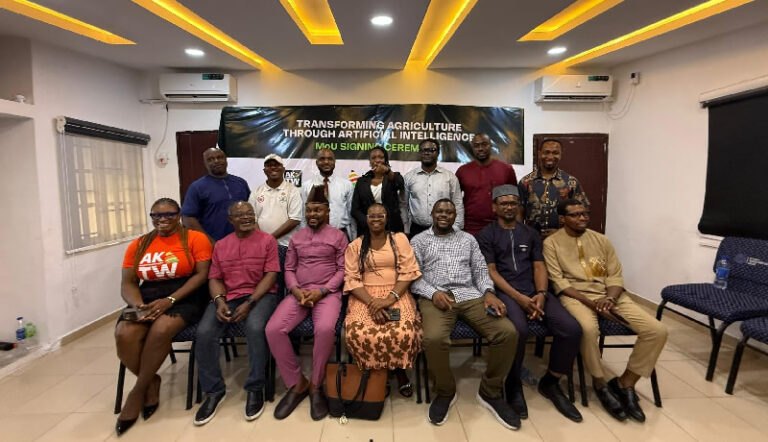
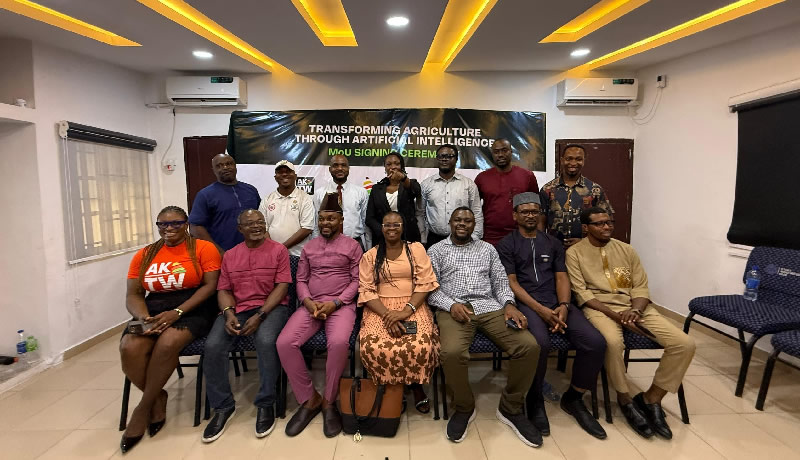
The project, known as Transforming Agriculture Through Artificial Intelligence, was launched by the Ibom Innovation Network through a Memorandum of Understanding signed by six institutions drawn from academia, engineering, and government agencies, according to a statement from the partners on Thursday.
The agreement brought together the University of Uyo, Akwa Ibom State University, the Technology Incubation Centre in Uyo, the Nigerian Institution of Mechanical Engineers, and the Ibom Innovation Network.
Speaking at the launch, the President of the Ibom Innovation Network, Hanson Johnson, said the initiative aimed to move agriculture from traditional methods to technology-driven production systems.
“We are moving beyond the era of ‘farming by chance.’ By integrating AI with mechanical engineering, we are providing farmers with the tools to predict, adapt, and scale. This isn’t just about technology; it’s about economic resilience for the entire region,” Johnson said.
According to industry estimates cited at the event, crop pests and diseases account for up to 40 per cent of annual agricultural losses globally, with climate change expected to worsen the situation.
Johnson said the project would focus on mechanised harvesting and post-harvest storage, areas he described as major weaknesses in Nigeria’s agricultural value chain.
“Project TAT AI zeroes in on the two most broken links in Nigeria’s food chain. The first is the harvesting stage, where the project plans to deploy autonomous robotics to address the soaring cost and scarcity of manual labour. The second is post-harvest storage, where IoT sensors and climate-controlled environments will be used to prevent crops from spoiling before they reach the market — a problem that has drained the earnings of farmers for generations,” he said.
The organisers referenced projections by the International Food Policy Research Institute, which estimate that artificial intelligence could increase global farm productivity by as much as 67 per cent by 2050 through improved efficiency, reduced input costs, and more resilient food systems.
The Director of the TETFund Centre for Computational Intelligence at the University of Uyo, Prof. Uduak Asuquo, said precision agriculture technologies had become increasingly important to global food security.
“With the adoption of precision agriculture, there is a turning point in the agricultural landscape. IoT and AI are no longer experimental approaches — they are essential technologies for global food security. With techniques like soil heat maps and atmospheric intelligence, there is real hope for an agricultural transformation through AI,” Asuquo said.
The organisers said the project would adopt a “Lab-to-Land” approach aimed at testing innovations developed in academic institutions under real farming conditions.
Chairman of the Nigerian Institution of Mechanical Engineers, Akwa Ibom Chapter, Dr Bassey Asanga, said the initiative aligned with the institution’s mandate to support national development through engineering innovation. “This is a fulfilling part of our mission: contributing to national development through innovative engineering solutions and sustainable practices,” Asanga said.
Also speaking, the Head of the Department of Mechanical Engineering at Akwa Ibom State University, Bassey Nkanang, called on farmers and innovators to participate actively in the initiative. “We are calling on young innovators, farmers, and partners to identify with this initiative,” he said.
The Manager of the Technology Incubation Centre, Uyo, Mrs Iniobong Elshaddai, said the centre would provide support for innovators involved in the project, including intellectual property protection and commercialisation assistance.
Globally, artificial intelligence is increasingly being deployed in agriculture to improve crop monitoring, optimise fertiliser use, and enhance farm management through precision farming technologies.