- ‘I will support anybody who emerges as ADC presidential candidate’
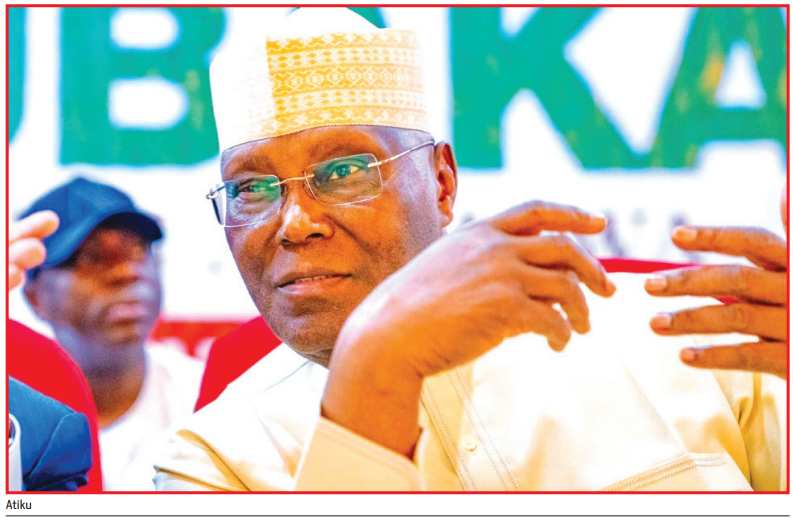
Atiku Abubakar is a former Vice President of Nigeria. In this interview monitored on Arise Television, he speaks on his 2027 presidential ambition, importance of experience in governance, and his willingness to support any consensus candidate that emerges in the African Democratic Congress (ADC), among other issues, EVINCE UHUREBOR reports
You’ve been a central figure in Nigerian politics for decades, and by the time the election comes around in 2027, you’ll be 80. Respectfully, I mean this may be your last realistic shot at the presidency. Does that make the stakes higher for you this time?
Certainly yes! The stakes are higher because I believe that will be my last outing.
Beyond the fact that you have said conclusively that it will be your last outing, why should Nigerians take that gamble on you now and why should they believe that you represent the future and not the past?
I represent both the past and the future simply because we have seen various levels of leadership in the country, both young and old, and we’re experiencing them but I still believe that our expectations of the young leadership is below what we thought.
Also, I personally believe that they require experience and tutelage from the older generation because what I was able to learn from President Olusegun Obasanjo through his experience, I couldn’t have learned it outside. Look at it; the political experience, it’s been a mixed one. We’ve had so many young governors in a number of states, who have failed woefully when it comes to governance.
And I believe these types of people still require tutelage and to learn from experience. Believe me; I don’t think I could have learned if I were a president but I learnt a lot being vice president because Obsanjo came with tremendous experience as a former military head of state.
Is wonder if the real challenge for you is not just defeating the incumbent, Bola Tinubu, but convincing Nigerians that you are not more of the same. I mean, why should they take the risk of choosing you now after so many previous attempts?
Well, there is a clear and stark difference. Take the cases of governments in a number of states being headed by relatively young people and failing woefully simply because at the apex, they did not have a capable and experienced president to guide them and, of course, to give them the benefit of his experience.
That’s why we have been having a number of verywoeful leaders in a number of states because they are being headed by inexperienced young men. Young men also require experience to be able to succeed.
s it an individual thing or a systemic thing?
I will describe it as a systematic issue because we have had more failures in states than we even had at the federal level.
I’m wondering whether you’re saying that the system only became broken when you were no longer in power…
Not necessarily, but when we did not have capable presidents with experience at the helm of affairs.
And when was that? I mean, everybody, to be fair, recognises the time that you and Obasanjo were in office as a sort of golden era after the return to democracy but what other time after that are you talking about?
Let’s take the era of Umaru Yar’Adua, who started very well and was succeeded by Goodluck Jonathan. I know Jonathan very well, a decent young man, but also inexperienced. That I believe contributed to his failure to manage affairs of the country, particularly when he was faced with challenges. In fact, what I would like to see is real leadership training of our upcoming and young generation of politicians, and I wish I could introduce leadership training.
Why hasn’t it occurred to you all this time that that’s something you ought to do?
Well, the university is an independent body. It’s a growing institution. It’s a little over 20 years now, and of course, it is not that it hasn’t produced very exceptional products. I have seen its products all over the world, but then, as you know, universities are developing institutions. So, maybe in due course, they should be able to do that.
You are now aligned with the African Democratic Congress, (ADC) at a time when the party is facing legal battles as well as internal disputes. Do you believe that your presence in the ADC is building a viable platform, or are you joining a coalition that’s already under terrible strain?
I must be frank with you. I am one of the initiators of this coalition, or perhaps the leading initiator of the coalition, because I remember that when the Peoples Democratic Party (PDP) lost the last election, I addressed the party and said that I don’t see a future for PDP unless there is a coalition or broad-based coalition or alliance.
The PDP leadership disagreed with me at that point in time but I said it because I have studied the political history of Nigeria, and I saw how alliances worked in the First Republic and in the Second Republic. So, it is not difficult for one to predict or to explain.
Because I consider those young politicians as future leaders of Nigeria, it was my responsibility to point it out to them. And I pointed out to them that the only future for PDP is in a broad coalition but they disagreed with me. The reason why they disagreed with me was simply because they didn’t want to see my face, not what I was proposing. Now, they have found themselves in the same position.
What was it that made you say that the future of the PDP was only in coalition, having being a presidential candidate of the party?
Specifically, what did you see in the PDP that was a warning sign for you? Because there was a decline in the popular ity of PDP and the states they were winning. There was no way they could have won on their own without a coalition
How about the Nyesom Wike factor?
In fact, more or less, it was like a kind of gang up possibly against the party or based on their individual ambitions.
Now that you’re in the ADC coalition; is the coalition driven by a shared vision or simply a shared determination to remove President Tinubu?
Let me say both because Tinubu has been a very bad president to be honest with you. I didn’t expect that from him. In the way he governs the country, whether economically or otherwise, it’s a disappointment.
On the second part of your question, I will say that a number of things unite us, for instance, the issue of deepening our democratic institutions and the issue of separation of powers under the constitution. We feel very concerned about that. We have seen how virtually a presidency has almost brought the various institutions that are supposed to be checks and balance under one roof, which is quite dangerous.
You’ve run for president multiple times and some have called you a perennial contender. I’m sure you’ve heard that yourself a number of times and you are aiming to run again in 2027. What makes this attempt different from the others?
What makes it different from the other times is that you have a more broad coalition now. You have elements from the All Progressives Congress (APC), PDP, New Nigeria Peoples Party (NNPP) and Lanour Party (LP), among others.
That makes it a much broader coalition than what even happened in the past. For me personally, I see a lot of future because within the broad coalition, you see people of my generation, you see people below my own generation and down the line. So, you can see a clear succession pattern emerging.
Wasn’t that the same thing that happened with the APC coalition?
Not necessarily. I didn’t see it in the APC coalition. You know, I left the APC quite early. Once I realised that they were going the wrong way, I left.
If a consensus candidate emerges within the ADC coalition, would you step aside in the interest of unity?
No, it’s not the issue of stepping aside, but would I support? I think what I would say in the coalition is that the first option would be to work out a consensus. If that doesn’t, of course work, then we go for direct primary.
I mean, I will support anybody who emerges. We will aim at consensus. If we don’t get it, then we go for primaries. That sounds like something that will be terribly disputatious. I don’t expect that we will get to that level because we are dealing with really matured and experienced politicians as well.
But you’re also dealing with people with huge political ambitions…
Ambitions! Well, that’s a different thing altogether. But we have all agreed that this is the way to save democracy in this country.
You now share the same political space with figures like Peter Obi, Rabiu KwanKwaso, Rotimi Amaechi, Nasir El-Rufai, Aminu Tambuwal and a host of others. Some would say that this is not a partnership but a rivalry waiting to happen because if you ask many Nigerians, their concern is that this might collapse under the weight of competing ambitions…
Clearly, you can see that there is a generational progression there. I mean, if people of my generation don’t get it, the people who may get it may be the next generation. I mean that you can see a generational structure there, and it’s deliberate.
If it comes down to that single ticket, will you step aside for Peter Obi, for example, if he’s more popular? Yes or no? I will step aside for any winner. What is difficult there?
In politics, it is either you go through democracy or you go through consensus. So, what is there if he emerges through consensus or he emerges through the electoral process?
Your political strength has often been tied to the North, but you’re also seen as somebody who has a widespread across Nigeria, particularly the South-East and South-South but today, the North appears more fragmented than ever. Do you agree with that assessment?
No, I think I would rather say the North appears to be more united now than fragmented. But there seem to be many multiple power blocs competing for loyalties. The North Central zone is asserting independence away from the rest.
The North Central has always asserted more independence because it used to be the Middle Belt. From the First Republic, it has been the position of the North Central. It has always been the Middle Belt but in the broader political sense, it has always been part of the North.
Do you genuinely have the backing of the North; can the region still unite behind you or has that political base shifted beyond your control?
The North still remains my major political base because I won more Northern states than any other states. I won only one in the South-West. I don’t think I won any in the South-East and the South-South.
If the North doesn’t monolithically rally behind you as their candidate, does that fundamentally weaken your path to the presidency?
The majority of the North will always come together.
What would be the basis for it?
Because the North is my political base just like the South is the political base of Peter Obi and the South-South is the political base of Ameachi.
There are so many different elements today in that Northern equation. It’s not like under Muhammadu Buhari, for example, where you had this massive vote that was constantly going to him….
Can you tell me among the current leaders in the North who has more votes than I have? I mean, you are talking about figures like Aminu Tambuwal, Rabiu KwanKwaso and Nasir El-Rufai as well as other emerging political figures. None of them has got that Northern bloc vote as much as I have got.
But people like KwanKwaso have the Northern strategic votes, don’t they?
Yes, that’s strategic. We concede that to him. That’s why he’s a leader in the coalition.
But you don’t think that the absence of such bloc votes will affect you fundamentally? Well, the absence of it may affect, but even in his own case, you can see how Kano is now split between himself and his former governor. So, there is even a split in that. Let’s turn to the issue of zoning. There is a strong argument rooted in Nigeria’s informal power rotation agreement, that after a Northern presidency, it is now the turn of the South to lead. Why are you seeking to run in 2027? Are you going against that principle or do you believe zoning no longer matters?
I think it is an error or a mistake to say that there is an agreement on the issue of zoning in Nigeria. Let me tell you, the only political party that has zoning provision in its constitution is the PDP, the rest don’t have. So, if anything, all the other political parties are borrowing or learning from PDP’s zoning formula.
Yes, I agree with the zoning formula but if you are talking about the zoning formula in the PDP, and it is North-South, the South has governed for 18 years and the North 10. So, who is in a deficit, if you want to be fair? I’m telling you that the only party that has zoning in its constitution is the PDP. The rest don’t have.
But do you agree with the principle of zoning?
I agree with the principle. In fact, I will even go further. Let me tell you what happened in 1994 Constitutional Conference of General Sani Abacha. There was an argument between the late Dr. Alex Ekwueme and myself, in particular, representing the late Shehu Yar’Adua group. Dr. Ekwueme proposed the provision rotational presidency in the constitution.
I was leading the Yar’Adua group, and I opposed it. And because we control about 60 to 70 per cent of the delegates, late Ekwueme’s amendment was not through. Now, with hindsight, when I attended Ekwueme’s funeral, I admitted that I made a mistake. I should have supported Ekwueme’s amendment and the presidency would have rotated to all the zones in the country. I think that is the most equitable provision that should be included in the constitution.