



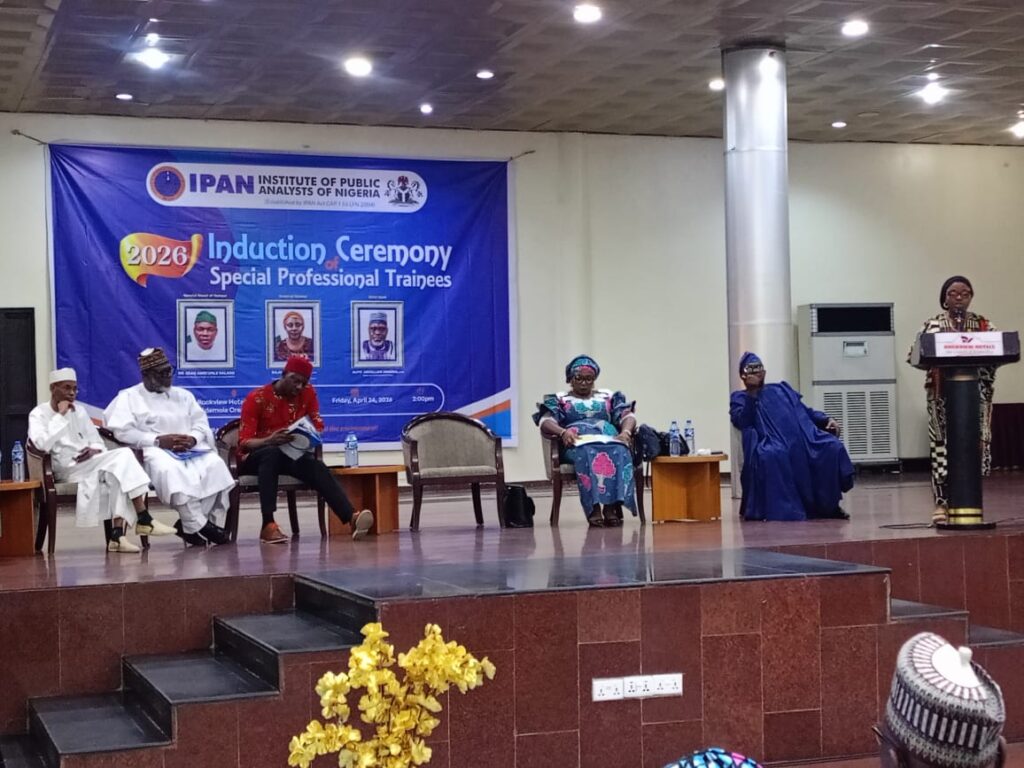
The Federal Government has charged newly inducted public analysts to reject compromise and uphold evidence-based standards in safeguarding public health, as the Institute of Public Analysts of Nigeria (IPAN) inducted 49 professionals into the sector.
The Minister of State for Health and Social Welfare, Dr Iziaq Salako, who gave the charge at the induction ceremony held at the weekend in Abuja, stressed that the role of public analysts remains critical to ensuring the safety and quality of products consumed by Nigerians.
He said, “Say no to compromise. Say no to bias. Say no to negligence. Say no to assumptions. And say yes to result-evidence-based analysis.”
Represented by the Director of Drug and Food Services, Mrs Olufowobi-Yusuf Adeola, he described the induction as a significant milestone for both the new members and the profession, noting that it reflects deliberate efforts to strengthen Nigeria’s analytical and regulatory systems.
“The role of public analysts is central to the mandate of the Federal Ministry of Health and Social Welfare. Through scientific analysis and evidence-based practices, they ensure that foods, drugs, water, cosmetics, and environmental elements meet established standards.”
The Minister added that the theme of the induction lecture, “Laboratory Leadership: Merging Science and Business Acumen,” underscores the need for professionals to move beyond technical competence.
“It highlights the importance of leadership, innovation, and strategic thinking in addressing emerging challenges within the sector.”
The Registrar of IPAN, Aliyu Angara, said the institute inducted 49 candidates out of 102 applicants after a rigorous screening process, representing about a 48 per cent success rate.
“We are inducting highly skilled and competent professionals who have reached the peak of their careers; professors, senior lecturers, directors in public service, and industry experts.”
Angara explained that the induction was part of a structured pathway designed to bring experienced scientists under a regulatory framework to strengthen quality assurance in Nigeria.
“We regulate the practitioners and the laboratories where analysis is carried out. Our role is to ensure that what Nigerians consume, the food they eat, the water they drink, the drugs they take, is safe.”
He clarified that IPAN does not regulate products directly but provides certified analytical reports that guide enforcement actions by agencies such as NAFDAC and the Standards Organisation of Nigeria (SON).
“We are the unseen hands behind quality assurance. Without proper analysis, no one can say whether a product is safe or not,” he added.
The registrar, however, raised concerns over the activities of quacks operating in the sector, warning that some individuals issue fake laboratory reports without conducting actual tests.
“Some people don’t even carry out analysis. They download reports, collect money, and issue results without competence or authorisation. That is dangerous to public health.”
He urged companies and manufacturers to engage certified public analysts in their quality control processes to improve product standards and boost consumer confidence.
“Those involved in quality assurance must interface with the institute and employ qualified analysts. That is the only way we can strengthen Nigeria’s quality infrastructure,” Angara said.
Also speaking, Chairman of the 4th Governing Council of IPAN, Dr Dahiru Adamu, declared that the country’s biggest problem was its failure to uphold quality standards.
Adamu said Nigeria’s quest for development would remain elusive without a firm commitment to quality and integrity in laboratory analysis and beyond.
“Why is Nigeria motivated to start the process of being developed? It’s very simple, it’s because we don’t believe in quality. There is nothing we do in this country based on quality.”
He described laboratories as critical tools for objective decision-making, stressing that analysts must resist pressure from money, power, or personal relationships.
“What I see is what I do. I’m not going to influence it by power, by the volume of naira, or by any personal connection. Let us call it chastity, dignity, and pride of being an analyst. Above all, safety is our priority.”
Also speaking, Chairman of the 6th Governing Council, Prof. Olugbenga Ogunmoyela, described the induction as historic, noting that it marked a new level of professional recognition within the institute.
“This is the very first time we have escalated it to this level. You are being recognised not just for your qualifications, but for the impact you are expected to make.”
He charged the inductees to leverage their experience and networks to uphold the ideals of the profession.
“When you have your foot in the door, we expect you to begin to make an impact. Integrity is not optional; it is fundamental,” Ogunmoyela added.
Delivering the induction lecture as the President of the Pharmacy Council of Nigeria (PCN), Pharm. Ibrahim Ahmed warned that Nigeria was currently battling a dangerous surge in counterfeit products.
“Nigeria is facing a counterfeit product crisis. The fake drug trade has reached a trillion-dollar scale globally, and this is now a national emergency threatening public health and economic stability.”
He noted that the proliferation of fake and substandard products had led to treatment failures, drug resistance, and preventable deaths, while also eroding investor confidence and weakening Nigeria’s export potential.
“The more public analysts we have actively practising, the stronger our capacity to fight counterfeit products.”
Represented by the Head, Programme Coordinating Department at PCN, Pharm Ene Daniel-Ebune, he stressed that beyond technical expertise, analysts must adopt strategic and business-oriented approaches to ensure the sustainability of laboratories.
“Analytical laboratories are not just service providers; they are pillars of public health, industry, and national development,” he said.