

…Demand Greater Voice in Governance
As Nigeria prepares for the 2027 general elections, domestic workers across the country have called for greater political inclusion and representation, insisting that their voices must be reflected in policies that affect their welfare and livelihoods.
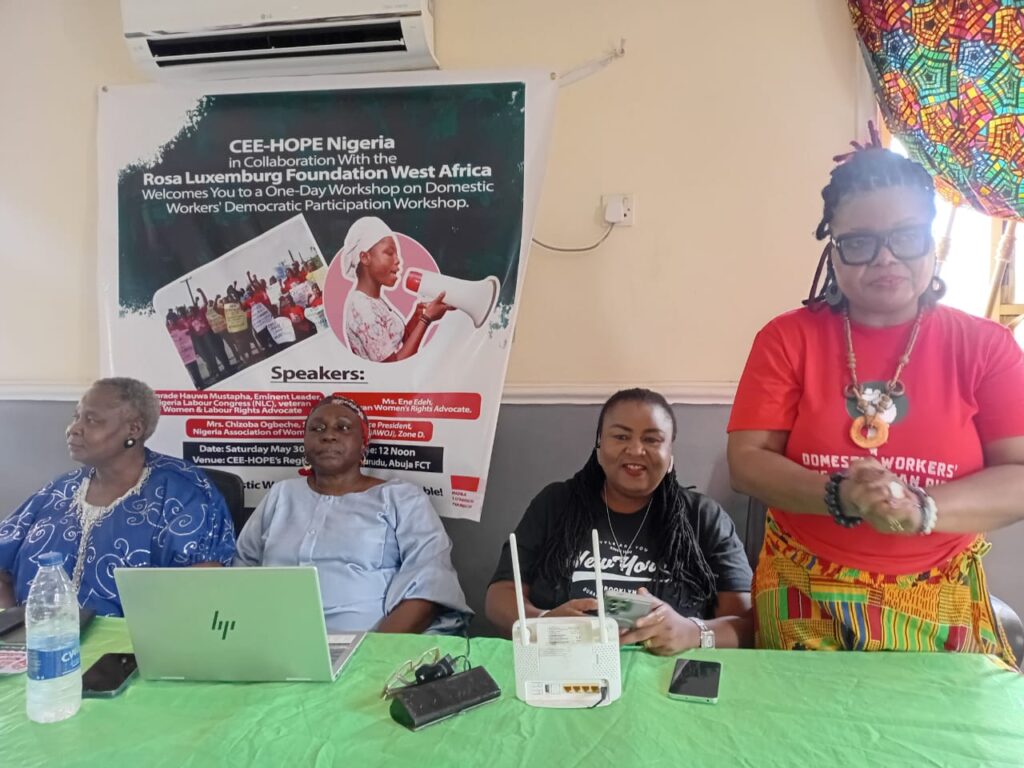
The call was made during a one-day Domestic Workers Democratic Participation Workshop organised by CEE-HOPE Nigeria in partnership with the Rosa Luxemburg Foundation West Africa in Abuja.
Participants at the workshop observed that despite constituting a significant segment of the country’s workforce, domestic workers remain largely excluded from political and governance processes.
They stressed the need for increased political awareness and civic engagement to ensure that labour and social protection policies address their realities.
The workshop formed part of an ongoing national campaign by CEE-HOPE Nigeria aimed at promoting the rights, welfare and recognition of domestic workers while encouraging their active participation in democratic processes.
The Executive Director, CEE-HOPE, Betty Abah, noted that domestic workers remain among the most vulnerable categories of workers in Nigeria, often operating without formal contracts, legal protection or access to justice. It noted that many continue to face exploitation, unpaid wages, abuse and other violations with limited avenues for redress.
CEE-HOPE has consistently advocated the passage of the Domestic Workers Protection Bill, which seeks to provide legal safeguards against forced labour, sexual abuse, child exploitation and other forms of workplace violations.
Abah maintained that unionisation remains essential to empowering domestic workers and breaking the culture of isolation that often characterises the sector.
She argued that collective organisation would strengthen workers’ ability to negotiate fair conditions, challenge abuse and seek justice when their rights are violated.
Speaking at the event, Comrade Hauwa Mustapha, a labour and women’s rights advocate of the Nigeria Labour Congress (NLC), urged domestic workers to become active participants in governance processes. She stressed that democracy must be inclusive and serve all citizens regardless of social or economic status.
Mustapha encouraged domestic workers to understand their civic rights and responsibilities, participate in elections, and engage with public institutions to ensure their concerns are reflected in national policymaking.
Ene Edeh, women’s rights advocate, highlighted the persistent challenges facing domestic workers across the country, particularly women and young girls who often experience exploitation, abuse, discrimination, and denial of basic labour protections.
She called for stronger advocacy, public awareness, and policy reforms to safeguard domestic workers and promote dignity, fairness, and respect within the sector.
The Vice President of the Nigeria Association of Women Journalists (NAWOJ), Zone D, Chizoba Ogbeche, reaffirmed the media’s commitment to amplifying the voices of vulnerable workers and ensuring their concerns receive public attention.
She assured participants of continued media support while urging domestic workers to uphold professionalism, integrity, and good conduct in their relationships with employers, noting that mutual respect is essential for sustainable working relationships.
In his remarks, cleric Wilson Idoko emphasised the importance of knowledge and self-development, citing the biblical principle that people perish for lack of knowledge.
He encouraged participants to understand their rights and responsibilities while pursuing personal growth and development opportunities.
He further urged domestic workers to embrace values of integrity, love, honesty, and service, noting that faith and good character remain essential foundations for success in life and work.
The workshop ended with a renewed commitment to advocate for the recognition of domestic work as a legitimate profession deserving dignity, respect and legal protection.
Participants reaffirmed that the rights and welfare of domestic workers must remain a priority as Nigeria pursues inclusive governance, social justice and human rights protection ahead of the 2027 elections.