

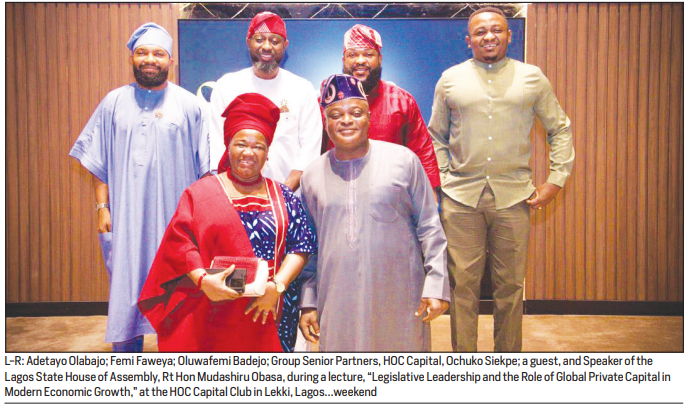
The Lagos State House of Assembly Speaker, Mudashiru Obasa, has said no economy can achieve sustainable prosperity without strong institutions and strategic collaboration between the government and private investors.
He made the comment in his address on the theme, “Legislative Leadership and the Role of Global Private Capital in Modern Economic Growth” at the HOC Capital Club in Lagos at the weekend.
Addressing investors, policymakers and diplomats, Obasa said global private capital can only thrive in an environment where laws are clear, governance is accountable and policies remain consistent. According to him, legislative leadership is central to building such an environment, noting that the Assembly’s constitutional mandate — particularly its control over public funds and oversight powers — is designed to safeguard transparency and strengthen investor trust.
The legislator said: “All the money that comes into the treasury must be legislated upon by the House for transparency. “The power of the purse is the most effective weapon for the people’s representatives to control government spending.” Obasa said credible institutions, the rule of law, and regulatory predictability are essential to attracting quality investments.
While emphasising the importance of attracting private capital, the legislator said economic growth must also translate into tangible social benefits such as job creation, poverty reduction and improved public services for citizens. He highlighted several landmark laws enacted under his leadership, including the Public Procurement Law (2021), the Public-Private Partnership Law (2011/2015), and the Electric Power Sector Reform Law (2024), which he said have boosted investments in Lagos.
Obasa also pointed to initiatives such as the Sovereign Wealth Fund, tax harmonisation efforts and the proposed Railways Corporation Bill (2025) as indicators of the state’s long-term economic vision and legislative foresight. He also highlighted initiatives such as the Sovereign Wealth Fund, harmonization of taxes, and the proposed Railways Corporation Bill (2025) as evidence of Lagos’ legislative foresight and long-term economic vision.
Obasa stressed that the future of growth will depend on the quality of leadership in public institutions and the confidence inspired in the global investment community. He said: “Together, we can unlock the full potential of Lagos, strengthen Africa’s economic future, and establish a new benchmark for economic and diplomatic engagement on the global stage.”