
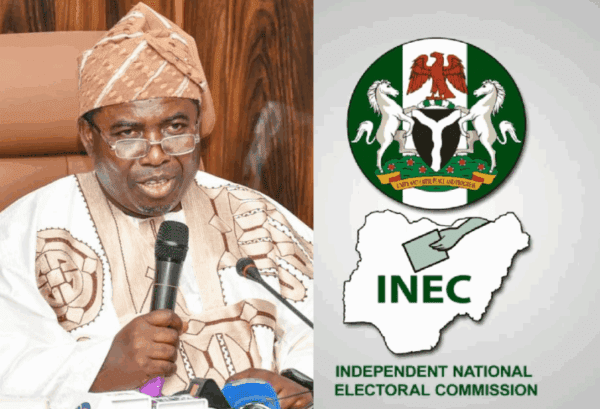
The Kwankwasiyya Movement, on Thursday, the Chairman of the Independent National Electoral Commission (INEC), Joash Amupitan, has lost the moral authority, public trust, and institutional credibility required to continue in office, as his continued stay represents a direct risk to democratic stability and national unity.
In a statement issued by Muhammad Sale Habibu, the Kwankwasiyya Movement insisted that the recent Encroachment on democratic principles by the Chairman, without recourse to Political and legal preservation, demands his quick exit as Chairman of the Electoral Umpire.
“We therefore demand the immediate resignation of the INEC Chairman, the urgent suspension of the voter revalidation exercise, greater judicial discipline and intervention by the National Judicial Council (NJC) to address conflicting rulings and
“A recommitment by all institutions to the principles of fairness, consistency, and constitutional order
“We also call on political actors to desist from weaponising the judiciary for partisan advantage, and on civil society and the international community to remain vigilant in defending Nigerians democratic space.
Habibu noted that Nigeria’s future depends on strong institutions, credible processes, and the protection of the people’s right to freely choose their leaders. These must not be compromised.
“Also alarming is the introduction of a voter revalidation exercise just months before critical elections, an action that is not only ill-timed but widely perceived as a deliberate and calculated attempt to disenfranchise millions of eligible Nigerian voters.”
” At a time when confidence in the electoral system is already fragile, such a policy introduces confusion, imposes unnecessary administrative hurdles, and threatens to exclude law-abiding citizens from exercising their fundamental right to vote.”
The Kwankwasiyya believes that this revalidation exercise bears all the hallmarks of a systemic trap capable of suppressing voter turnout, distorting electoral participation, and disproportionately affecting opposition-leaning populations. It represents not reform, but regression, a direct assault on democratic inclusion.
They added that taken together, these developments point to a dangerous trajectory: a weakened judiciary marked by inconsistency, political parties crippled by legal uncertainty, and an electoral body whose actions increasingly inspire doubt rather than confidence.
“This convergence of institutional failures poses a grave threat to the credibility of future elections, particularly as Nigeria approaches the 2027 general elections.
“Let it be stated clearly: democracy cannot survive where political parties are incapacitated by judicial confusion and where the electoral umpire is perceived to be complicit, whether by action or omission, in the suppression of voters and the distortion of political competition.
The Movement expresses concern over the unfolding threats to Nigeria’s democracy arising from a combination of judicial inconsistencies and the increasingly questionable conduct of the Independent National Electoral Commission (INEC) under its current leadership.
“Recent developments surrounding the leadership crisis within the African Democratic Congress (ADC), and the consequential decision by INEC to suspend recognition of any faction pending judicial determination, have once again exposed the fragile and troubling state of Nigeria’s democratic institutions.”
” While INEC may claim compliance with court orders, the broader circumstances reveal a dangerous pattern where conflicting judicial pronouncements and administrative decisions combine to paralyse political parties and weaken opposition platforms.
They reminded us that this situation is not isolated. Similar crises have plagued the Peoples Democratic Party (PDP), Labour Party (LP), and New Nigeria Peoples Party (NNPP), where judicial interventions have often been contradictory and procedurally questionable, triggering prolonged leadership disputes and institutional uncertainty.
“The cumulative effect is the systematic erosion of internal party democracy and the shrinking of the political space necessary for a healthy, competitive system.
“At the heart of this crisis is the growing disregard for established legal principles, including the doctrine of Stare Decisis, and the troubling trend of courts of coordinate jurisdiction issuing conflicting orders on the same matters.
“These developments not only undermine the credibility of the judiciary but also create an environment where electoral management becomes susceptible to manipulation, discretion, and selective compliance.
Unfortunately, Mailemo hints that, rather than acting as a stabilising force in this chaotic environment, the leadership of INEC has, unfortunately, reinforced public distrust through actions that raise serious concerns about neutrality, consistency, and commitment to democratic values.