



Vice President, Kashim Shettima, has called for a fresh framework for youth leadership development, noting that it was the backbone of sustainable progress. He particularly warned that the country’s status as one of the world’s youngest nations would count for nothing without deliberate institutional investment to match its demographic scale.
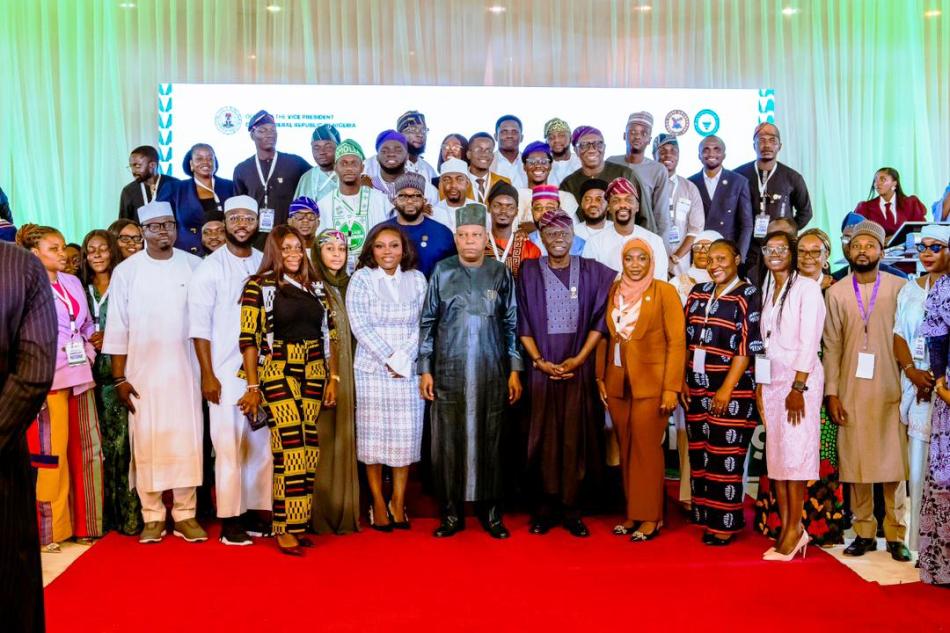
Speaking yesterday in Abuja during the Abuja Dialogue 2026, convened by the Office of the Vice President and Lagos State’s Lateef Jakande Leadership Academy, Shettima said the country’s demographic profile must no longer be treated as a rhetorical point in public discourse, but as a strategic reality requiring policy attention at the highest levels of governance.
“We are one of the youngest nations on earth. That fact should not be treated as a line for conferences or a statistic for brochures. It is a national condition with profound consequences,” he stated.
He stressed that the future of Nigeria would depend not merely on the abundance of its natural resources or the ambition of government programmes, but on the systems built to sustain leadership continuity and national development.
Shettima described the Abuja Dialogue as an important national platform for reflection at a time when governments around the world were being forced to respond more precisely to rapid changes in technology, economics and public expectations. According to him, leadership in the present age could not be casual or accidental, but must be cultivated through structured pathways that prepare young people for responsibility.
“Youth leadership must be understood with clarity. It is not a ceremonial handover waiting for age to perform its arithmetic. It is a structured process through which young men and women are prepared, trusted, integrated, and supported within the institutions that shape our future,” he maintained.
The Vice President noted that this new framework must go beyond slogans and applause to reshape the design of education, public service, enterprise and civic institutions He further emphasised the need for gradual pathways through which young Nigerians can assume responsibility, arguing that leadership matures through practice and accountability.
According to him: “Leadership grows when young people are given room to learn, to contribute, to make decisions, and to be held accountable for results. Responsibility is the workshop where capacity is refined.” Addressing the nation’s youth directly, Shettima noted that the moment now presents both an invitation and an obligation to participate meaningfully in shaping the future of the country.








