Nigeria has called for stronger global cooperation, practical migration systems, and increased investment in migrant protection and diaspora engagement at the just concluded International Migration Review Forum (IMRF) 2026 held at the United Nations (UN) Headquarters in New York.
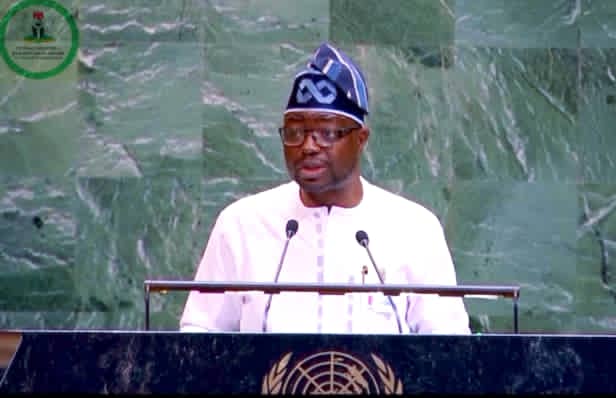
Speaking on behalf of both Nigeria and the African Group at high-level sessions of the forum, Nigeria’s Honourable Minister of Humanitarian Affairs and Poverty Reduction, Dr Bernard M. Doro, stressed the need for migration governance that protects human dignity while advancing sustainable development.
The IMRF is the principal global platform for reviewing the implementation of the Global Compact for Safe, Orderly and Regular Migration (GCM), adopted by the United Nations in 2018.
Delivering the African Group’s statement during the plenary segment, Dr Doro said Africa remains committed to cooperation, protection of human rights, and balanced migration governance that respects national sovereignty while safeguarding migrants irrespective of status.
“The Global Compact is essential. Its effective implementation requires enhanced cooperation among countries of origin, transit, and destination,” he stated.
He noted that migration remains deeply connected to Africa’s economic and development realities, calling for greater global commitment backed by adequate financial and technical support.
“The story of migration is largely the story of Africa. This Forum must honour that reality,” the Minister said.
Dr Doro also advocated the expansion of legal migration pathways through labour mobility partnerships, skills recognition frameworks, social security portability, and accessible migration channels.
He further urged stronger commitments toward lowering remittance transfer costs, promoting digital financial systems, and expanding diaspora investment opportunities across African countries.
On climate-related migration pressures, the Minister emphasised the need for proactive adaptation measures, resilience-building in countries of origin, and stronger coordination in managing cross-border movement.
In Nigeria’s national statement, Dr Doro highlighted the country’s efforts to translate global migration commitments into practical national systems through a whole-of-government and whole-of-society approach.
According to him, Nigeria has strengthened policy coordination, institutional collaboration, migrant protection systems, reintegration mechanisms, and migration data management as part of its commitment as a Global Compact Champion Country.
He disclosed that Nigeria recently completed its second Voluntary National Review process, which assessed progress across all 23 objectives of the Global Compact and identified both achievements and existing gaps in implementation.
While acknowledging progress, the Minister noted that challenges still exist in areas such as migration data systems, financing, public awareness, and uneven implementation across different levels.
He outlined Nigeria’s future priorities to include strengthening labour mobility systems, ethical recruitment frameworks, migration data infrastructure, diaspora engagement, and sustainable reintegration programmes for returning migrants.
“Migration is a human reality that must be governed in a manner that protects dignity, safeguards rights, and contributes to development,” Dr Doro stated.
As part of Nigeria’s engagements at the forum, the country also co-hosted side events focused on decent work, legal identity, skills recognition, and youth-led innovations on safe and regular migration.
Beyond migration governance discussions, DDrDoro also contributed to conversations at the UN Transforming Global Education Summit, where he emphasised the strong connection between education, poverty, and social exclusion.
At the summit, the Minister advocated for coordinated systems that connect education, humanitarian interventions, skills development, and economic opportunities, stressing that education must go beyond certification and lead to productivity, self-reliance, and sustainable livelihoods.
Observers at the forum noted that Nigeria’s interventions reflected a growing emphasis on coordinated governance systems, diaspora-driven development, education-linked economic inclusion, and practical reforms capable of translating global commitments into measurable outcomes for vulnerable populations.