


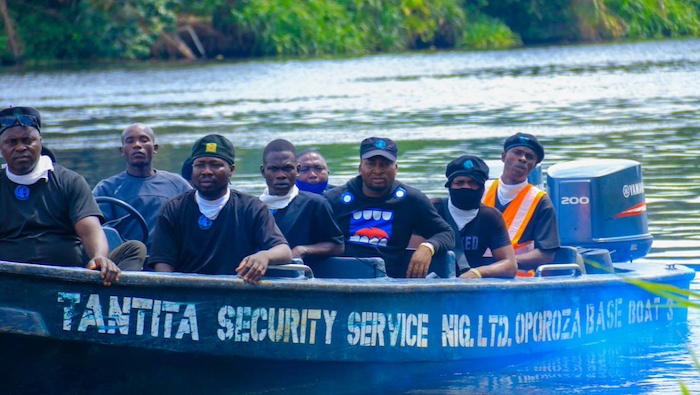
A report before the Joint Committee on Petroleum Resources of the Senate and House of Representatives, has highlighted how Tantita Security Services Nigeria Limited exposed the highly dangerous methods employed by criminal syndicates, who have been tapping directly into wellheads.
The criminals are said to be using technical knowledge to attach hoses to pressurized discharge points and allowing crude to flow directly into waiting canoes in operations that pose severe risks of catastrophic explosions and environmental disaster. The report presented to the joint committee described how these wellhead tapping operations represent perhaps the most technically sophisticated and simultaneously most dangerous form of crude oil theft occurring in the Niger Delta.
Unlike pipeline tapping, which typically requires welding or drilling into a pipeline under controlled conditions, wellhead tapping involves working directly with pressurized equipment designed to contain oil and gas under extreme conditions. Any mistake, committee members were told, could result in a catastrophic release of hydrocarbons with the potential for massive explosions.
According to testimony delivered before the joint committee, the criminal syndicates conducting these operations have demonstrated access to individuals with genuine technical expertise in oilfield operations. The methods used to attach hoses to wellhead discharge points, the report explained, required understanding of pressure dynamics, valve operations, and safety systems.
This suggests that the networks have recruited or coerced current or former oil industry personnel into assisting their criminal activities. The joint committee heard alarming testimony about the environmental consequences of these wellhead tapping operations.
The report documented multiple cases, where crude tapped directly from wellheads had spilled into surrounding environments, contaminating soil, water, and vegetation across significant areas. Unlike pipeline spills, which can sometimes be isolated by shutting down sections of pipeline, wellhead spills often continue until they are physically stopped by security personnel.
Committee members were shown evidence of how the stolen crude is collected in waiting canoes positioned near the tapped wellheads. These canoes, the report noted, are typically small vessels that can be quickly moved and hidden if security personnel approached. The crude is transferred from the wellhead through hoses directly into the canoes, a process that frequently results in additional spills as connections are made and broken under less-thanideal conditions.
The report before the joint committee emphasized that the wellhead tapping operations were particularly difficult to detect and interdict. Wellheads are often located in remote areas with limited access, and the tapping equipment can be quickly disconnected and removed if security personnel approached.
The criminal syndicates have also become adept at disguising their tapping operations, using vegetation and makeshift structures to conceal the hoses and collection points. In one case detailed before the joint committee, Tantita operatives discovered a wellhead that had been tapped for what appeared to be an extended period. The hose attachment was professionally installed, the report noted, and the collection area had been modified to facilitate efficient loading of canoes.
The volume of crude being stolen from this single wellhead was substantial, suggesting that it had become a significant source of illicit revenue for the criminal network operating it. The joint committee was further informed about the safety risks faced by Tantita personnel when interdicting these wellhead tapping operations.
Unlike pipeline theft, where the primary danger comes from potential ignition of spilled crude, wellhead tapping operations involve working in close proximity to pressurized equipment that could fail catastrophically at any moment. The report noted that this has required Tantita to develop specialised procedures for approaching and securing tapped wellheads.
Testimony before the committee highlighted the broader implications of wellhead tapping for Nigeria’s oil industry. When wellheads are damaged by tapping operations, the report explained, they may require extensive repairs or even replacement before legitimate production can resume. This results in lost production revenue beyond the volume of crude actually stolen.
Additionally, the presence of tapping operations can force operators to shut down entire fields while security assessments are conducted. The report before the joint committee documented how criminal syndicates have become increasingly bold in their wellhead tapping operations. In some cases, committee members were told, multiple wellheads in the same field have been tapped simultaneously, suggesting coordinated operations involving substantial criminal resources.
The networks have also demonstrated the ability to rapidly retap wellheads that have been secured by enforcement personnel, indicating that they maintain the technical capability and personnel to resume operations quickly. Committee members expressed particular concern about the potential for wellhead tapping to trigger major accidents.
A single spark near a tapped wellhead releasing gas along with crude, the report noted, could cause an explosion, killing not only the criminals conducting the tapping but also innocent people in the surrounding area. The environmental damage from such an explosion could be catastrophic, with longterm consequences for the affected communities.
The joint committee was told that Tantita has responded to the wellhead tapping threat by increasing surveillance around known wellhead locations and developing intelligence capabilities focused on identifying the technical personnel who enable these operations. The company has also worked with oil industry operators to improve physical security at wellhead sites, including the installation of tamper-detection systems and improved lighting and access controls.
Despite these efforts, the report before the joint committee acknowledged that wellhead tapping remains a significant challenge. The number of wellheads in the Niger Delta, including many that are abandoned or poorly maintained, make comprehensive protection difficult. Committee members were urged to consider measures that would accelerate the decommissioning of abandoned wellheads and improve security at active ones as part of a broader strategy to combat crude oil theft.








