
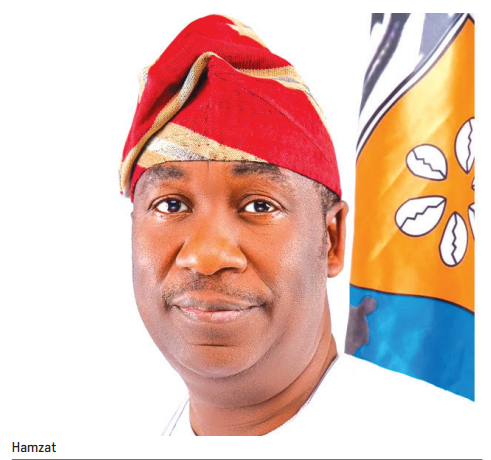
Following the endorsement by his principal and governor of Lagos State, Mr. Babajide Sanwo-Olu, as his preferred successor, coupled with Wednesday’s adoption by the apex decision making body of the All Progressives Congress (APC) in Lagos, the Governance Advisory Council (GAC), the deputy governor of the state, Dr. Obafemi Hamzat, will most likely emerge as the flag bearer of the ruling party in Lagos come 2027.
But his emergence, analyst has observed, would be a departure from the known pattern in Lagos – an anomaly. It is on record that no deputy governor in the history of Lagos has ever signified interest in succeeding their principal. If and when Hamzat eventually emerge from the APC’s primary elections as candidate, he would be the first deputy governor to be so elected.
Having served as Sanwo-Olu’s deputy since 2019, he is also the first in the history of the state to serve two terms. Since the return of democracy in 1999, there have been six deputy governors: Chief (Mrs.) Kofoworola Bucknor-Akerele, Olufemi Pedro, Abiodun Ogunleye, Sarah Adebisi Sosan, Adejoke Orelope-Adefulire and Oluranti Adebule, who all served shorter terms, either a single four-year tenure or in Pedro’s case, five years.
Historically, Lagos politics has developed a distinct pattern, one that blends strategic selection with an element of surprise. Since the exit of President Bola Tinubu as governor in 2007, the process of producing successors has often leaned toward individuals, who at the point of their emergence, were either relatively unknown in the political arena or had limited exposure to elective contests.
From Babatunde Fashola to Akinwunmi Ambode and Babajide SanwoOlu, the trajectory has been consistent: technocrats or administrators elevated into leadership, often catching even party faithful off guard. Yet, the possible emergence of Hamzat as a gubernatorial candidate represents a notable shift, arguably the most significant departure from this established tradition.
When Fashola was presented in 2007, he was widely regarded as a brilliant mind but largely unknown beyond legal and policy circles. His role as Chief of Staff to Tinubu introduced him to governance, but not necessarily to grassroots political contestation.
His emergence, therefore, was less about political longevity and more about perceived competence and trust. Ambode’s rise in 2015 followed a similar script, albeit from a different background. A career civil servant, he was drawn from retirement and thrust into the political limelight, surprising many seasoned politicians who had long nursed ambitions for the governorship.
His selection reinforced the pattern of elevating non-traditional politicians into executive leadership. Sanwo-Olu’s candidacy in 2019 also bore the hallmark of surprise. Though he had served in government as a commissioner, he had never tested his popularity in an elective contest. His emergence, during the pre-primary period signaled once again that Lagos politics favoured strategic consensus over prolonged political apprenticeship.
Against this backdrop, Hamzat stands out as an anomaly. Unlike his predecessors, he is not a late entrant into the political arena. He is neither a technocrat drafted at the eleventh hour nor a quiet administrator suddenly elevated to prominence. Rather, he is a career politician who has consistently demonstrated interest, resilience and patience within the system.
Hamzat’s political journey is neither abrupt nor accidental; he signified interest in the governorship position as far back as 2015. He remained active in the political space and re-emerged during the pre-primary processes leading up to the 2019 elections. Although he did not clinch the ticket at the time, he accepted the role of deputy governor under Sanwo-Olu and went on to serve two consecutive terms, an achievement unprecedented in Lagos history.
Indeed, no deputy governor in the state had previously served two full terms, let alone stood on the threshold of succeeding their principal. In this sense, Hamzat’s trajectory is historic. If he eventually assumes the governorship, he would not only break the jinx but also redefine the pathway to power in Lagos.
More importantly, his emergence signals a deeper evolution within the political culture of the state. It suggests a gradual shift from the era of “surprise candidacies” to one that acknowledges persistence, loyalty and institutional memory.
Hamzat embodies the archetype of a politician, who has paid his dues, not merely through appointments, but through sustained engagement with the political process. This distinction matters. In a system where many aspirants often view politics as a sprint, Hamzat’s journey reinforces the value of endurance. It tells a different story: that ambition, when tempered with patience and service, can eventually find expression.
There is also a symbolic dimension to his candidacy. For party faithful and grassroots mobilizers, who have long sought recognition within the hierarchy, Hamzat’s rise could be interpreted as validation.
It suggests that the ladder of progression is not entirely closed, that it is possible to rise through the ranks without being an outsider brought in at the decisive moment. None of this diminishes the contributions of past governors, whose tenures have each left distinct imprints on Lagos. Rather, it highlights the evolving nature of political succession in a state that often sets the pace for governance and political strategy in Nigeria. In Hamzat, Lagos may be witnessing the consolidation of experience over experimentation, continuity over surprise.
His story is one of waiting, of staying the course, and of navigating the complexities of power without losing sight of long-term ambition. Whether this shift becomes a permanent feature of Lagos politics remains to be seen. But for now, one thing is clear: Hamzat is not just another candidate in a familiar cycle, he is, in many respects, an uncommon one.