

The minority caucus in the House of Representatives no longer has leadership following the defection of all but one of its leaders to the ruling All Progressives Congress (APC), PHILIP NYAM reports
Before the House of Representatives embarked on recess on May 6, to enable lawmakers to participate in the ongoing party primaries in preparation for the 2027 general election, its minority caucus had lost all but one of its officers to the ruling All Progressives Congress (APC). However, this was not noticeable by many political watchers, even as only the Deputy Minority Whip, Hon. George Ozodinobi, defected from the African Democratic Congress (ADC) to the newly registered Nigeria Democratic Congress (NDC).
New Telegraph observed that in the last two weeks, the minority leader, Hon. Kingsley Chinda, would come to the chambers with the leadership entourage and take his rightful seat on the floor, but when it comes to representing the minority caucus, the deputy whip, Ozodinobi, will be called upon by the presiding officers to second a motion or speak on behalf of the minority.
As at last week, Hon. Chinda never turned up for plenary sessions, and the presiding officers kept referring to Ozodinobi as the acting minority leader, prompting the last man standing in the opposition leadership to at a point enthuse that “I pray I become the minority leader.” As it stands, only Ozodinobi is still in an opposition party among the minority leaders.
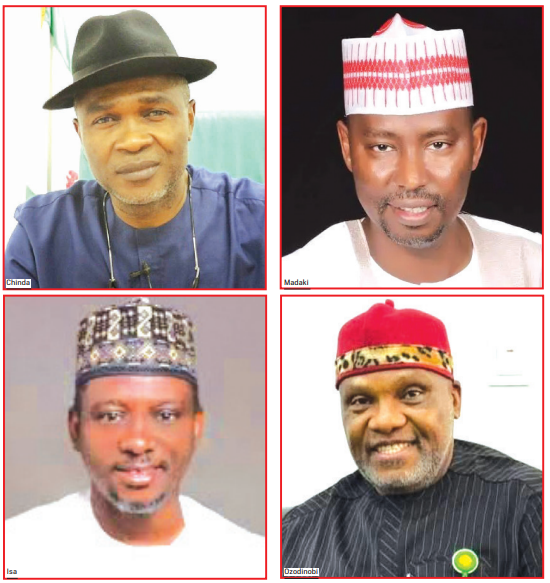
Recall that at the composition of the minority leadership has Chinda (PDP, Rivers) as the minority leader; Ali Madaki (NNPP, Kano), deputy minority leader; Ali Isa (PDP, Gombe), minority whip and Ozodinodi (LP, Anambra) as deputy minority whip. When the House reconvenes on June 2, only Ozodinobi will be eligible among the four to be in the speakers’ chambers. This means a new minority leadership has to emerge to fill the vacuum created by the trio of Chinda, Madaki and Ali.
Chinda
Chinda’s defection is mired in controversy as he did not formally announce his defection from the PDP to the APC on the floor of the House. Although there had been stories of his alleged endorsement by the Minister of the Federal Capital, Nyesom Wike, as the likely successor to Governor Siminalayi Fubara, many thought he was going to contest the election on the platform of the Wike-led PDP faction.
However, his membership of the APC only became an open secret when he appeared before the party’s screening committee ahead of the governorship primaries in Rivers State. While his screening confirmed that he has parted ways with the PDP, some unconfirmed reports indicate that Chinda was compelled to defect to the APC following the Supreme Court’s judgement on the leadership of the PDP.
Whether he has tendered his resignation letter to the chairman of his ward remains a matter of conjecture, Chinda may have anticipated his latest move because he had stopped speaking for the opposition in the House in the last two weeks, although he never publicly withdrew from the minority caucus or resigned from membership of the PDP.
Of course, as a lawyer and an experienced legislator, he is not oblivious of the provisions of section 77 of the Electoral Act, 2026, which bars politicians from registering with two political parties concurrently, so he must have taken precautions to avoid being convicted for flouting the extant rule. A close confidant of Wike, Chinda is also the representative of the minister in the House and has been there since 2011.
In 2019, he contested for the position of minority leader, but was defeated by Ndidu Elumelu from Delta State. He, however, returned in 2023, following the strong collaboration between the Wike-led PDP and the ruling APC. Despite being in the PDP, Chinda was at the forefront of those marketing the candidature of the APC-endorsed speakership candidate and helped galvanise members of the PDP for the emergence of Speaker Tajudeen Abbas.
Madaki
The member representing Kano Municipal federal constituency was elected on the platform of the New Nigeria Peoples Party (NNPP). He had earlier served in the House between 2011 and 2019 but lost his return bid in 2019.
He was elected as the deputy minority leader at the composition of the leadership in June 2023 after he campaigned vigorously for the election of Speaker Abbas. An erstwhile disciple of the Kwankwasiya Movement, Madaki fell out with the leader of the group and a former governor of Kano State, Rabiu Kwankwaso, in November 2024, when he and Alhassan Rurum, representing Rano/Kibiya/Bunkure federal constituency of Kano, publicly announced that they will no longer align with the movement over growing discontent within the NNPP ranks in Kano State. Since then, Madaki dropped the Kwankwasiya red cap and replaced it with the traditional Hausa cap.
Despite severing his relationship with the Kwankwasiya group, Madaki remained a member of the NNPP until the wave of defection in the House began early this year. On March 31, Madaki, along with seven other lawmakers from the state, abandoned the NNPP for the ruling APC. Their defection was elaborately celebrated and was witnessed by Governor Abba Yusufl and the immediate past National Chairman of APC, Abdullahi Ganduje.
Those who defected with Madaki are Ghali Mustapha (Ajingi/Albasu/ Gaya; Shehu Muhammad Bello (Fagge), Dankawu Idris (Kumbotso), Hussain Shehu (Nasarawa), Rabiu Yusuf (Sumaila/ Takai), Muhammad Chiroma (Gezawa/ Gabasawa), Ibrahim Mohammed (Gwale) and Tijjani Jobe (Tofa/Dawakin-Tofa/ Rimingado).
Isa
The resignation of the erstwhile minority whip of the House from the PDP was not formally announced on the floor of the chambers. He had, however, written to the chairman of the PDP in his ward on April 14, citing internal crisis and what he described as deep-rooted undemocratic practices within the opposition party as reasons for his resignation.
In the resignation letter addressed to the chairman of Kindiyo Ward in Balanga Local Government Area of Gombe State, Isa said his decision takes immediate effect. The lawmaker, who represents the Balanga/Billiri Federal Constituency of Gombe, stated that his exit was driven by concerns about the party’s direction, alleging that certain forces had taken control in a manner inconsistent with its founding ideals.
According to him, his decision was “compelled by the way and manner some undemocratic forces have hijacked the party for reasons that are contrary to the founding principles and philosophy of the party, which created a factional leadership.” Isa further noted that his resignation followed extensive consultations with family members, political allies, and other stakeholders.
“After a series of rigorous consultations with my family, political associates, friends, and relevant stakeholders, I have arrived at the conclusion that the path to my political future, as well as the political future of the great people who gave me their mandate, lies outside the PDP,” he said.
The lawmaker emphasised that his priority remains the welfare and political advancement of his constituents, stressing the need for a more viable political platform to advance their interests. “It is my firm belief that the people of my constituency deserve a platform on which their interests and political future will be better guaranteed,” he added.
Nevertheless, he expressed appreciation to the PDP for the opportunity to serve in the National Assembly. “I wish to sincerely thank the leadership and membership of the party for giving me the platform on which the people of Balanga/Billiri Federal Constituency gave me the wonderful opportunity to represent them at the National Assembly. I will ever remain grateful and wish you all the best,” he said.
But like the other opposition leaders, Isa has not been replaced and his position remains vacant almost two months after his resignation. Curiously, he never made public the party he defected to. Perhaps, when the House resumes from its recess on June, a new leadership will be constituted for the opposition to checkmate the ruling party in the House.