
…Request NDC To Consider His Achievements
The member of the House of Representatives representing AMAC/Bwari Federal Constituency of the Federal Capital Territory (FCT), Hon. Jonathan Obika, has said the presence of the former Vice President Atiku Abubakar in the African Democratic Congress (ADC) prevented him from defecting alongside Mr Peter Obi to the party.
Obika, who was elected on the platform of the Labour Party (LP) in 2023 but later defected to the All Progressives Congress (APC) in 2026, recently defected to the Nigeria Democratic Congress (NDC) to seek re-election.
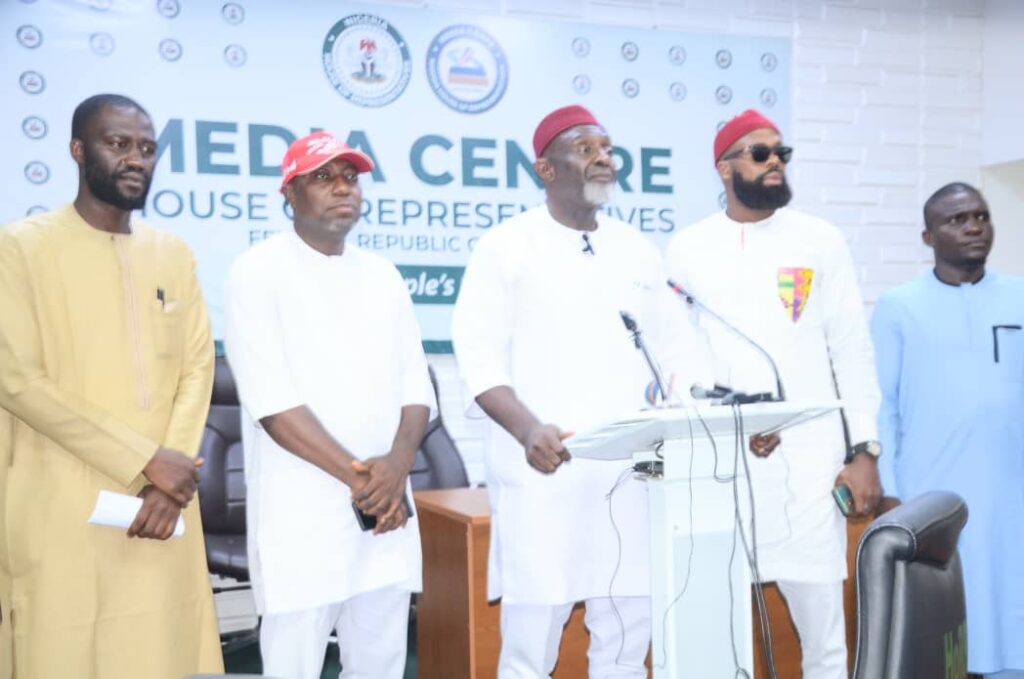
Addressing the media in Abuja on Tuesday, the lawmaker decried reports criticising him for abandoning Obi and joining the APC after riding on his popularity to win the election in 2023.
“People are directing accusations at me, saying that I defected from the Labour Party to the APC and now I’m from the APC to ADC, and I find it very important to put this message out there.
“We all know here that most of us are very aware of the crisis we had in the Labour Party some time ago. And these crises led to the INEC not uploading even some of our candidates during the Area Council electioneering campaign.
“And automatically, when a party can no longer get its candidates uploaded, I think such a party has its own existence has ceased. And people like me also waited for a long time when so many of our party members were leaving.
“And my own idea was that I would never leave the Labour Party until our leader, Peter Obi, leaves the party. If not, I will not do otherwise.
“Finally, our leader (Peter Obi) made up his mind to go into ADC. Some of us in the labour and his supporters knew that it would be practically impossible for our leader to claim the ticket of ADC, being that Atiku Abubakar is in the forefront of the party formation, and most people who were there in the hierarchy of the party are mostly his political associates.
‘And because of that, most of us feared that at the end of the day, if all of us went into ADC, we would be consumed.
Obika insisted that his decisions were driven by political realities and loyalty to the “New Nigeria” movement championed by Peter Obi.
He argued that many supporters feared Obi might eventually fail to secure the party’s presidential ticket, a development he said could create division among supporters and jeopardise the political future of candidates contesting under the platform.
“When we are preaching for a New Nigeria, we cannot use old wine to mix with new wine,” he said.
He maintained that Obi and former Kano State governor, Rabiu Kwankwaso, remain the two politicians with the strongest organic support base committed to national transformation, stressing that both men needed to work together for Nigeria’s progress.
He disclosed that he temporarily joined the APC because the party appeared stable while the Labour Party crisis lingered, but later moved to the NDC after Obi eventually joined the coalition.
Defending his multiple defections, the lawmaker said politicians must sometimes move across parties to remain politically relevant and pursue their objectives.
“Even Peter Obi has crossed several parties. President Bola Tinubu has also done the same. What matters is identifying people who are committed to the betterment of the country,” he stated.
Highlighting his achievements in the National Assembly, Obika listed several bills he said were aimed at addressing long-standing challenges in the Federal Capital Territory, FCT.
The legislation includes bills seeking to establish an Original Inhabitants Resettlement and Compensation Agency, an FCT Scholarship Board, an FCT School of Nursing and Midwifery, and an FCT Emergency Management Agency.
He said the proposed compensation agency was designed to tackle issues surrounding demolitions, resettlement and compensation of indigenous communities displaced by development in the FCT.
The lawmaker also said his proposed scholarship board bill sought to ensure transparency and accountability in the management of scholarship funds while reserving 30 per cent of scholarships for original inhabitants of the FCT.
On constituency projects, Obika said his office had facilitated the construction and renovation of schools, restoration of boreholes in public schools, distribution of educational materials, and scholarships for students within and outside the constituency.