The Lagos State Government is set to deepen its Infrastructure, Economy, Housing and Education with the newly signed 2026 “Budget of Shared Prosperity.”
According to the Commissioner for Economic Planning and Budget, Ope George, the ₦4.444 trillion budget, ratified by Governor Babajide Olusola Sanwo-Olu, is strategically designed to drive infrastructure development, diversify the economy, enhance institutional efficiency, and expand social services across the State.
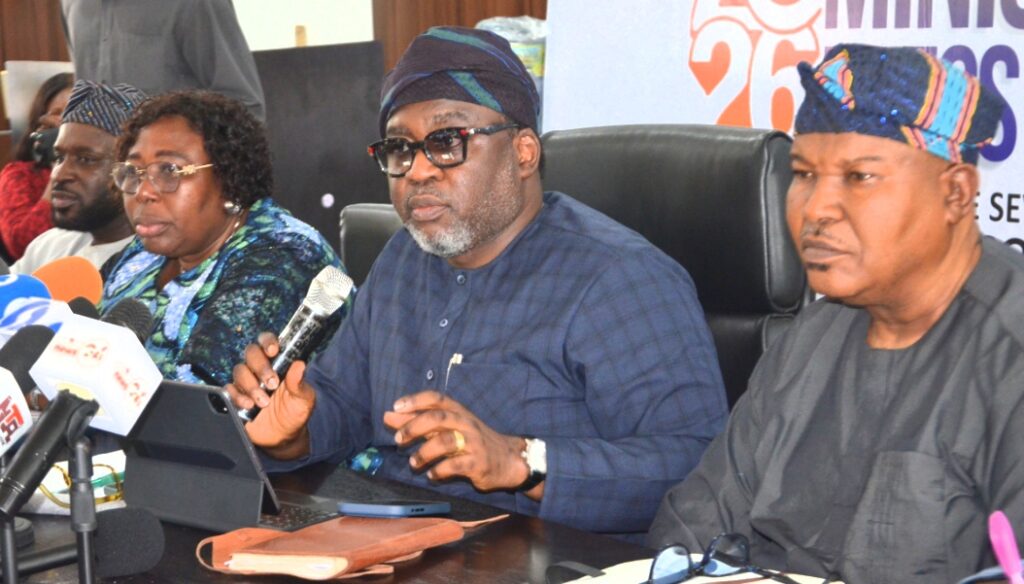
Addressing journalists at the Bagauda Kaltho Press Centre, Alausa, Ikeja, George highlighted that the budget prioritises long-term investment, with ₦2.338 trillion allocated to capital projects and ₦2.106 trillion for recurrent expenditure, a 53:47 ratio aimed at accelerating economic transformation.
A total of ₦1.467 trillion is earmarked for critical infrastructure initiatives spanning transportation, healthcare, education, and public works. Key projects such as the Opebi-Mende Link Bridge and the Eti-Osa/Lekki/Epe Expressway Phase IIB are expected to ease traffic congestion, enhance connectivity, and stimulate economic activity along strategic corridors.
The Opebi-Mende Link Bridge, for instance, will link residential hubs like Mende and Maryland to Ikeja’s commercial districts, boosting property values, business growth, logistics efficiency, and urban renewal along the route.
On housing, George noted that Lagos is focused on reducing the housing deficit with affordable homes for low and middle-income residents. Priority projects include the 504-unit LAGOSHOMS Sangotedo Phase II, Epe and Ibeshe Housing Schemes, Late Abdul-Wahab Oke Benson Estate, LAGOSHOMS Ajara-Badagry, and the Egan Mixed Housing Scheme. These initiatives aim to broaden access to quality housing across the State.
Economic diversification is also a core focus, with ₦87 billion allocated to food security initiatives such as the Lagos Wholesale Produce Hub, ₦35 billion to tourism projects including the Badagry Point of No Return and the Lagos Heritage Centre, and ₦112 billion to energy and power development to strengthen productivity and competitiveness.
George emphasised that institutional reforms remain a cornerstone of the budget, with ₦33 billion dedicated to technology and digital transformation projects to automate government processes, boost revenue, and improve the Ease of Doing Business in Lagos.
In education, the Lagos Education Access Fund (LEAF), under the Education Outcomes Fund (EOF), is now in active implementation, aiming to impact over 200,000 children within three years.
The programme, supported by international partners such as CIFF, UBS Optimus Foundation, and Japan’s Ministry of Foreign Affairs, is performance-driven, targeting improved school enrollment and learning outcomes.
Reflecting on fiscal performance, the Commissioner revealed that Lagos achieved an 84% budget execution in 2025 and anticipates a first-quarter 2026 performance rate of 60-70%, consistent with the fiscal cycle where capital project momentum builds after recurrent obligations are met.
George concluded by reaffirming the Ministry’s commitment to prudent fiscal management, economic resilience, and people-centred policies that will maintain Lagos’ position as a smart, globally competitive, and economically vibrant State.