

That Nigeria is almost reeling on the floor over terror attacks is stating the obvious. That it is assuming a characteristic proportion at this period is even more frightening. BIYI ADEGOROYE argues that killing of the nation’s crown jewels, Generals, top military officers and civilians should elicit decisive action against financiers and sympathisers.
The current upsurge in the brazen killing of the nation’s servicemen, top officers inclusive and civilians by terrorists, especially in the North-East, represents the introduction of a more petrifying dimension by these terrorists. These killings have practically elevated the intractable insurgency to the state of war.
On April 9, 2026, Brigadier General Oseni Braimah, the Commander of the 29 Task Force Brigade and some of his troops, were killed during a coordinated attack by Boko Haram along with suspected ISWAP elements on a military base in Benisheikh, Borno State. As if marking the 12th anniversary of the kidnap of Chibok Girls, few days later, on April 14, 2026, the terrorists felled the Commanding Officer of the 242 Battalion, Colonel I.A. Mohammed, along with over 10 soldiers in Monguno, in the same Borno State, when their vehicles ran into some Improvised Explosive Device (IED) followed by an ambush by insurgents.
Earlier, in November 2025 about 40 soldiers paid the supreme price and 65 others missing in a Boko Haram ambush in Borno State. Top officers killed so far in various Boko Haram attacks include Brigadier General Dzarma Zirkusu (Killed in Askira Uba, Borno); Colonel Dahiru Chiroma Bako (Killed in Damboa LG, Borno); Colonel Muhammad Abu Ali (Killed in Malam Fatori, Borno), and Lieutenant Colonel Ibrahim Sakaba.
Crest fell, top military chiefs on Wednesday, 15 April 2026, laid to rest Late Brigadier General Omo Braimah, Captain Ismail, and other gallant soldiers who paid the supreme price in the line of duty. The burial, held at the Maimalari Cantonment Cemetery in Maiduguri, Borno State, was marked by deep sorrow, honour and reflection.
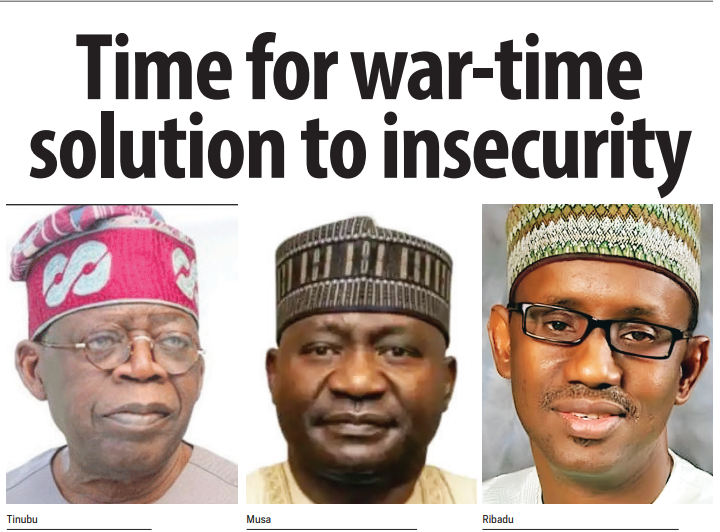
Governor of Borno State, Professor Babagana Umara Zulum, Minister of Defence, General Christopher Musa (Rtd), the Chief of Defence Staff, Lt. Olufemi Oluyede, the Chief of Army Staff, Lt Waidi Shuaibu and other senior military officers, all gathered to honour the courage and dedication of the departed.
According to Zulum, Musa, Oluyede and Shuibu, the fallen soldiers were true patriots “who stood firm in the face of danger and made the ultimate sacrifice so that others might live in safety. They noted that their bravery and sense of duty will continue to inspire generations and remain etched in the nation’s history.”
Desperations foretold
One fact that has not escaped the notice of many Nigerians is that ISAWAP, Boko Haram and bandits have become more desperate and virulently combative in recent times. The terrorists have evidently increased in numbers, weapons and are more coordinated in their operations.
Emboldened by seemingly limitless sophisticated weapons like RPG and landmines and vain promises of divine benefits, the terrorists engage soldiers without caution. Some Opinion leaders have asserted that the current development further fuels the perception that the attacks were informed by a combination of factors.
One, the alleged moves to Islamise Nigeria, as noticed from the claims of the terrorists in the North-East after each operation. This move, they said, might be reminiscent of the gruesome incidents in Sudan which culminated in the split of the country in two. If this is terrifying, the other dimension mineral war can be very disturbing. Experts have said that the entire Middle Belt and the North-East are a reservoir of Latium and other minerals.
Like it occurred in Congo DRC, the criminal elements are reportedly providing protection to illegal miners of these minerals for funds. They are reportedly responsible for kidnap for ransom in the area. The third is what the Defence Minister described as the Hausa/Fulani superiority contest and battle for land. Till date, the Hausas believe they are the most populous tribe in the North, but dominated and denied prominent positions by the Fulanis.
Terror financing
Not to be ignored, a strand of the war is the emergence of those described as conflict entrepreneurs. Notable among them are weapon importers and some corrupt officials who benefit from it. Some sources alleged that the regular trillion of Naira disbursed for weapon purchase annually is their target.
Interestingly, the Federal Government last week released the list of alleged terror financials, which included three entities like Alin Yar Yaya General Enterprises, K. Are Nigeria Limited, and Suhailah Bashir General Enterprises. The NIGSAC document states that promoters of the firms, Bashir Ali Yusuf and Surajo Abubakar Mohammad, were convicted in Abu Dhabi for terrorism financing linked to Boko Haram. Other individuals listed include Fannami Alhaji Bukar, Muhammed Musa, Sahabi Ismail, and Mohammed Saleh Buba.
Reasons for designation cite “membership of Boko Haram terrorist group, terrorism financing, receiving training and rendering support to the terrorist group,” and “concealment of information, attending terrorist meetings and provision of facility in support of terrorist acts.” The latest step in Nigeria’s counterterrorism financing regime under the 2022 Act.
The Nigeria Sanctions Committee has previously issued designations to disrupt financial support to proscribed groups, including Boko Haram, ISWAP, Ansaru, and IPOB. The updated list broadens the scope of enforcement for banks, capital market operators, and designated non-financial businesses nationwide.
Unfortunately, hundreds of Nigerian soldiers have lost their lives as heroes, sacrificing it in their unwavering commitment to the defence of the nation. Security experts view the killing of the soldiers who have never failed to display exceptional courage, professionalism, and firepower in their numbers as national embarrassment, and wanton depletion of the nation’s armed forces.
Evaluating impact of Operation Safe Corridor
The intractable nature of the war has informed the view that it is high time the government evaluated its strategies. For instance, what has been the impact of the Operation Safe Corridor where repentant Boko Haram members are deradicalized, trained and reabsorbed into the society? Last week, a total of 744 of them completed training at their camp in Gombe.
They will be dismissed and returned to the community for continuing life after confirming they have kept their ideology. It has been alleged that these people, especially those integrated into the Civilian Joint Task Force may have become a mole to the insurgent, culminating the heavy military casualties suffered in recent times.
Akin to this poor intelligence management. Time and again, critical intelligence has either been poorly managed or leaked to the terrorists, thereby enabling them to frustrate planned military operations. Worse still are observed cases of sabotage, as was in the Kebbi attack where a top official allegedly ordered troops withdrawal from responding to a distress call.
The allegation of criminal collaboration with terrorists has become louder recently. The Director General, Centre for Justice on Religious and Ethnicity in Nigeria (CJREN), Rev. Kallamu Musa Ali Dikwa, pointed out that some government appointees provide cover and siding with members of Boko Haram and SWAP insurgents in the state. He promised to expose “the network of Boko Haram appointees and operatives embedded in our state and federal institutions.”
ACF seeks war-time approach
Many concerned leaders and groups have called for a quick end to the terrorism. At its 38th meeting of the Board of Trustees of the Arewa Consultative Forum, (ACF) aptly deplored that the country is at war which requires a war-time approach to address it.
“Nigeria’s security crisis has moved far beyond a routine governance challenge; it has since evolved from insurgency in the North-East, banditry and mass kidnappings across the North-West and North-Central, persistent inter-communal clashes, violent conflict between herders and farmers, to a state of all-out war that now threatens the continued existence of Nigeria as we know it.
The scale, persistence, and human cost of violence demand a fundamental shift in national priorities.” It said the government should treat this crisis not as one issue among many, but as the overriding national emergency.
“The human cost is unacceptable; hundreds of thousands of Nigerians have been killed or displaced in Borno, Plateau, Niger, Kwara and many other places. “This is not even counting the large number of our armed forces personnel, including very senior military officers. Families have been shattered, livelihoods destroyed, and entire generations traumatized,”
Where is the foreign support?
Observers have wondered the justification for this upsurge despite the presence of 300 top US soldiers who arrived in the country months ago to provide intelligence and sundry support to Nigeria. They also called on the US government to provide military support by bombing the notorious Sambisa Forest, the hideout of the terrorist.
Though the trial of 500 terror suspects commenced two weeks ago with some of them currently in detention, it has been argued that the Army reviews its strategy. “The attack and withdraw method enables terrorists to regroup and launch fresh attacks,” one retired General said. More camps and military bases should be built in these areas.”
They also blamed the government and politicians, some of whom have either been accused of collaborating with them for political gains for the protracted attacks. Equally condemned is the failure of the military to justify the trillion defense budgets with corresponding results.
Generals’ death, devastating blow Amachree
Security expert, Dennis Amachree, MON, said the protracted nature of Nigeria’s counter-terrorism efforts is fundamentally tied to a “security economy” where conflict has become a profitable enterprise. In an extensive interview with Sunday Telegraph, Amachree, a former Deputy Director of DSS said: “Lack of genuine political will, coupled with the opaque management of “security votes,” creates a perverse incentive to maintain a state of controlled instability rather than achieving a definitive conclusion.
Furthermore, the historical use of armed groups as political enforcers during election cycles has left a legacy of well-armed non-state actors who, once abandoned by their patrons, turn to kidnapping and banditry to sustain their operations. Compounding these internal issues are the porous borders of the Sahel and the persistent challenge of “fifth columnists” who leak operational intelligence to the enemy.
Procurement corruption frequently ensures that frontline personnel remain under-equipped despite massive budgetary allocations, while the professionalization of groups like ISWAP allows them to outpace bureaucratic responses. Ultimately, the war drags on because the socio-economic and political structures necessary to sustain peace are consistently undermined by those who benefit from the status quo of perpetual crisis” On the killing of soldiers, he said: “Although in war, soldiers will die, as well as the terrorist.
The death of a Brigadier General is not just a tactical loss; it is a profound psychological blow to the nation’s defense architecture. When officers of this rank men like Dzarma Zirkusu and more recently Musa Uba and Oseni Braimah fall in the line of duty, it signals a dangerous breach in the “invincibility” of military leadership.
A General represents decades of institutional investment, strategic intelligence, and the very morale of the troops they lead. “The government’s immediate reaction often follows a script of initial denial followed by a sanitized press release. In the case of Brigadier General Musa Uba (November 2025), the military initially denied his capture even as insurgent propaganda showed proof.
This “body language” suggests a government more concerned with managing public perception and “optics” than confronting the sobering reality that their top commanders are vulnerable. When the state treats the death of a General with the same bureaucratic template used for a routine road incident, it risks normalizing disaster.








