



…Signalling New Era of Nigerian-Made Military Technology
…As DICON, EIB Group commit to strengthening Nigeria’s security infrastructure
Nigeria took a significant step toward defence self-reliance as the Defence Industries Corporation of Nigeria (DICON) signed a far-reaching Memorandum of Understanding (MoU) with EIB Group to localise the production of unmanned systems, military hardware and advanced digital defence solutions.
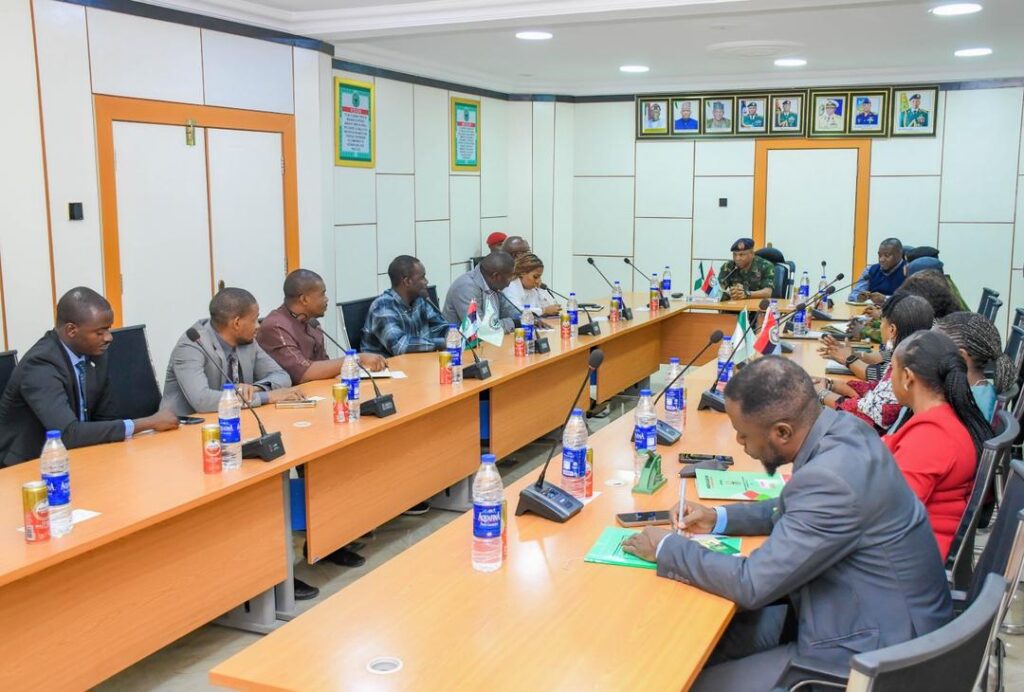
The agreement, signed at DICON Headquarters in Kaduna, positions DICON, Briech UAS, Poctova, and EIB Group Chairman Bright Echefu at the centre of Nigeria’s push to build a globally competitive, technology-driven defence industry.
Under the partnership, DICON and EIB Group will collaborate on the end-to-end domestic production of Unmanned Aerial Systems (UAS), tactical drones, ballistic protection equipment, military uniforms, high-grade explosives and secure software-driven intelligence systems.
The initiative is expected to significantly reduce Nigeria’s dependence on foreign defence imports while strengthening national security infrastructure.
Director General of DICON, Major General Babatunde Ibrahim Alaya, described the agreement as a transformational shift enabled by the DICON Act 2023, which restructured the corporation to support private-sector collaboration and innovation.
“Our mission is to ensure that the Nigerian Armed Forces are powered by Nigerian-built technology,” Alaya said.
“This partnership goes beyond manufacturing — it is about full technology transfer, including control over software and systems. By eliminating reliance on foreign ‘black box’ technologies, we are securing our sovereignty and advancing what we call the DICON evolution.”
The DICON Act 2023 has been widely credited with unlocking new opportunities for strategic partnerships, allowing the corporation to transition from a traditional manufacturing entity into a regulatory and innovation-driven defence hub.
At the centre of the collaboration is Bright Echefu, Chairman of EIB Group, whose companies, including Briech UAS and Poctova, will play a critical role in delivering technical infrastructure, engineering expertise and proprietary software development.
Echefu said the initiative is designed to position Nigeria as a continental leader in defence technology while building local capacity in advanced engineering.
“We are bringing the full strength of EIB Group’s innovation ecosystem to this collaboration with DICON,” Echefu said.
“Through Briech UAS, we will scale production of world-class drones, while Poctova will drive the development of secure, indigenous software for surveillance and battlefield intelligence. Our goal is to establish a defence technology hub, a ‘Defence Silicon Valley’ right here in Nigeria.”
He added that the partnership will maintain production lines for reconnaissance and payload-capable drones, while also supporting encrypted intelligence systems tailored to Nigeria’s security environment.
Beyond military applications, the agreement is expected to stimulate economic growth by creating a network of local suppliers and small and medium-sized enterprises integrated into the defence value chain.
Officials say the localisation strategy could conserve billions of naira in foreign exchange annually while positioning Nigeria as a potential exporter of defence equipment within the ECOWAS region.
The initiative also includes a structured skills transfer programme aimed at training Nigerian engineers and technicians in robotics, aerospace systems and secure software development — areas considered critical for modern warfare and national security.
Alaya credited President Bola Ahmed Tinubu for enabling the transformation through the enactment of the DICON Act, while also acknowledging the roles of defence leadership in advancing the initiative.
“This milestone reflects the collective commitment of Nigeria’s leadership to a self-reliant military,” he said.
With DICON, Bright Echefu, Briech UAS, and Poctova driving the partnership, analysts say the agreement signals a decisive shift in Nigeria’s defence posture from import dependence to indigenous capability, innovation and regional leadership.