
Hours after President Donald Trump issued a 48-hour ultimatum to Iran to re-open the Strait of Hormuz or have their power plants ‘obliterated’, the Persian state refused to back down warning that it will retaliate against US linked energy infrastructure in the region if he carries out his threat.
The war, which began on February 28 with the US and Israel carrying out bombardment of Iran, appears to be entering a more dangerous phase with attacks on energy facilities ramping up.
Last week Israel attacked Iran’s South Pars – part of the world’s largest natural gas field – which saw Tehran retaliating with attacks on energy facilities in neighbouring states, including Qatar, Bahrain, Kuwait and Saudi Arabia. However, yesterday the Islamic State indicated that it was ready to rack up the crisis by attacking the desalination facilities of its neighbours.
The Middle East is the global leader in desalination, hosting over 40% of the world’s capacity with roughly 5,000 plants, mostly in the Gulf. Saudi Arabia, UAE, Kuwait, Oman, and Bahrain rely on these facilities for most of their drinking water.
Should Iran carry their threat out it could lead to a dramatic twist in the narrative and could force the Gulf State to take a more hardline stance towards its beleaguered neighbour.
Already Saudi Arabia has given Iran’s military attaché along with four other diplomats 24 hours to leave the country in the wake of the Islamic State’s continued violation of its sovereignty with repeated drone and missile attacks. Saudi authorities said they have had to contend with more than 60 drone and missile attacks in the last 24 hours, while Bahrain said it had destroyed more than 200 drones/ missiles since February 28.
Reacting to Trump’s ultimatum Iranian President Masoud Pezeshkian said US threats to strike Iran’s energy infrastructure show “desperation”, adding the Strait of Hormuz is “open to all except those who violate our soil” Early yesterday Qatar lost seven military officials when their helicopter on a routine duty crashed. Six bodies have been recovered while officials are still searching for the last victim.
Meanwhile, Iranian officials have said over 1, 400 have been killed and 3.2 million people displaced since the outbreak of the crisis three weeks ago. While Lebanese authorities said over 1,000 of their citizens have also been killed and thousands displaced since militant group Hezbollah launched missiles into Israel in support of its benefactor, Iran, prompting a heavy response from the Jewish state.
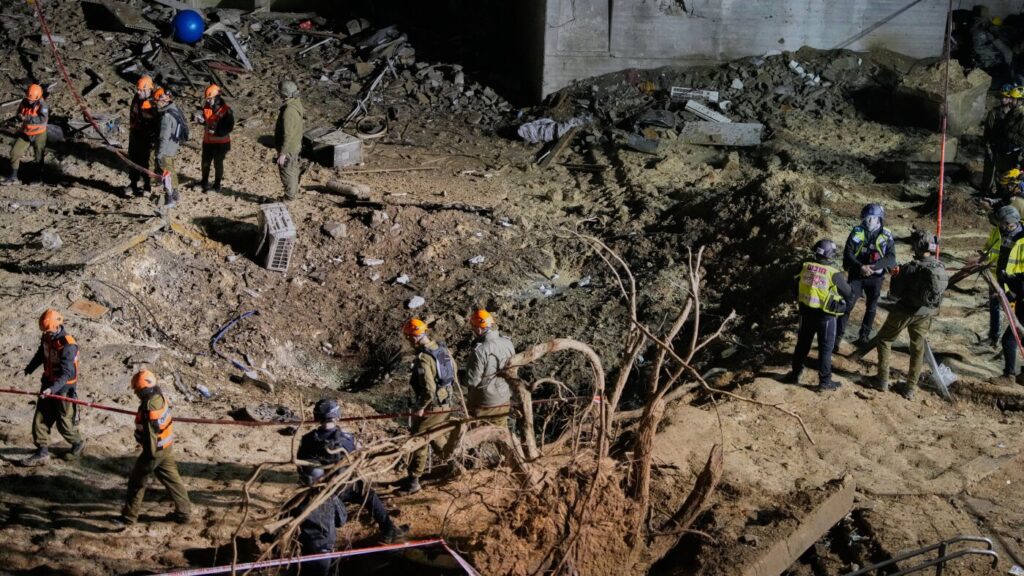
According to reports, more than 160 people were injured in Israel on Saturday night from missile and drone attacks by Iran and Hezbollah. This prompted Israeli Prime Minister Benjamin Netanyahu to vow yesterday to pursue senior commanders of Iran’s Revolutionary Guards “personally”, during a visit to a town struck by an Iranian missile the previous day.
“We’re going after the regime. We’re going after the IRGC, this criminal gang,” Netanyahu said, as he inspected the damage in the southern Israeli town of Arad.