


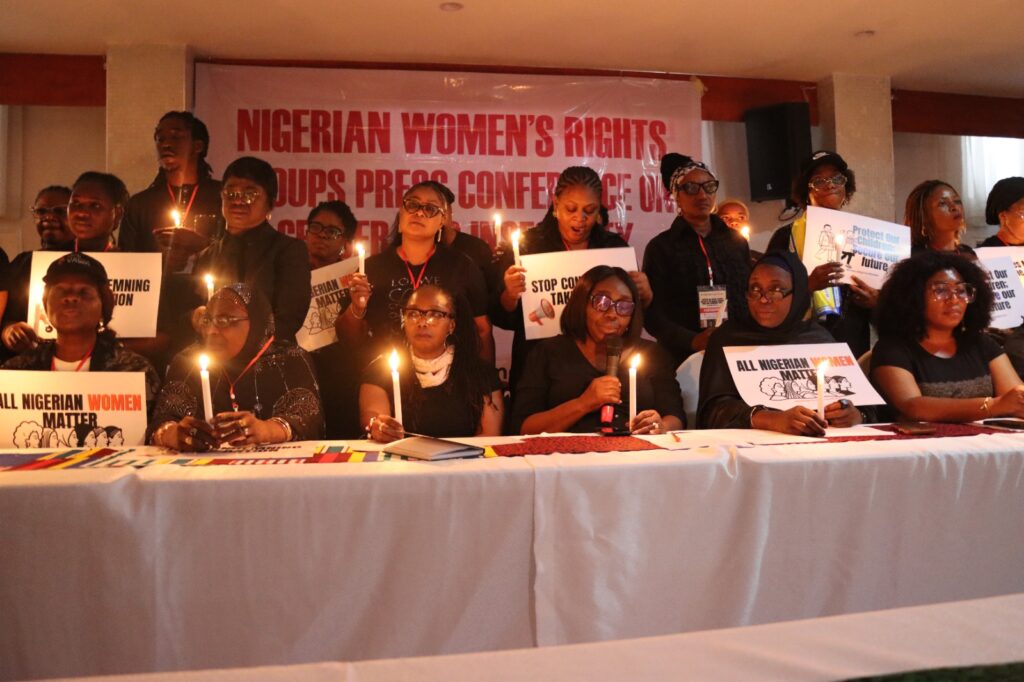
A coalition of over 60 women’s rights organisations has called for urgent and decisive action to address Nigeria’s worsening security crisis, warning that the situation is pushing the country to the brink and disproportionately affecting women, children, and other vulnerable groups.
At a press briefing in Abuja, the coalition led by the Executive Director of Women in Politics Forum, Ebere Ifendu, expressed deep concern over the persistent wave of terrorism, banditry, kidnappings, and communal violence across the country.
The group said the escalating insecurity has exposed women and girls to increased risks, including sexual violence, displacement, loss of livelihoods, and limited access to healthcare and education.
“Insecurity in Nigeria is no longer episodic; it is a daily reality. It is deepening poverty, eroding public trust in governance, and threatening national stability.”
The coalition noted that beyond the immediate loss of lives, insecurity has worsened economic hardship, particularly for women, who now shoulder increased unpaid care responsibilities while losing their means of income.
Farmers, traders, artisans, and small business owners have been forced to abandon their livelihoods due to attacks, while women farmers face targeted violence, including the destruction of storage facilities, abductions, and sexual assault.
Describing the situation as dire, she said Nigeria is “under siege,” with citizens across all six geopolitical zones living in fear.
The coalition highlighted recent violent incidents across the country, including killings in Benue, Plateau, Kwara, and Niger states, insurgent attacks in Borno, and bandit raids in Kaduna and other parts of the North-West. Similar violence, they said, has also disrupted livelihoods in the South-East and South-South regions.
Ifendu urged the government to strengthen security architecture with a focus on protecting vulnerable populations as a panacea to the situation.
“Securing farmlands and supporting displaced communities to address food insecurity. Investing in community-based protection systems and psychosocial support services. Ensuring security agencies adopt human rights and gender-sensitive approaches,” she added.
Also speaking, the Executive Director of Advocacy for Women with Disabilities Initiative, Patience Ogolo-Dickson, drew attention to the plight of persons with disabilities, describing their situation as “especially dire.”
According to her, many women with disabilities are abandoned during attacks and displacement, often unable to flee due to mobility challenges.
“Some are left behind and die because there is no one to help them escape. Others who attempt to flee face enormous risks and, in some cases, die along the way,” she said.
From a faith-based perspective, the National President of the Federation of Muslim Women’s Associations in Nigeria (FOMWAN), Sumaye Hamza, emphasised the sanctity of human life and the need for unity.
She lamented that insecurity has torn families apart, increased school dropouts, and left children traumatised.
“Families are disempowered, livelihoods destroyed, and the well-being of communities has deteriorated significantly. We urge the government to take urgent and sustained action to address this crisis.” Hamza said.
Similarly, the President of the League of Women Voters of Nigeria, Irene Awunah-Ikyegh, warned that prolonged insecurity is eroding hope in affected communities.
Citing her experience in Benue State, she said some local government areas have remained under siege for years, with schools shut down and increasing cases of human trafficking.
“Some are left behind and die because there is no one to help them escape. Others who attempt to flee face enormous risks and, in some cases, die along the way,” she said.
From a faith-based perspective, the National President of the Federation of Muslim Women’s Associations in Nigeria (FOMWAN), Sumaye Hamza, emphasised the sanctity of human life and the need for unity.
She lamented that insecurity has torn families apart, increased school dropouts, and left children traumatised.
“Families are disempowered, livelihoods destroyed, and the well-being of communities has deteriorated significantly. We urge the government to take urgent and sustained action to address this crisis.” Hamza said.
Similarly, the President of the League of Women Voters of Nigeria, Irene Awunah-Ikyegh, warned that prolonged insecurity is eroding hope in affected communities.
Citing her experience in Benue State, she said some local government areas have remained under siege for years, with schools shut down and increasing cases of human trafficking.
“We are witnessing a generation of children growing up without education, while young girls are being trafficked and forced into exploitation,” she said.
Awunah-Ikyegh also expressed concern over the impact of insecurity on Nigeria’s democratic process, stressing that citizens must be alive to participate in elections.
“Nigerian women voters are saying clearly: we need to be alive to vote. Government must prioritise security over politics and treat this crisis with the urgency it deserves,” she added.
The coalition called on the Federal Government to adopt a coordinated and long-term strategy to address insecurity, protect vulnerable populations, and restore public confidence.