
As 2027 general elections draw closer, the political atmosphere is already thick with intrigue, realignments, and subtle power plays.
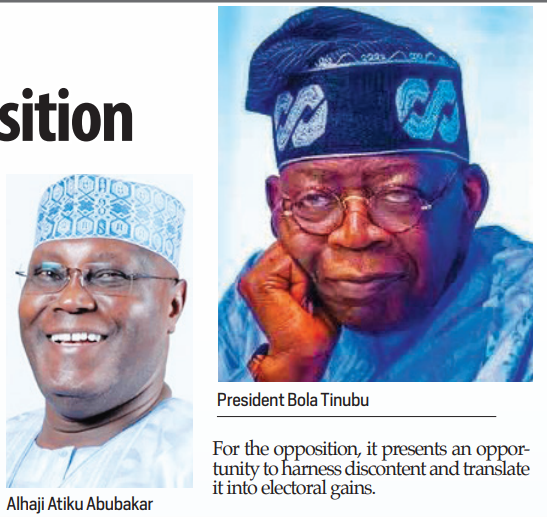
At the centre of the unfolding drama is President Bola Ahmed Tinubu, whose administration is expected to seek a second term amid growing pressure from an emboldened opposition determined to wrest power from the ruling All Progressives Congress (APC).
What once appeared to be a fragmented opposition landscape is gradually evolving into a more strategic and coordinated front, driven by the urgency to break the APC’s dominance at the federal level and capture power.
Since assuming office in 2023, Tinubu’s administration has pursued sweeping economic reforms, including subsidy removal and exchange rate unification; policies that have drawn mixed reactions. While the government insists these measures are necessary for long-term stability, many Nigerians continue to grapple with inflation, rising cost of living, and economic uncertainty.
These realities have provided fertile ground for opposition parties to intensify their criticisms and position themselves as viable alternatives.
The President, once widely regarded as a master strategist, now finds himself navigating a more complex political terrain where performance, perception, and political alliances will shape his re-election prospects.
Opposition regroups, repositions Key opposition parties such as the Peoples Democratic Party (PDP), Labour Party (LP), and African Democratic Congress (ADC) are already recalibrating their strategies ahead of 2027. Within the PDP, efforts are ongoing to resolve internal divisions that weakened the party in previous elections. Influential figures are pushing for unity and a stronger grassroots presence to challenge the APC effectively.
The Labour Party, which gained significant traction in the 2023 elections, particularly among urban youths, is also seeking to consolidate its support base. Its performance in the last election cycle demonstrated the growing appetite for alternative political platforms, though sustaining that momentum remains a critical challenge.
Meanwhile, the ADC is emerging as a potential convergence platform for political heavyweights seeking a fresh coalition vehicle. Reports of alignments involving prominent figures like Atiku Abubakar, Peter Obi, Rotimi Amaechi, Rauf Aregbesola, Nasir El-Rufai, Pat Utomi etc, suggest early moves toward building a formidable alliance capable of mounting a serious challenge to the ruling party.
Ibadan Summit:
As part of their renewed determination to wrest power from President Bola Tinubu and the All Progressives Congress (APC), the major opposition parties, at a historic national summit held in Ibadan, Oyo State capital, last week announced plans to field one presidential candidate in the 2027 general elections.
The opposition parties made the declaration in a communiqué issued at the end of the summit, where key opposition figures, including former Vice President Atiku Abubakar, former presidential candidate of the Labour Party (LP), Mr. Peter Obi, presidential candidate of the New Nigeria People’s Party (NNPP) in the 2023 general election, Dr. Rabiu Musa Kwankwaso, ex-governor of Rivers State, Rotimi Amaechi, and ex-governor of Osun State, Rauf Aregbesola, among others, met to chart a common strategy.
While demanding the resignation of the Chairman of the Independent National Electoral Commission (INEC), Prof. Joash Ojo Amupitan, the opposition parties also urged the commission to extend the deadline for the party primaries till the end of July 2026.
In a communique issued at the end of the summit with the theme: “Safeguarding Nigeria’s Democracy: A National Dialogue”, which was read by the factional National Chairman of the Peoples Democratic Party (PDP), Taminu Turaki, the parties vowed to “resist all machinations by the APC to foist a one-party state on Nigeria and fight for the survival of multi-party democracy in our country.”
On the 2027 elections, the opposition parties revealed plans for a united ticket, declaring, “We shall work towards fielding one presidential candidate for the 2027 elections, which shall be agreed and supported by all participating opposition parties to rescue our nation and her long-suffering masses.”
Raising concerns about INEC, the communiqué stated that the Chairman of the commission, Prof. Amupitan, should not conduct the 2027 general election, “having shown bias and partisanship in favour of the ruling APC.”
The communique further warned, “His continuous stay in office is vexatious and capable of triggering widespread crisis in our nation.” Addressing electoral reforms, the opposition parties urged the Senate and the House of Representatives to immediately review the Electoral Act, 2026, “to remove all sections that threaten the sanctity and integrity of the elections.”
The communiqué also addressed alleged political repression, insisting that “all leading politicians that are being detained or harassed on bailable offences be released with immediate effect and allowed to exercise their fundamental rights of participation and inclusivity as Nigerians.”
While criticising recent electoral guide- lines, the opposition parties asked INEC to extend the deadline for party primaries to the end of July 2026. Also addressing the summit, the National Chairman of the ADC and former Senate President, Senator David Mark, described the gathering as a critical mo- ment in Nigeria’s history, and “an urgent response to our nation’s call to patriotic duty.”
He said, “My prayer is that history will remember us, that when the nation cried out to be rescued, we answered. When children went to bed hungry, we answered, when proud, hardworking citizens were turned to beggars; we answered.”
While raising alarm over insecurity, Mark stated, “Across the length and breadth of our country, insecurity has become a defining feature of daily life. Nigeria faces a historic challenge.” Citing grim statistics, he added, “In 2025 alone, Nigeria recorded more than 12,000 conflict-related deaths. Nigeria is now ranked 4th in the global terrorism index. At least 15 Nigerians are killed daily, while about 19 people are abducted.”
He criticised the government’s response, saying: “We are a nation that is constantly in mourning, yet the APC-led government is behaving as if all is well,” accusing it of being “preoccupied with election matters and politics of self-succession.” On democracy, Mark warned: “The essence of democracy is to provide the people with a choice.
However, the ruling party has done everything to deny the people of Nigeria this very right to seek an alternative.” In his remarks, the host governor, Seyi Makinde, warned that Nigeria’s democracy was facing a gradual erosion due to the weakening of opposition parties.
He stated, “Across Nigeria today, we are witnessing a level of political concentration that should concern all of us. Taken together, they point to a pattern where the space for real political competition is disappearing.” He cautioned that democracy “is not destroyed overnight,” but “weakened step by step,” stressing that “when opposition becomes ineffective, democracy itself begins to lose meaning.” Makinde drew attention o the “Operation Wetie” violence that rocked the South-west in the mid-1960s to caution against one-party domination in the country.
He emphasised that democracy must be defined by “the existence of real alternatives” and warned that without this, “what we have may still be called democracy, but it will no longer function as one.” The governor warned, “For those that are carrying on as if there’s no tomorrow, they should remember that ‘operation wetie’ started from here. This is the same Wild Wild West.
“Back in 1950, this city hosted a conversation that helped shape Nigeria’s constitutional future. Those discussions were not perfect, but necessary. They were driven by a recognition that the structure of the nation was a deliberately built, protected, and well-necessary debated. In many ways, this gathering carries the same responsibility.
“There are open efforts to consolidate legislative control under one party. At the same time, opposition parties are increasingly entangled in internal crises and le- gal battles, raising serious questions about their ability to function effectively.
“This is not something that we should treat lightly. I don’t want to think saboteurs are here. Because democracy is not destroyed overnight, it is weakened step by step until people begin to feel it no lon- ger works for them,” he said.
The renowned political economist and strategist, Prof. Pat Utomi, in his intervention, painted a stark picture of the country’s economic hardship, using a personal experience to illustrate the widening gap between living costs and citizens’ income.
He said, “Let me begin with a simple experience from yesterday. I set out to buy fuel, and by the time I was done, I had spent nearly N250,000 just to fill my tank. “At the same time, I came across a report showing that a large percentage of Nigerians live on less than N100,000 a month. That contrast is not just troubling; it is absurd. If that doesn’t reveal something fundamentally broken in our system, then nothing will.”
The battle within APC
Even as opposition parties mobilise, the APC is not without its own internal tensions. Questions around zoning, succession politics, and intra-party rivalries are beginning to surface. While Tinubu remains the party’s central figure, managing competing interests within the APC will be crucial.
Historically, Nigerian ruling parties have faced internal fractures when power dynamics shift, and how the APC navigates these pressures could significantly impact its electoral strength. One of the defining features of recent elections has been the increasing influence of young voters. Issues such as unemployment, digital economy opportunities, governance transparency, and social justice are shaping political conversations.
The 2023 elections demonstrated that traditional structures alone may no longer guarantee victory. Mobilisation through digital platforms, civic engagement, and issue-based campaigns are becoming more decisive. For Tinubu and the APC, reconnecting with this demographic will be essential. For the opposition, it presents an opportunity to harness discontent and translate it into electoral gains.
Economy, Security, and Public Sentiment
Beyond political maneuvering, the core issues likely to define the 2027 elections remain the economy and security. Persistent challenges such as inflation, currency volatility, and insecurity in parts of the country continue to dominate public discourse.
Opposition parties are expected to frame the elections as referendum on the APC’s handling of these issues, while the ruling party will likely campaign on reforms, infrastructure, and long-term policy outcomes. Public sentiment, therefore, will play a decisive role. If economic conditions improve and security stabilises, the APC could strengthen its position. Conversely, prolonged hardship may tilt the balance in favour of the opposition.
Tinubu insists he will win second term
President Bola Ahmed Tinubu has expressed confidence that he will secure a second term in office ahead of the 2027 general elections, declaring that his administration’s policies and reforms will ultimately earn him renewed support from Nigerians. Tinubu, who was elected on the platform of the APC, maintained that despite current economic challenges, his government is laying a solid foundation for longterm growth and national development.
The President pointed to key policy decisions, including the removal of fuel subsidy and foreign exchange reforms, as necessary steps to stabilise the economy and reposition the country for sustainable progress.
While acknowledging the hardship experienced by many citizens, Tinubu assured Nigerians that the reforms would soon begin to yield positive results, improving living standards and restoring confidence in the economy. His remarks come amid growing political activities and early alignments by opposition parties such as the Peoples Democratic Party (PDP), Labour Party (LP), and African Democratic Congress (ADC), all of which are strategising to challenge the APC’s dominance in 2027.
Political analysts say Tinubu’s confidence signals the beginning of what is expected to be an intense contest, as opposition figures work to build coalitions capable of mounting a strong challenge for power at Aso Rock. Within the APC, party leaders have continued to express support for the president, emphasising the need for continuity to consolidate ongoing reforms and development initiatives.
High-stakes contest ahead
The road to 2027 is shaping up to be one of Nigeria’s most competitive electoral cycles in recent history. With President Tinubu at the centre of both governance and political contestation, the stakes are exceptionally high. For the opposition, unity remains the biggest hurdle, and the greatest opportunity.
For the APC, performance and internal cohesion will determine whether it retains power or yields ground. As alliances form, ambitions crystallise, and campaigns gradually take shape, one thing is clear: the battle for Aso Villa in 2027 has begun in earnest, and Nigeria stands on the cusp of another defining political moment.