
CHUKWU DAVID reports that the Senate has been giving expeditious approvals to President Bola Tinubu’s loan requests in spite of public concerns about the nation’s growing debt burden under the present administration
The 10th Senate of the Federal Republic of Nigeria, has become popular in giving expeditious approvals to President Bola Tinubu’s loan requests, without giving attention to public outcry about the increasing debt burden being incured for the nation since this administration took over power in 2023.
On March 31, for instance, the Senate approved a fresh $6 billion (approximately N9 trillion) external loan request, aimed at funding the 2025–2026 budget deficit and infrastructure projects.
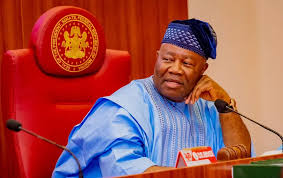
This signaled a pattern of rapid sign-offs that has triggered debt sustainability warnings. The Senate made the approval after Aliyu Wamakko, chairman of the Senate Committee on Local and Foreign Debts, presented his panel’s report. It is interesting to note that minutes earlier, the President of the Senate, Godswill Akpabio, had read President Tinubu’s request for the loan approval on the floor.
The President’s letters sought two facilities – a $5 billion loan from Abu Dhabi Bank to finance the budget and manage existing debt and a $1 billion arranged through UK Export Finance and Citibank London to overhaul the Lagos Port Complex and Tin Can Island Port. Explaining to the Senate the reason for the loan, President Tinubu said the ports upgrade will address decades of inefficiency, boost safety, and position Nigeria as a regional trade hub for non-oil exports.
Akpabio sent both requests straight to Wamakko’s committee. Hours later, the committee returned with a recommendation, urging the lawmakers to immediately approve the requests, and stressed the need for the loan. Also, on April 23, President Tinubu asked the Senate to approve a fresh external borrowing of $516.3 million for the Sokoto–Badagry Superhighway project, describing it as a critical infrastructure investment under his administration’s Renewed Hope Agenda.
In a formal communication to the Senate, the President said the request was made “pursuant to the provisions of sections 16 and 21 of the Debt Management Office (Establishment) Act, 2011,” seeking legislative backing for a syndicated loan facility to fund key segments of the project. “The purpose of this communication is to formally request the resolution of the National Assembly to approve a proposed foreign financing arrangement of a syndicated loan facility of US$516,333,007 for the construction of the Sokoto–Badagry Superhighway Project,” the letter read.
Tinubu explained that the facility, to be sourced through a consortium led by Deutsche Bank, will finance sections 1, 1A and 1B of the highway, covering about 120 kilometres. “Approval is sought for the syndicated financing facility from Deutsche Bank in the total sum of US$516,333,007 for the execution of sections 1, 1A, and 1B of the Sokoto–Badagry Superhighway project,” he stated. He further requested that the facility be incorporated into the Federal Government’s borrowing plan already approved by the National Assembly.
“The Senate is invited to note that the Sokoto–Badagry Superhighway is a flagship infrastructure initiative under the Renewed Hope Agenda,” the President said. He described the project as a strategic corridor designed to connect Nigeria’s North-West to the South-West through a 1,000-kilometre high-capacity dual carriageway stretching from Illela to Badagry, traversing Kebbi, Niger, Kwara, Oyo, Ogun and Lagos states.
According to him, the road is expected to “enhance north–south connectivity and road safety, improve network performance along the corridor, reduce logistics costs and travel time, facilitate trade and strengthen food security, and promote national integration by linking production zones to markets and ports.”
Tinubu added that the project will also “provide long-term intermodal flexibility through provision for future rail integration and utility corridors.” On financing structure, the President disclosed that the loan would be backed by a partial risk guarantee from the Islamic Corporation for the Insurance of Investment and Export Credit, an arm of the Islamic Development Bank.
“The proposed financing arrangement comprises a syndicated loan… supported by a partial risk guarantee from ICIEC,” he said, adding that the Federal Government would provide counterpart funding of N265.5 billion for land acquisition, compensation and ancillary infrastructure. Providing details of the terms, Tinubu noted that “the loan has a tenure of nine years, including a grace period of up to three years, with an interest rate not exceeding the Chicago Mercantile Exchange (CME) SOFR plus 5.3 percent per annum.”
He informed lawmakers that the Federal Executive Council had already approved the arrangement and urged swift legislative action, saying: “I look forward to the expeditious consideration and approval of this request by the Senate.” Following the presentation at plenary, Senate President, Akpabio referred the request to the Senate Committee on Local and Foreign Debts, directing it to report back within one week. During deliberations, Senator Adamu Aliero, representing Kebbi Central Senatorial District, described the highway as a longawaited project that had remained unrealised for decades.
“This is a landmark project that has been on the drawing board for over five decades,” he said, noting that work is already progressing on several sections. He added that the superhighway, constructed with reinforced concrete and fitted with solar-powered street lighting meets modern infrastructure standards, adding that the project would significantly cut travel time between Sokoto and Lagos.
“The project will drastically reduce travel time from about 13 hours to roughly six hours,” he said, describing it as transformative for the North-West, North Central and South-West zones. He urged lawmakers to support the proposal when the committee submits its report. Also speaking, Akpabio aligned with the position expressed by Aliero, describing the project as a major economic catalyst. “This is a major economic game changer capable of saving lives and boosting national productivity,” he said.
He further justified the borrowing plan, noting that “borrowing for critical infrastructure is justified, particularly where such investments yield long-term economic benefits and can facilitate repayment through generated value.” The Senate leadership subsequently urged the committee to expedite its review to enable timely consideration and approval of the request in one week.