



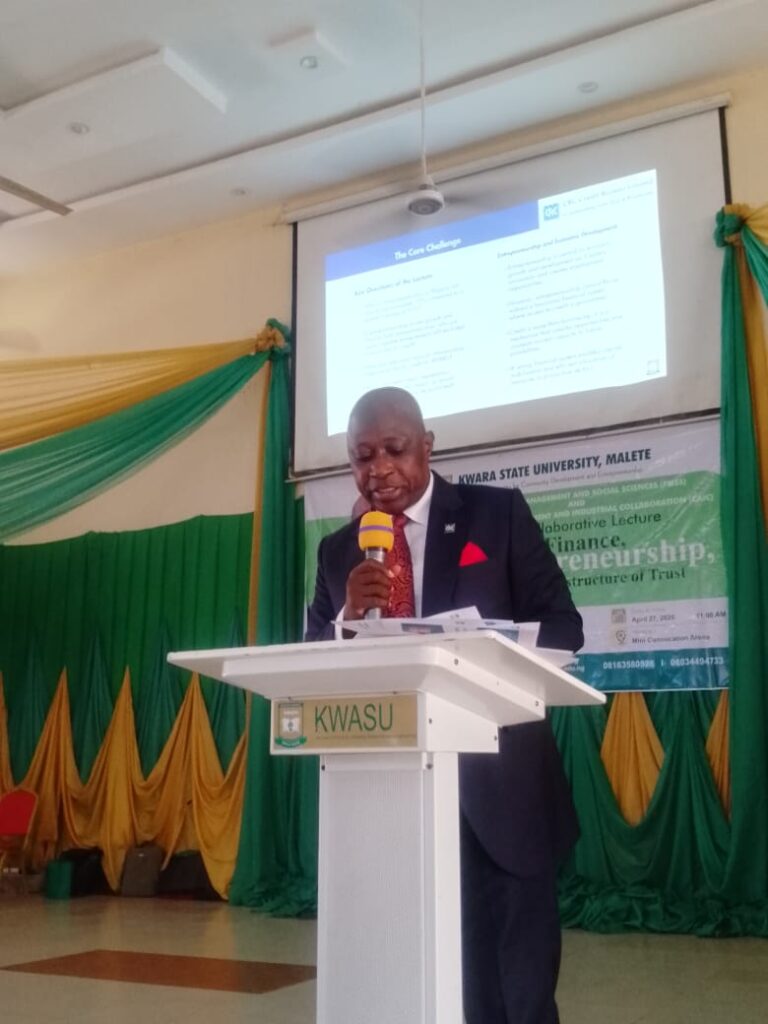
The Managing Director of CRC Credit Bureau Limited, Dr Ahmed Babatunde Popoola, stated that Nigeria’s quest to build a vibrant entrepreneurial economy is under serious threat due to inconsistent government policies, weak infrastructure and fragmented data systems.
Popoola raised the alarm while delivering a lecture at the Kwara State University (KWASU), Malete, where he stressed that access to finance alone cannot drive business growth without trust, reliable data and coordinated policy direction.
According to him, Nigeria must urgently strengthen three key pillars: financial services, financial infrastructure and socio-economic systems—to compete with leading entrepreneurial economies globally.
“We must develop all these three in Nigeria to join the league of entrepreneurial economies,” he said.
He expressed concern that frequent policy changes by successive administrations have weakened the impact of government interventions on small businesses and consumers.
“At the public policy level, a coherent access to finance framework for consumers and SMEs needs to be developed. We have observed that different administrations embark on different policies, and continuity is not guaranteed. This is a major challenge in Nigeria,” Popoola stated.
The CRC boss also decried the dominance of informal credit systems, warning that millions of Nigerians, including users of unregulated digital lending platforms, remain outside the formal financial ecosystem.
“A lot of credit activities take place informally outside the formal financial system. A robust finance framework would connect these fragmented sources to the formal system and enhance financial inclusion,” he said.
On identity management, he called for the harmonisation of multiple identification platforms under the National Identification Number (NIN), proposing a unified system for all Nigerians.
“We need to accelerate the fusion of tax ID, passport, BVN, driver’s licence and voter’s card with the NIN. It should be the only unique number for everyone,” he added.
Popoola further warned that rising digital financial transactions have increased exposure to fraud and data breaches, urging stricter enforcement of data protection laws.
“Data is central to the success of the financial system. It must be protected from abuse and unauthorised access. Strict compliance with data protection regulations should be enforced,” he said.
He also urged the government to unlock critical data held by telecom firms, power distribution companies, insurers and tax authorities to support credit bureaus in improving lending decisions.
“With the right data, credit bureaus can unlock access to credit for consumers and small businesses. Today, data is locked up in silos and not useful to the economy,” he noted.
Highlighting infrastructure gaps, Popoola described poor electricity supply as a major obstacle to industrialisation and enterprise development.
“I do not think any nation can achieve greatness if access to electricity remains as poor as we currently have it in Nigeria,” he said.
He challenged universities to conduct impact assessments on government-backed SME programmes, noting a lack of evidence on whether such interventions are achieving desired outcomes.
“Rigorous research should determine whether these supports are achieving expected outcomes. As of now, we have little research activities in this area,” he added.
Popoola, however, acknowledged progress in Nigeria’s digital ecosystem, citing the growth of fintech firms such as Flutterwave, OPay, Interswitch and MoniePoint as evidence of emerging trust infrastructure.
“Government direct financial support is a form of subsidy and cannot materially address the gaps in access to finance. The promotion of financial infrastructure will move the needle faster,” he said.
He emphasised that improving education and healthcare systems is critical to unlocking the potential of Nigeria’s youthful population.
“When we build the capacity of people through quality education and accessible healthcare, we will unleash opportunities for our youthful population to live lives of dignity and prosperity,” Popoola said.
Meanwhile, the Vice-Chancellor of Kwara State University, Professor Shaykh-Luqman Jimoh, reaffirmed the institution’s commitment to bridging the gap between academia and industry through strategic partnerships.
Jimoh said the collaboration between the university and CRC Credit Bureau Limited would enhance students’ employability through internships, research and industry exposure.
“This lecture is one way we as a university are forging synergy with industry,” he said.
“Our students stand to benefit from structured internships, industry exposure, and targeted employability training, while our faculty will engage in joint research and knowledge exchange that strengthens both academic output and industry practice,” Jimoh added.
He noted that the partnership, formalised in January 2026, focuses on finance, data science and credit management, positioning the university as a driver of economic transformation.
“For us, theory must meet practice on our campuses while practice must reflect grounded theories in our communities. This is the only way universities can contribute meaningfully to national development,” he said.
Also speaking, the Dean of the Faculty of Management and Social Sciences, Dr Rahman Mustapha, underscored the importance of trust in building a sustainable financial and entrepreneurial ecosystem.
“The future of finance and entrepreneurship in Nigeria rests on your shoulders, and trust remains the currency that will sustain your endeavours,” Mustapha told students.
He described the lecture as timely, noting that stronger collaboration between academia and industry is essential for preparing students for real-world challenges and driving national development.