
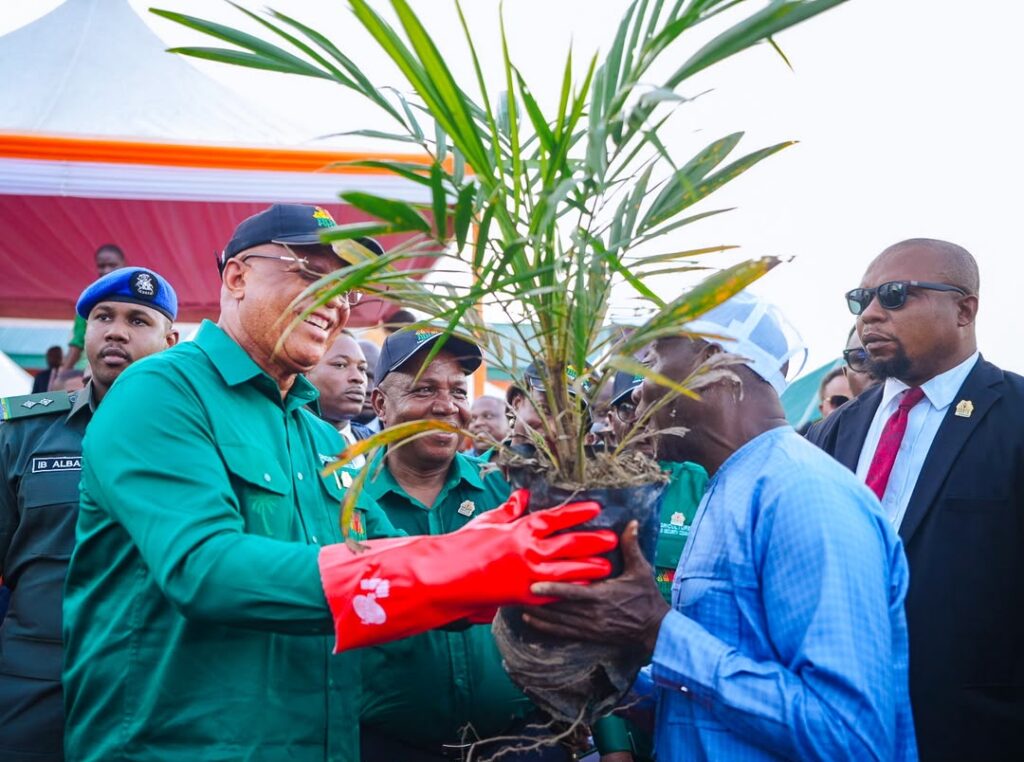
Governor Umo Eno, has officially launched the Akwa Ibom State Tree Crop Revolution Initiative, a strategic agricultural intervention designed to ensure food availability, stimulate rural economic growth, and advance the agricultural objectives of the ARISE Agenda.
The Tree Crop Revolution Initiative reflects a broader vision of transforming agriculture into a sustainable economic driver, capable of improving livelihoods and ensuring long-term food security in Akwa Ibom State.
Speaking at the flag-off ceremony which took place at the Akwa Ibom Agricultural Development Project’s office (AKADEP), Governor Eno described oil palm as “a symbol of wealth, heritage, enterprise, and community life,” noting that Akwa Ibom was historically renowned for oil palm production long before the dominance of crude oil in the Nigerian economy.
According to him, “What we are doing now is simply returning to our generational heritage,” recalling how many families in the state built prosperity and trained their children through proceeds from oil palm plantations.
He added, “Tree crops, particularly oil palm, play a significant role in food systems and agro-industrial development. Oil palm products are widely consumed in homes and industries, serving as raw materials for cooking oil, food processing, cosmetics, pharmaceuticals, and manufacturing.
“In view of Akwa Ibom’s natural comparative advantage within the tropical rainforest belt where oil palm originates, the state government is leveraging the crop to drive industrialisation and economic expansion.
The State Chief Executive further averred that Akwa Ibom State Government has fully paid for 660,000 elite Tenera oil palm seedlings supplied by the Nigerian Institute for Oil Palm Research (NIFOR) for distribution to farmers across the state which will be distributed on a local government basis, targeting about 500 households per council area, while churches and other strategic groups have also been captured in the programme.
Farmers, as explained by Gov. Eno, have already been digitally profiled to ensure transparency and effective implementation of the initiative. Therefore, each beneficiary household will receive seedlings capable of cultivating approximately a quarter hectare of farmland, while farmers with greater capacity will also be accommodated.
“At the end of the programme’s initial five-year phase, the state anticipates that over 60,000 hectares of land would have been cultivated, thereby generating substantial volumes of fresh fruit bunches to attract commercial and industrial processing investments. The long-term goal therefore is to establish Akwa Ibom as a major oil palm production and processing hub with visibility on the Nigerian Stock Exchange.
“Furthermore, the initiative is also expected to contribute directly to food availability through income generation for rural households. With thousands of farmers already enumerated across all local government areas through collaboration between the Akwa Ibom Agricultural Development Programme (AKADEP), the Ministry of Agriculture, and local government committees, participating families are expected to experience improved purchasing power, enabling them to access food and meet household nutritional needs.
In addition, the programme is designed to place “wealth directly into the hands of our people”, says Gov. Eno, stressing that the government’s responsibility is not to distribute unsustainable handouts but to provide productive assets capable of generating lasting prosperity.
“I was not raised to take government money and distribute recklessly. Instead, we will put productive assets and opportunities into the hands of our people so they can create sustainable wealth for themselves,” he stated.
Another important dimension of the Tree Crop Revolution Initiative is employment generation across the agricultural value chain as the initiative is expected to create opportunities in nursery management, plantation cultivation, harvesting, transportation, processing, and marketing.
“Consequently, the programme is positioned to reduce rural unemployment and discourage youth migration to urban centres, while strengthening local food production systems and economic stability.
Governor Eno also revealed that the state government plans to establish produce buying centres across Akwa Ibom to purchase fresh fruit bunches directly from farmers at fair market prices. The objective according to him will ensure that “the financial benefits go directly into the pockets of our people”, thereby creating an organised and sustainable supply chain for industrial processors.
According to the Executive Director of NIFOR, Dr Isona Gold, the elite Tenera oil palm seedlings are expected to mature and begin fruit production within four years of planting, thereby creating sustainable income streams for beneficiaries and supporting long-term rural economic development.
It will be recalled that in 2025 Gov. Eno inaugurated the Akwa Ibom State Committee on Agriculture and Food Security, with the mandate of developing progressive agricultural policies capable of eliminating hunger and malnutrition through increased food and industrial commodity production.
The committee, chaired by renowned agricultural expert, Prof. Okon Ansa, recommended the accelerated cultivation of oil palm and other tree crops as a pathway to reposition Akwa Ibom among Nigeria’s leading oil palm-producing states and the heart of the programme is the revival of agricultural productivity through grassroots participation.
Unlike conventional plantation models that rely on large expanses of land owned by corporations, the Umo Eno Tree Crop Revolution Initiative adopts a household and community-based approach.
It is structured around smallholder farmers across the 31 Local Government Areas, with each participating household receiving oil palm seedlings free of charge for cultivation.