
KENNETH OFOMA writes on the recent endorsement of Enugu State Governor Peter Mbah for a second term by the people of Awkunanaw Clan of the state
In the evolving political theatre of Enugu State ahead of the 2027 general elections, few events have resonated as loudly – or as symbolically – as the recent rally staged by the Awkunanaw Clan. It was not just another gathering of political stakeholders or a routine endorsement ceremony.
Rather, it was a carefully choreographed statement of intent, steeped in culture, strategy and a keen awareness of the shifting dynamics within Nkanu land and the broader Enugu political landscape. The Awkunanaw Clan, comprising Obuoffia, Amodu, Umueze, Obeagu, Akegbe-Ugwu, Ugwuaji, and Amechi, occupies a unique position in Enugu socio-political structure.
Spread across Enugu South, Enugu North and parts of Nkanu West local government areas, the clan represents a bridge between urban political influence and traditional grassroots authority. Historically, Awkunanaw has played a pivotal role in shaping electoral outcomes in the state, often acting as a bellwether for wider political alignments. Their recent decision to openly endorse Governor Peter Mbah for a second term, therefore, is not merely symbolic – it is strategic.
A rally beyond the ordinary
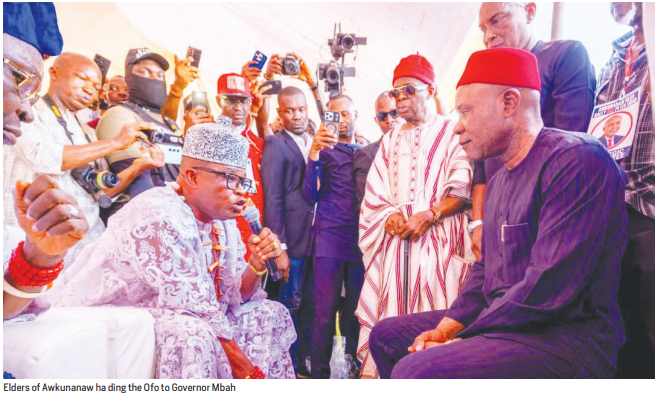
The rally held at the Civic Centre, Akpasha, drew a massive crowd of political leaders, traditional rulers, technocrats, and ordinary citizens. But beyond the optics of numbers was the weight of what transpired: the presentation of the Ofo, the revered Igbo symbol of authority, justice and moral legitimacy. In Igbo cosmology, the Ofo is not casually bestowed.
It is both a spiritual endorsement and a binding covenant, invoking ancestral witness. By presenting it to Governor Mbah, the Awkunanaw Clan did more than endorse a candidate—they consecrated a political choice. This act, as articulated by several speakers at the event, effectively forecloses internal dissent within the clan, at least symbolically. It also raises the stakes for any aspirant from Awkunanaw extraction contemplating a run against the incumbent.
The Nkanu equation
To understand the implications of this endorsement, one must situate it within the broader Nkanu political calculus. Nkanu land, comprising Enugu East, Enugu South, Enugu North, Nkanu West, Nkanu East, and Isiuzo LGAs, has emerged as a dominant bloc in Enugu politics. Governor Mbah himself hails from Nkanu East, and his emergence in 2023 reinforced the zone’s influence. However, as the 2027 elections approach, the familiar currents of ambition, zoning debate, and intra-regional competition have begun to surface.
Several prominent figures from Nkanu land are reportedly positioning themselves for the governorship contest. Among them is Chief Chinyeaka Oha, a respected technocrat from Obuoffia in Awkunanaw Clan. His recent resignation as chairman of the Governing Council of Enugu State University of Science and Technology (ESUT), coupled with his move to the African Democratic Congress (ADC), has been widely interpreted as a clear signal of gubernatorial ambition.
Similarly, former Minister of Innovation, Science and Technology, Chief Uche Nnaji, from Akpugo in Nkanu West, is believed to be rebuilding his political machinery after a turbulent period that saw him exit federal office under controversial circumstances. Despite internal party realignments and the fragmentation of his former political structure, Nnaji remains a factor in the unfolding equation. Even he doesn’t eventually contest; he may throw his weight behind any other candidate.
Another contender, Chief Sampson Nnamani from Nkanu East, is reportedly pursuing his ambition on the platform of the Peoples Democratic Party (PDP), aligning with a faction that traces its influence to the national leadership orbit of the Minister of the Federal Capital Territoryl, Nyesom Wike. In this crowded and complex field, the Awkunanaw endorsement of Mbah appears designed to achieve a singular objective – to consolidate support within a critical subbloc and preempt internal fragmentation.
Strategy or solidarity
The question, however, is whether this move is driven purely by admiration for the governor’s performance or by a calculated political strategy aimed at narrowing the field. Speakers at the rally left little doubt about their position. Articulating the stand of the mammoth crowd, a former President of the Senate, Ken Nnamani, noted that Mbah had become a poster boy for subnational governance in Nigeria.
“We want to make it clear that the people of Awkunanaw are solidly behind Peter Mbah to complete his second term. His good works in Enugu are earning him public acclaim throughout the country. The high point of our coming here today is that we want to bequeath him with an Ofo, and it is rarely given.
So, nobody in Nkanu land should use Governor Mbah’s remaining four years to play with us,” he said. Reinforcing Nnamani’s remarks, a former governor of old Anambra State, Jim Nwobodo, said, as a forthright people, Awkunanaw clan, having presented the Ofo staff to Governor Mbah, could not renege on their support for him. Nwobodo, who was represented by the Enugu State Commissioner for Local Government Affairs, Okey Ogbodo, declared that Mbah remains the best hand for the state come 2027. The people praised Mbah’s governance record, describing him as a transformative leader who has, in less than three years, redefined the developmental trajectory of Enugu State.
From the introduction of Smart Schools and Type-2 hospitals across wards to the revival of key state assets and the launch of ambitious transportation initiatives, the administration’s achievements were repeatedly highlighted. Yet, beyond the accolades was a clear message: Awkunanaw will not entertain internal opposition to Mbah’s second-term bid.
This was most explicitly captured in the advisory issued to any son or daughter of the clan nursing governorship ambition to “perish the thought” until power rotates back to Enugu East Senatorial Zone in the future. It was a firm, almost unequivocal directive – one that blends political pragmatism with cultural authority.
Weight of elders and tradition
The presence and pronouncements of elder statesmen and traditional rulers added further gravitas to the event. Their involvement underscored the fusion of modern political processes with enduring traditional institutions in Igbo society. The invocation of ancestral authority during the presentation of the Ofo was particularly significant.
It signaled that the endorsement transcended partisan politics and entered the realm of communal obligation. In such a context, defiance is not merely political—it is cultural. This dimension could prove crucial in shaping the behavior of aspirants from the clan. While Nigeria’s democratic framework guarantees the right to contest, the influence of communal norms and expectations remains powerful, especially in closely-knit societies.
Mbah’s response
Governor Mbah, on his part, used the platform not only to express gratitude but also to draw a clear contrast between his administration and potential challengers. He pointed to the absence of key infrastructure and initiatives prior to his tenure, framing his achievements as both tangible and transformative.
His remarks also contained a subtle but pointed warning against what he described as “forces of falsehood and division.” It was a direct appeal to unity within Nkanu land and a critique of what he perceives as self-serving political maneuvers by opponents. By positioning his administration as both effective and inclusive, Mbah is attempting to build a narrative that transcends local rivalries and appeals to a broader electorate.
Ripple effects across Enugu
The implications of the Awkunanaw rally are likely to extend beyond the clan itself. In Enugu’s political ecosystem, endorsements often trigger a domino effect, prompting other clans, cultural groups, and political blocs to declare their positions.
Already, there are indications that similar rallies may be organized in other parts of the state, each seeking to align with—or counter— the momentum generated by Awkunanaw’s move. For Mbah, this presents an opportunity to consolidate support and build an aura of inevitability around his candidacy. For his opponents, it raises the urgency of articulating alternative visions and mobilizing countervailing coalitions.
Meanwhile, other Awkunanaw leaders at the event include Hon. U.S.A Igwesi, Amb. Gordi Agbo. Hon. Offor Chukwuegbo, Hon. Chimaobi Atu, Hon. Iloabuchi Aniagu, Chief Nwabueze Nnamani, Hon. John Egbo, Dr. Amaka Ngene, Hon. Nwabueze Ugwu, Igwe Dr. Greg Ugwu and other traditional rulers from within and outside the Awkunanaw clan, as well as friends and well wishes from other oarts of the state.
Will endorsement deter aspirants?
Despite the apparent strength of the endorsement, it remains uncertain whether it will significantly reduce the number of aspirants in the race. Nigerian politics has often demonstrated that endorsements, while influential, are not always determinative.
Ambition, personal networks, party dynamics, and access to resources all play critical roles in shaping electoral contests. Figures like Oha, Nnaji, and Nnamani may still proceed with their plans, calculating that broader statewide support could offset localized opposition. Internal party structures and alliances could either reinforce or undermine the impact of endorsements like that of Awkunanaw.
A glimpse into 2027
What is clear, however, is that the Awkunanaw rally has set the tone for the 2027 governorship race in Enugu State. It has introduced a narrative of consolidation versus contestation, unity versus ambition, and continuity versus change. By moving early, the clan has sought to shape the conversation and establish a reference point for subsequent political developments. Whether this strategy will ultimately succeed in delivering an uncontested path for Governor Mbah remains to be seen.
But one thing is certain: the presentation of the Ofo has transformed the political discourse. It has elevated the stakes, invoked tradition, and underscored the enduring interplay between culture and politics in Enugu State.
As the months unfold and more actors enter the stage, the echoes of that moment in Akpasha will continue to reverberate – reminding all stakeholders that in the contest for power, symbolism can be as potent as strategy, and unity, when effectively mobilized, can be a formidable force.