



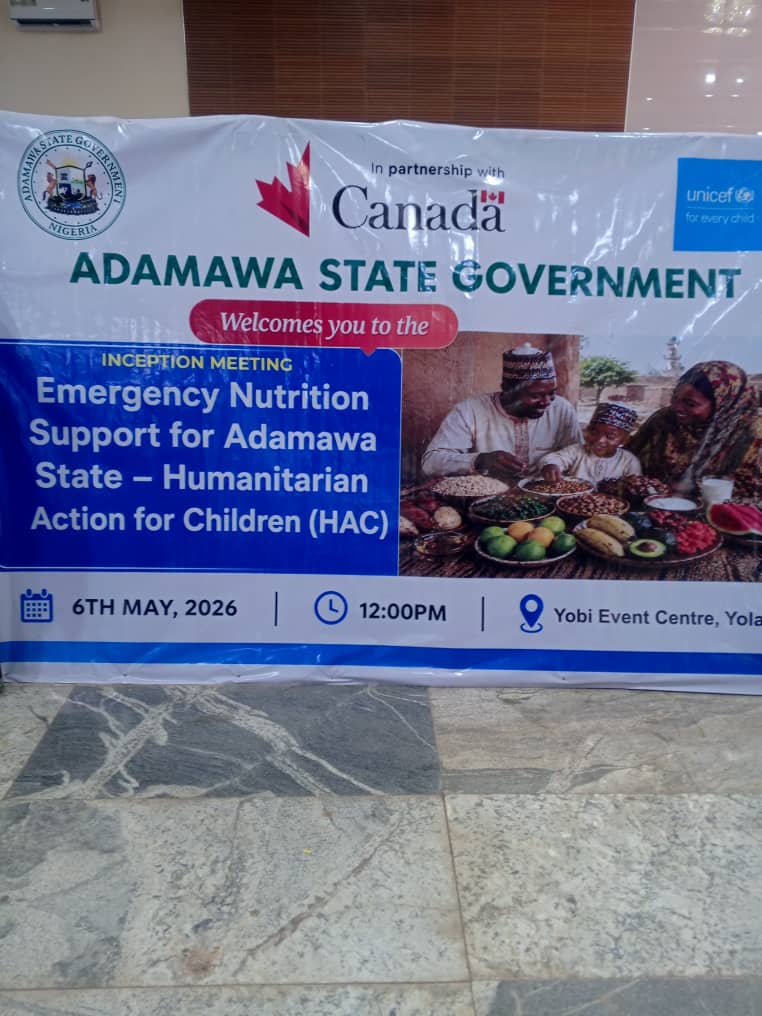
The Adamawa State Government, in partnership with the United Nations Children Fund (UNICEF) and Global Affairs Canada, has explained that malnutrition remains a major driver of Child deaths in the country.
The stakeholders at a meeting held at a Yobi Event Centre in Yola, Adamawa State emphasised the need to improve maternal and child nutrition during the critical first 1,000 days of a child’s life.
The partnership between the Adamawa State Government and other partners is aimed at strengthening healthcare delivery for pregnant women, newborns, and infants across the state through preventive and community-based healthcare interventions.
The Executive Chairman of the Adamawa State Primary Healthcare Development Agency (ADPHCDA), Dr Sulaiman Bashir, described the partnership as a major step toward improving child survival and healthy development in Adamawa State and beyond.
According to him, the project, supported by Global Affairs Canada in partnership with UNICEF, is known as the Essential Support Humanitarian Action for Children project and focuses on the period from pregnancy to a child’s second birthday.
It is aimed at targeting the first 1,000 days of life, from pregnancy to childbirth and up to the second birthday of the child,” he said.
Dr Bashir explained that the programme is designed to improve the health and survival of children while ensuring they grow and develop optimally.
He noted that the state government would play a critical role in sustaining the initiative through the provision of human, financial, and material resources, while development partners would support the initial implementation phase.
The partnership, the Chairman explained would emphasise preventive healthcare using what he described as “high-impact, low-cost interventions” capable of reaching communities across the state.
“In Adamawa State, our mantra is to leave no one behind and nothing untouched, and we will do just that,” he said.
Also speaking, the Chief of UNICEF Bauchi Field Office, Nuzhat Rafique, said the first 1,000 days of a child’s life remain the most critical stage for physical and mental development.
She explained that the initiative would focus on maternal health, antenatal care, nutrition counselling, exclusive breastfeeding, vaccination, birth registration, and child protection.
“At the time of conception, the mother needs to be healthy during pregnancy. When the child is born, all the rights of the child, including vaccination, nutrition and protection, must be ensured,” she said.
Dr Rafique emphasised that proper nutrition and exclusive breastfeeding during the first six months are key to preventing malnutrition, infections, and childhood diseases.
“If breastfeeding is not exclusive and feeding practices are poor, the child becomes sick repeatedly and may fall into malnutrition,” she explained.
She added that UNICEF and partners are optimistic that strengthening healthcare delivery systems for mothers and infants would significantly improve child nutrition outcomes in the state.
Speaking on diversion of humanitarian aid and nutrition products, Dr Rafique disclosed that monitoring committees have been established at both state and local government levels to prevent misuse and diversion of supplies.
According to her, the committees include traditional rulers, teachers, local leaders, healthcare workers, and local government officials who will monitor distribution and report cases of diversion.