



After processing more than 39,039 applications for licences, permits, certificates and other trade-related documents within eight weeks, the National Single Window (NSW) is to commence the second phase of its implementation from the first week of June 2026.
In the second phase, the NSW will also finalise the manifest rollout for all airlines and shipping lines to enable them submit manifests, saying that 100 per cent of airlines will be on the platform.
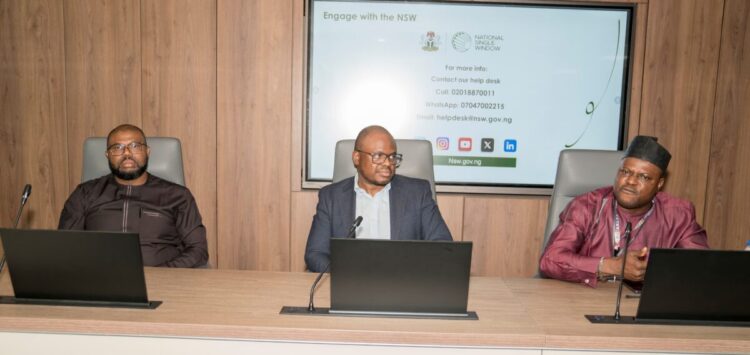
The Director of the NSW Secretariat, Tola Fakolade, explained in Lagos on the platform’s performance since its March 2026 go-live.
He explained: “Over the last eight weeks since go-live, approximately 39,039 LPCO applications have been submitted through the platform since the go-live date. This indicates growing reliance on the NSW for the submission and processing of trade-related licences, permits, certificates, and other documents.”
The director said that the Standards Organisation of Nigeria (SON) accounted for the largest share with 30,937 applications, followed by the National Agency for Food, Drug Administration and Control (NAFDAC) with 7,942.
The National Environmental Standards and Regulations Enforcement Agency (NESREA) recorded 138 applications, while the Nigeria Agricultural Quarantine Service (NAQS) submitted 22.
On user onboarding, Fakolade said 7,567 registered users had been brought onto the platform within the period, comprising traders, importers, licensed customs agents, clearing and forwarding agents, and other private-sector stakeholders.
The breakdown showed 6,935 importers, 359 clearing and forwarding agents, 104 freight forwarders, and 169 licensed customs agents.
The director explained that progress on the Air Cargo Manifest Module, which went live on 27 March 2026 with DHL as the pilot airline, adding that 136 manifests had since been submitted, with eight airlines and courier operators now active on the module.
Fakolade stressed that the NSW commenced preparatory sessions in February 2026 across Lagos, Abuja, Port Harcourt, and Kano, targeting both government agencies and private-sector stakeholders, stressing that end-user training for private stakeholders was ongoing to ensure that new users continue to receive the guidance required to fully understand the NSW platform and carry out their respective activities effectively.
A total of 2,990 private stakeholders were trained, covering importers, exporters, freight forwarders, licensed customs agents, and other users.
He explained: “On Public stakeholder training, a total of 579 MDA representatives were trained. The training was designed to ensure that MDA officers understood the NSW process flow, their agency-specific responsibilities, and how to carry out assigned tasks such as application review, approvals, escalations, and stakeholder support. Regulatory agencies trained included NAQS, SON, NESREA, NAFDAC, among others.”
However, the director said the level of stakeholders’ compliance is still at 30 per cent, while over 70 per cent are non-compliant and still trying to circumvent the system.
He stressed: “They decide to pay less on permits or bring the wrong documents in order to circumvent the system. If you have this level of non-compliance and you bring a new system that actually forces them to comply, they would start kicking back.
Fakolade explained that the challenges and teething problems around SON and NAFDAC, which the stakeholders had complained seriously about, have since been resolved, tracing the challenges to learning curve, knowledge gap and data migration.