

…warns against misuse of digital media
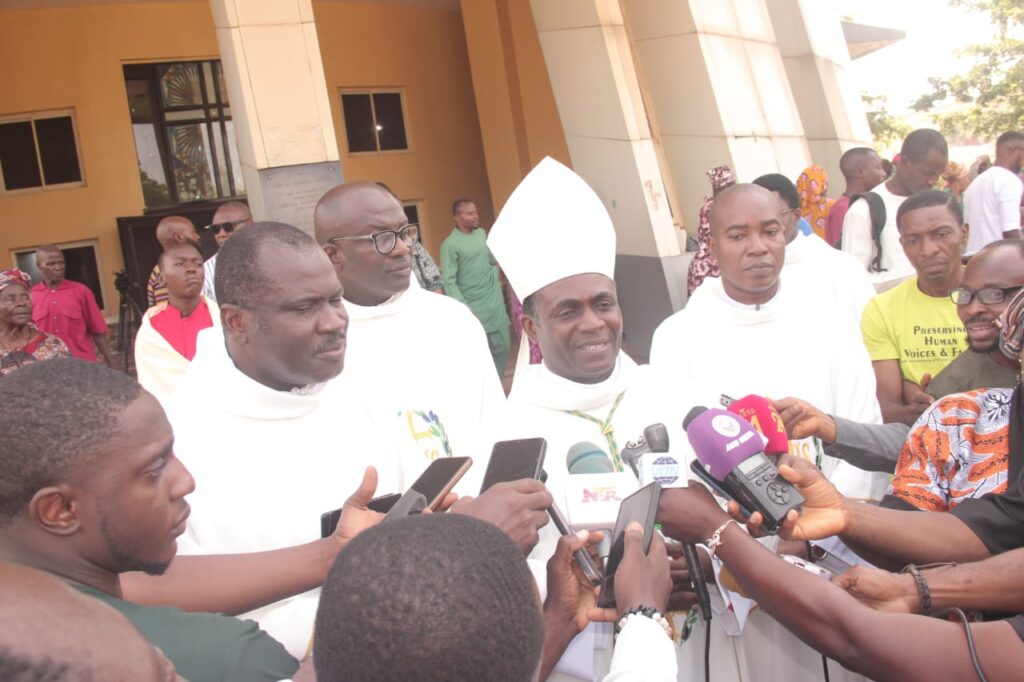
The Catholic Bishop of Katsina Diocese, Most Rev. Gerald Musa, has called for greater protection of journalists facing persecution for speaking the truth, even as he warned that digital technologies and algorithms must not erode human dignity or replace the “human face and human voice” in communication.
Musa, who assumed his new position as Bishop Chairman for Social Communications at the Catholic Secretariat of Nigeria (CSN), regretted that journalists have continued to remain at global risk, particularly during electioneering periods, for exposing the truth to the public despite threats, intimidations and attacks.
The Cleric spoke during the commemoration of the 60th World Communication Day (WCD) and grand finale of a week-long grassroots media literacy programme to mark the 5th edition of the Communication Week (ComWEEK), themed, ‘Preserving Human Voices and Faces.’
He said, “At this time when elections are coming up, journalists and media practitioners who are often on the front line are often in danger. They are at risk, especially for propagating what truth is.
“We have journalists who are persecuted in so many ways for propagating the truth. We have journalists who are persecuted for showing their faces. We have many evil people who are unable to show their faces and are perpetrating all kinds of evil.
“We have journalists who show their faces, speak the truth and enlighten the public, and they are persecuted. We have journalists who have disappeared mysteriously. We have journalists who have been killed.
“On this day, we also have to give honour to journalists who are constantly persecuted, journalists who are often in danger by speaking the truth and propagating the gospel message.”
Musa, who noted that the world was becoming digitally connected but emotionally disconnected, warned that society risks losing genuine human connection despite rapid technological advancement and digital communication.
He emphasised the need to preserve human dignity in the digital age, warning against allowing algorithms and digital technologies to dictate human values and interactions.
The cleric expressed concern over the growing influence of misinformation, especially on young people, describing children and youths as highly impressionable and vulnerable to false narratives spread through digital platforms.
According to him, many young people struggle to distinguish between fantasy and reality because of the overwhelming content consumed through phones and other digital devices.
“With the many forms of misinformation that we have, the young people need to have critical minds that will enable them to differentiate between truth and fantasy, between misinformation and truth itself.”
He described the media as a “double-edged sword” capable of shaping society positively or negatively depending on how it is used.
The cleric praised trained journalists and ethical media practitioners for using communication tools responsibly to enlighten, educate and inform the public, while condemning individuals who deploy such technologies unethically.
“We’re also aware that there are so many people today who use these technologies negatively, unethically and immorally. But the church continues to advise us to use all these digital technologies positively to enlighten the society, to propagate the gospel message, to inform and to enlighten the public.”
Secretary-General of the Catholic Secretariat of Nigeria, Fr. Michael Banjo, who said communication must not become what he described as “another weapon of injury,” warned Nigerians against fake news, hate speech and divisive propaganda as the 2027 elections fast approach.
According to him, communication should be used to promote peace, truth and national cohesion, rather than deepen division.
“In a country already burdened by insecurity, political tension, economic hardship and social mistrust, communication must not become another weapon of injury.
“Preserving human voices and faces means verifying before we share, so that falsehood does not destroy reputations, inflame communities or endanger lives.”
Banjo stressed that journalists remained critical in combating misinformation despite the rise of social media.
“In an age where everyone with a phone can publish, the professional journalist must become more necessary, not less necessary. The answer to misinformation is responsible journalism; the answer to propaganda is truth.”
The cleric who urged Nigerians to see elections as “a moral responsibility and not a battlefield,” warned against fake election results, hate speech, vote-buying and voter intimidation, as he called for credible elections and protection of polling unit results transmitted electronically.
Banjo further urged the media to avoid sensationalism and inflammatory reporting capable of worsening ethnic and religious tensions.
“In an election season, responsible journalism is not merely a profession; it is a service to democracy and to the human face of the nation.”
The National Director of Social Communications, Rev. Fr. Michael Umoh, who is set to complete his six-year tenure in a few months, reflected on the achievements recorded under his leadership.
According to him, the Catholic Church had significantly expanded its digital presence and strengthened its communication structure since 2020.
“By God’s grace, we can humbly say that we have revolutionised the digital presence of the Catholic Church in Nigeria, notably through the launch and sustenance of the Nigeria Catholic Network, the institutionalisation of ComWEEK, and the restructuring of our various communication bodies to form a unified, synergistic front.”
He thanked media practitioners for their support over the years, describing journalists as reliable allies who amplified the Church’s advocacy on public accountability, infrastructure reform, and good governance.
Umoh urged journalists to extend the same cooperation to his successor, stressing that the media and the Church shared a common responsibility of serving as the conscience of society.
“The media and the Church share a sacred duty to be the conscience of the nation, especially in times of socio-economic anxieties, as we are currently experiencing,” he said.
The event coincided with Umoh’s 58th birthday, which he described as a providential coincidence, saying it was a fitting way to celebrate his lifelong passion for communication.