



While judicial pronouncements are often described as the verdict on cases, a regular occurrence in contemporary Nigeria is that the courts, especially the Apex Court’s pronouncements create more confusion than solution. TUNDE OYESINA examines this and its implication on good governance
The judiciary has traditionally been described as the last hope of the common man. In Nigeria, particularly at the level of the Supreme Court, judicial pronouncements are expected to bring certainty, closure and finality to disputes. Yet, in recent years, a growing number of judgments, especially politically sensitive decisions have generated a different outcome and confusion.
In many cases, both plaintiffs and defendants emerged from court premises claiming victory, armed with different interpretations of the same verdict. The result has been a dangerous trend where judgments that ought to settle disputes instead deepen controversies.
Legal analysts describe such situations as “verdicts without justice” , decisions that may satisfy procedural legal requirements but fail to provide clarity, certainty or public confidence.
These controversies are often linked to non-declarative judgments, ambiguous pronouncements, technical dismissals, or decisions that fail to clearly define the rights and obligations of parties. The phenomenon has become increasingly visible in political litigations, party leadership tussles, constitutional disputes and electoral matters.
Lawyers, politicians and commentators frequently dissect the same judgment differently, while supporters on opposing sides celebrate simultaneously. This has raised concerns about the burden of clarity on courts and whether judicial pronouncements are becoming excessively technical, thereby leaving room for dangerous political interpretations.
Indeed, senior lawyers and judicial scholars have repeatedly warned that conflicting interpretations of judgments, especially from the apex court, threaten public confidence in the judiciary. Recent debates surrounding the ADC leadership disputes, PDP leadership battles and constitutional cases have brought the issue into sharper focus.
Writing on the issue recently, Prof. Chidi Anselm Odinkalu, a professor of law and former Chairman of National Human Rights Commission lamented: “The phenomenon of verdict without judgment is new, however, because the absence of judgment is itself injustice and the vacuum in time until it is produced can do damage, both foreseeable and unpredictable.
The scary thing is that it’s impossible to say that this is not deliberate because there is evidence to show that judgments can be available on the day they are issued. Some Nigerian judges do that as a matter of habit. Why many of their peers choose not to do so should bother the Chief Justice of Nigeria.”
He added that “In many ways, political harlotry in a court’s name is increasingly an international affair…Many will recognize these patterns in Nigeria.
When he addressed the annual conference of the Nigerian Bar Association (NBA) in August 2025, the Sultan of Sokoto complained that judicial verdicts in the country had become a purchasable commodity. In a rigged judicial market, it is evident that the winners will almost always be the most powerful. In Nigeria, they are politicians.”
S’Court judgement on PDP leadership tussle
For instance, the Supreme Court judgment in the leadership crisis involving Senator Samuel Anyanwu and the office of National Secretary of the Peoples Democratic Party (PDP) has become one of the clearest examples in recent Nigerian political jurisprudence where an apex court decision produced sharply conflicting interpretations among political actors and legal analysts.
The dispute originated after Anyanwu contested the 2023 Imo State governorship election while still serving as PDP National Secretary. Some party members argued that by contesting the governorship election, he had automatically relinquished his position under the PDP constitution.
This led to litigation instituted by Aniagu Emmanuel at the Federal High Court in Enugu, seeking his removal and recognition of Sunday Udeh-Okoye as substantive National Secretary. The Federal High Court ruled against Anyanwu and ordered his removal from office.
The Court of Appeal subsequently affirmed the judgment, holding that his continued stay as National Secretary violated provisions of the PDP constitution after emerging as governorship candidate in Imo State. Dissatisfied with the decisions, Anyanwu approached the Supreme Court, arguing principally that the courts lacked jurisdiction because the matter concerned the internal affairs of the PDP, which are generally non-justiciable under Nigerian law.
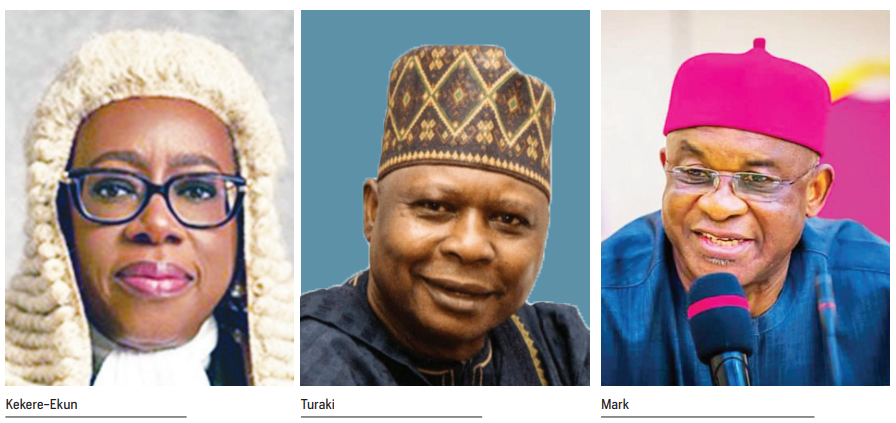
He also argued that the plaintiff lacked locus standi to institute the suit. In its final judgment delivered by a five-member panel led by Justice Jamilu Tukur, the Supreme Court nullified the judgments of both the Federal High Court and the Court of Appeal.
The apex court held that the issue of who occupies the office of PDP National Secretary was fundamentally an internal affair of the political party and therefore beyond judicial interference.
The Supreme Court also held that the plaintiff, Aniagu Emmanuel, failed to establish sufficient legal standing to challenge Anyanwu’s position, noting that he did not demonstrate how he was personally affected by the PDP leadership arrangement. Immediately after the verdict, the Anyanwu camp declared total victory.
Supporters interpreted the judgment as a complete restoration and judicial affirmation of Anyanwu as the authentic PDP National Secretary. They argued that once the apex court nullified the lower court decisions removing him from office, his position automatically remained valid.
However, rival factions within the PDP offered a completely different interpretation. This disagreement created a fresh political crisis within the PDP. While the Anyanwu camp focused on the practical implication of setting aside the earlier judgments, the opposing camp emphasized the technical nature of the Supreme Court’s reasoning.
They argued that a jurisdictional decision is different from a substantive declaration on the merits of leadership entitlement. The confusion became even more pronounced because the judgment contained substantial procedural reasoning but no elaborate declaratory order spelling out the exact operational consequence for the party leadership structure.
Political stakeholders subsequently began selectively quoting portions favorable to their positions. Supporters of Anyanwu repeatedly cited the court’s pronouncement that the issue was an “internal affair of the party,” while opponents emphasized that the Supreme Court did not expressly pronounce him permanent secretary in explicit terms.
The judgment therefore became a classic illustration of what many lawyers describe as a “non-declarative political verdict” — a decision that resolves procedural legal questions but leaves political consequences open to multiple interpretations.
Controversy did not end there
Subsequent PDP leadership disputes recently further exposed the lingering uncertainty generated by the earlier judgment. Following another Supreme Court ruling concerning the PDP’s national convention and leadership structure, rival factions again claimed victory from the same verdict.
The Board of Trustees faction led by Senator Adolphus Wabara interpreted the later judgment as invalidating the existing National Working Committee and justifying the BoT’s assumption of interim leadership powers.
Conversely, another faction aligned with FCT Minister, Nyesom Wike argued that the same judgment actually affirmed the legitimacy of the Mohammed–Anyanwu leadership structure within the PDP.
Some lawyers described the aftermath of the ruling as leaving the PDP “in flux,” with rival camps offering sharply conflicting interpretations regarding the true meaning and effect of the apex court’s pronouncement.
Some report similarly observed that the judgment threw the opposition party into “a political logjam of different interpretations by parties in the dispute. Legal analysts say the PDP crisis demonstrates a broader challenge within Nigeria’s judicial system, the growing tendency of politically sensitive judgments to create uncertainty instead of closure.
The result is that opposing political actors often emerge from the same courtroom claiming victory simultaneously, thereby weakening public confidence in the clarity and finality of judicial pronouncements.
As one legal observer noted in analysing the PDP crisis, the judgment became “a victory for everybody and a defeat for nobody,” precisely because the court resolved the legal technicalities without sufficiently clarifying the practical political consequences of its decision.
Judgement on ADC leadership tussle and interpretations
The Supreme Court judgment in the leadership tussle within the African Democratic Congress (ADC) is also another major illustration of how politically sensitive judicial pronouncements in Nigeria can generate multiple and conflicting interpretations among litigants, party stakeholders and legal analysts. One faction aligned with former Senate President David Mark insisted that the crisis was essentially an internal party affair beyond judicial intervention.
Their lawyers argued that by settled Nigerian constitutional jurisprudence, courts generally lack jurisdiction to interfere in the domestic affairs, leadership choices and administrative decisions of political parties except where statutory violations are clearly established.
The opposing faction, however, maintained that the dispute transcended ordinary internal party administration because it allegedly involved breaches of the ADC constitution, abuse of party procedures and questions affecting democratic participation within the party structure.
According to that camp, judicial intervention was necessary to preserve constitutional order within the party. Before the matter reached the apex court, conflicting decisions had reportedly emerged from lower courts.
At one stage, the Court of Appeal issued consequential orders affecting the leadership arrangement and directing parties to maintain status quo pending determination of substantive issues. Those orders themselves became subjects of conflicting political interpretations within the party.
When the Supreme Court eventually heard the appeal, counsel representing the David Mark faction, Jibrin Okutepa (SAN), strongly relied on previous Supreme Court authorities holding that leadership disputes within political parties are ordinarily non-justiciable because they fall within the internal domestic affairs of the parties.
In its final judgment, the Supreme Court set aside portions of the Court of Appeal ruling and directed that certain substantive issues be returned to the Federal High Court for proper determination.
However, rather than conclusively ending the crisis, the judgment immediately produced sharply different interpretations among the rival factions. The David Mark faction emerged from court celebrating what it described as a major judicial victory.
According to supporters of that camp, the Supreme Court’s decision to set aside the Court of Appeal orders effectively invalidated attempts to destabilize the existing leadership structure.
They argued that the apex court had indirectly affirmed their long-standing position that courts should not interfere in internal party matters. Supporters of that interpretation particularly focused on the Supreme Court’s apparent acceptance of arguments relating to jurisdiction and internal party autonomy.
They maintained that once the appellate court’s orders were nullified, the leadership arrangement associated with David Mark remained intact and legally protected. But the opposing faction interpreted the same judgment in an entirely different manner.
According to that camp, the Supreme Court did not finally determine the substantive leadership dispute in favor of any faction. Instead, they argued that by remitting aspects of the matter back to the Federal High Court, the apex court merely reopened the controversy for substantive adjudication.
That faction insisted that the Supreme Court never made any express declaratory pronouncement affirming the permanent legitimacy of the David Mark leadership structure.
In their view, the judgment only addressed procedural and appellate deficiencies while leaving substantive questions unresolved. As a result, both camps simultaneously claimed victory from the same Supreme Court verdict.
Legal analysts described the aftermath as another example of what has increasingly become known as “judicial ambiguity in political litigation” , situations where the legal effect of a judgment differs sharply from the political interpretations promoted by interested parties. The confusion was aggravated by the technical nature of the judgment.
Legal analysts noted that much of the apex court’s reasoning reportedly centered on procedural issues, appellate jurisdiction and judicial competence rather than straightforward declaratory pronouncements identifying which faction validly controlled the party structure.
This created room for selective interpretation. Supporters of one faction emphasized the setting aside of the Court of Appeal ruling, while the opposing camp focused on the remittal of substantive issues back to the trial court. Consequently, the public received conflicting narratives regarding the true implication of the apex court decision.
Immediate political consequences
Party members across different states reportedly became divided over which faction legitimately controlled the ADC’s national structure. Some stakeholders interpreted the verdict as preserving the status quo, while others argued that the leadership issue remained legally unresolved pending fresh proceedings before the Federal High Court. Different political commentators and party supporters celebrated the same verdict from opposing standpoints, each insisting that the Supreme Court had vindicated their position.
Several constitutional lawyers later cited the ADC judgment as another indication that Nigerian appellate courts, particularly in political matters, increasingly rely on procedural reasoning without sufficiently clarifying the practical political consequences of their decisions.
According to legal commentators, while technical legal correctness remains important, politically sensitive judgments often require explicit declaratory clarity capable of preventing manipulation and propaganda by rival political actors.
Some lawyers also warned that where Supreme Court judgments produce multiple conflicting interpretations, public confidence in judicial certainty becomes weakened. In the ADC crisis, the inability of the judgment to produce immediate political closure meant that the litigation continued to shape internal party instability even after the apex court had spoken.
The ADC leadership tussle therefore joined a growing list of Nigerian political cases where court judgments, instead of conclusively settling disputes, became fresh battlegrounds for competing legal and political narratives. As one commentator observed after the verdict, “the court resolved the appeal, but the political argument survived the judgment.”
Judgment on Rivers’ political crisis
One of the most controversial examples involved the political crisis between Siminalayi Fubara and members of the Rivers State House of Assembly loyal to Nyesom Wike. Following the Supreme Court’s intervention, both camps emerged claiming victory.
Supporters of the governor argued that the judgment did not invalidate his authority as governor and merely addressed procedural constitutional issues. On the other hand, lawmakers loyal to Wike insisted the verdict affirmed their legitimacy and weakened Fubara politically. The ambiguity surrounding the interpretation of the ruling fueled fresh political tension across the state.
Legal observers argued that the court failed to issue sufficiently declarative pronouncements on critical constitutional questions surrounding defections, legitimacy of lawmakers and executive powers. As a result, politicians selectively interpreted portions favorable to them.
Judgement on LP leadership tussle
The leadership crisis within the Labour Party also produced contradictory interpretations after judicial pronouncements from superior courts. Different factions loyal to Julius Abure and opposing stakeholders separately claimed judicial victories. At different times, court pronouncements were interpreted as either affirming or nullifying party leadership structures.
The confusion became so intense that party officials issued parallel statements claiming legal legitimacy. Analysts noted that while courts often focused on procedural jurisdictional issues, the public expected definitive declarations regarding authentic leadership. The absence of clear declaratory language encouraged political propaganda and conflicting narratives.
Meanwhile, the confusion arising from conflicting interpretations has had serious consequences for public confidence in the judiciary. The public increasingly perceive courts as political battlegrounds where judgments can be “spun” differently depending on partisan interests. In some instances, supporters of opposing parties organize parallel victory celebrations immediately after the same judgment. This development weakens the authority of judicial pronouncements and undermines the principle of certainty in law.
Lawyers React
An Abuja based lawyer, Adeolu Aladekugbe warned that conflicting and unclear judgments from superior courts have become a major concern within the legal profession. “Uncertainty in judicial pronouncements weakens confidence in the justice system and leaves lower courts confused about applicable legal principles.
“The growing culture of political actors twisting judicial pronouncements for propaganda purposes has become dangerous. Judgments, especially from the apex court must be sufficiently clear to eliminate room for deliberate manipulation by interested parties. “Courts have a constitutional responsibility to speak clearly on matters affecting democratic governance. Where judgments are ambiguous, political actors exploit such gaps to justify unconstitutional conduct”.
Another lawyer, Abiodun Olugbemide in his reaction stressed the importance of certainty in judicial decisions, warning that contradictory interpretations damage the credibility of the judiciary. “The authority of the Supreme Court depends largely on the clarity and consistency of its pronouncements. Technical justice without substantial clarity often creates social dissatisfaction.
Judgments must not only resolve legal disputes but must also communicate justice in a manner understandable to ordinary citizens. “As the final court in the land, the Supreme Court carries a unique constitutional burden. Its pronouncements are binding on all authorities and persons in Nigeria. Consequently, any ambiguity from the apex court reverberates throughout the entire legal system”.








