
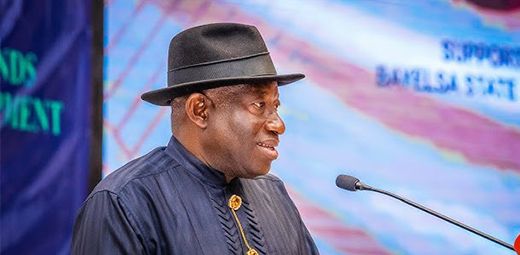
The Federal High Court Abuja yesterday fixed May 15 for the hearing of a suit seeking to stop former President Goodluck Jonathan from contesting the 2027 presidential election.
Justice Peter Lifu could not hear the suit filed by Johnmary Jideobi following the absence of the plaintiff and his lawyer, as well as lawyers for the Independent National Electoral Commission (INEC) and AttorneyGeneral of the Federation (AGF), without any information.
Following Jideobi’s absence as well as INEC and the AGF, Chris Uche (SAN), who represented Jonathan, applied to the court to strike out the suit for lack of diligent prosecution.
He said the suit was liable to dismissal and should be dismissed with a N5 million cost to be awarded against the plaintiff and payable to his client. Uche said that, from all indications, Jideobi had abandoned the suit and ran away upon sighting the preliminary objections raised against it.
Justice Lifu said there was no evidence of service of hearing notice on INEC and AGF to appear in court for the hearing of the suit, adding that the lack of service of hearing notice is fundamental. The judge said, rather than striking out the suit, he preferred to bend backwards to accommodate the plaintiff and the two defendants for the last time.
While adjourning the matter to May 15, Justice Lifu ordered that a hearing notice be served on the plaintiff and the 2nd and 3rd defendants. Jideobi filed the case seeking an order to restrain Jonathan from presenting himself to any political party as an aspirant to the 2027 election.
He also asked the court to stop INEC from accepting, processing, or publishing Jonathan’s name as a presidential candidate. In the suit, the plaintiff asked the court to determine whether, based on Sections 1(1), (2), (3) and 137(3) of the 1999 Constitution, Jonathan remains eligible under any circumstances to contest Nigeria’s highest office again.
According to him, Jonathan has already exhausted the constitutional limit for the office after completing the late President Umaru Musa Yar’Adua’s tenure and subsequently serving a full four-year term following the 2011 election.