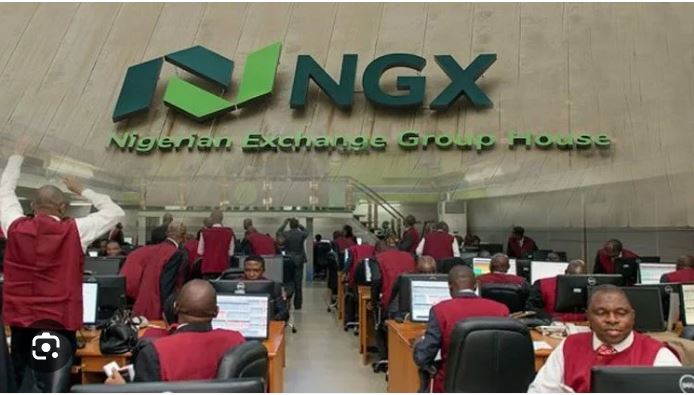



The Nigerian Exchange closed April 2026 on a record high, shrugging off a volatile week in financial stocks as gains in industrial heavyweights lifted total market capitalisation to N155.9tn. Despite a steep banking-sector sell-off driven by disappointing dividend announcements, the broader market recorded its strongest monthly performance of the year, delivering investors a N2.68tn gain and pushing year-to-date returns to 55.69 per cent. JIDE AJIA reports
The Nigerian Exchange closed the curtain on April 2026 with a performance that can only be described as a “bullish masterclass”, despite a stark divergence in sectoral fortunes. Propelled by massive gains in industrial heavyweights and a surge in investor confidence, the market capitalisation hit a staggering N155.994tn, marking a month where investors walked away with N2.68tn in total gains.
The final week of the month saw the All-Share Index leap 7.33 per cent to close at 242,277.81 points. This rally pushed the Month-to-Date return to a robust 20.36 per cent, the strongest monthly showing of the year so far, while Year-to-Date returns accelerated to 55.69 per cent.
Sectoral divergence
The headline figures, however, mask a tale of two markets. While the broader index soared, the banking sector, traditionally the market’s bellwether, faced a brutal reckoning. The NGX Banking Index tumbled 5.52 per cent during the week, largely dragged down by a sell-off in Tier-1 lenders.
The most dramatic casualty was United Bank for Africa, which saw its share price plummet by 22.27 per cent. This sharp decline followed the bank’s unexpected decision not to announce a full-year dividend, catching income-hungry investors off guard in a high-inflation environment where yields are paramount. Similarly, Access Holdings and FBN Holdings dipped 13.17 per cent and 13.80 per cent, respectively, as investors rotated capital out of financials to chase growth elsewhere.
Conversely, the Industrial Goods sector became the market’s primary engine, gaining 16.89 per cent. This was fuelled by a “buying frenzy” in cement stocks, with BUA Cement (+24.78%) and Dangote Cement (+8.99%) leading the charge. This rotation suggests that investors are increasingly betting on infrastructure-led growth as the Nigerian economy shows signs of structural recovery.
April surge
Market analysts point to a potent mix of robust corporate earnings, a stabilising naira, and improved macroeconomic liquidity as the catalysts for this record-breaking month. With foreign exchange reserves rising above $45bn, foreign portfolio investors are showing renewed interest in large-cap Nigerian equities.
“Performance was driven by strong buying in large-cap names… The gains were supported by positive earnings releases across some of these names, reflecting resilience in the face of previous economic headwinds,” noted a market analyst at Meristem Securities.
However, the report also highlighted the sensitivity of the current market to corporate actions. “Gains were partially offset by profit-taking, with pressure concentrated in the banking sector, where sell-offs were seen in UBA following no full-year dividend announcement. This triggered a ripple effect across the sector as investors re-evaluated their positions,” according to the NGX Weekly Market Summary.
Despite the banking volatility, sentiment remains overwhelmingly positive. Market breadth, a key indicator of investor participation, improved to 0.98x, supported by a 28.29 per cent jump in trading volume and a 34.22 per cent increase in total value traded.
Capital raising, resilience
As the market enters May, liquidity remains high. Even with a four-day trading week (shortened by the Workers’ Day public holiday), turnover hit 4.842 billion shares worth N287.756bn.
While the banking sector is currently licking its wounds, the broader market remains buoyant. The entrance of new raises, such as Neimeth International Pharmaceuticals’ N2.4bn Rights Issue, suggests that corporate Nigeria still views the Exchange as a viable and deep platform for capital formation.
The bottom line
For investors, the lesson of April is clear: while the tide is rising, choosing the right ship, whether in the flourishing industrial sector or the dividend-yielding oil and gas space, is the difference between riding the wave and being swept away in the wake of sectoral volatility.