




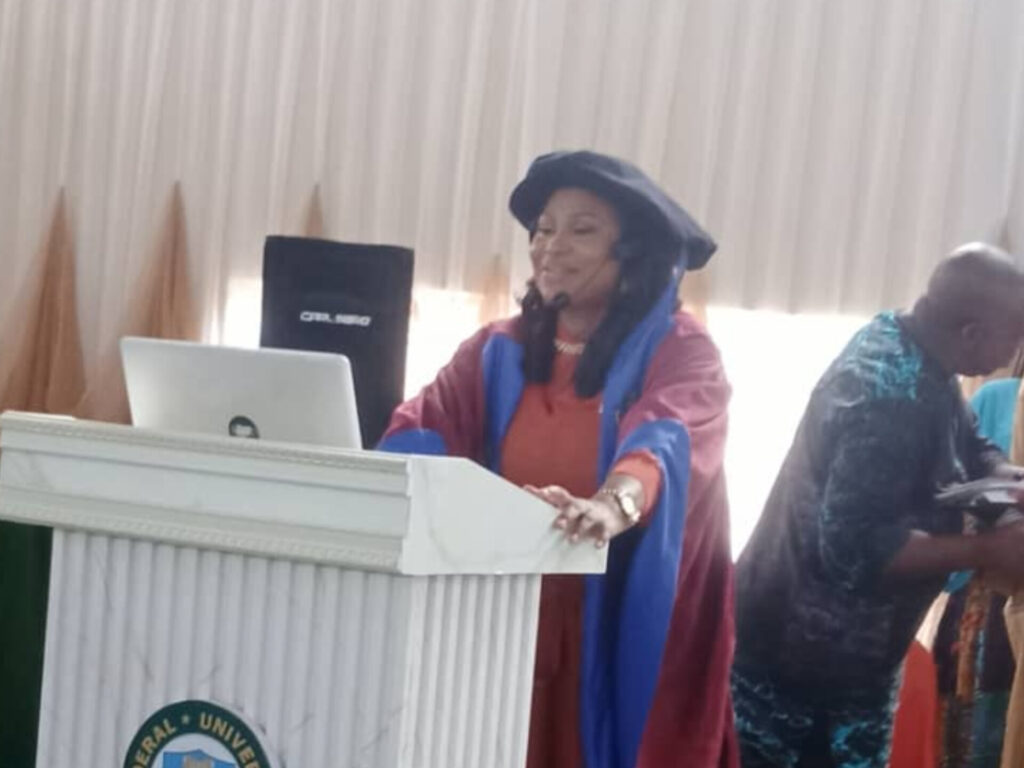
Professor Juliet Bodise-ere Teibowei has warned that Nigeria’s growing social and economic instability is pushing more citizens into mental health crises, with only a fraction receiving treatment.
Speaking on Saturday during the 32nd Inaugural Lecture of Federal University Otuoke, she said: “The more unstable Nigeria is, the more unstable the mental health of the citizens will become.
Teibowei, a Professor of Guidance and Counselling and Dean of Student Affairs, said that Professional assistance is needed to cater for those suffering from mental disorders.
Delivering her lecture titled “Many Are Mad, But Few Are Roaming: The Counselling Psychologist To The Rescue”, Professor Teibowei said Nigerians are constantly exposed to traumatic experiences that “clash with their mental health.”
She listed anxiety, inflation, unemployment, insecurity, kidnapping, banditry, herder attacks, financial stress, and hopelessness as key stressors.
These pressures, she explained, cause otherwise normal people to overreact to minor provocations, leading to conflicts, especially in workplaces.
Tracing the roots of mental health challenges to the biblical account of the fall of man in Genesis 3, she described mental health as “social capital.” “Without it, people are bankrupt,” she told the audience.
Using the World Health Organisation’s definition, she described mental health as a state of well-being in which individuals realise their abilities, cope with normal life stresses, work productively, and contribute to their community.
Professor Teibowei drew a distinction between visible and hidden mental illness. “Many have not lost touch with reality but are facing mental health issues. Only a few are seen and known as mad, while the roaming few have lost touch with reality,” she said.
She said that ” Nigeria has only 10 functional neuropsychiatric hospitals and about 250 practising psychiatrists for a population exceeding 200 million. Out of an estimated 60 million Nigerians with mental disorders, 1 in 4 suffers mainly from depression, anxiety, and substance abuse. Yet, WHO data shows less than 10% get treated due to stigma, scarce resources, few professionals, and cultural beliefs.
Professor Teibowei advocated for counselling psychologists to “intervene and rescue society from the silent and widespread challenge.”
She urged federal, state, and local governments to establish functional counselling units and mental health facilities nationwide.
She also called on employers, healthcare providers, and the government to collaborate in integrating mental healthcare into primary healthcare and increasing funding for accessibility.
The professor disclosed that she has 75 publications in national and international journals and books, adding that she developed the BJT Mental Healthcare Counselling Support Model, which integrates emotional, practical, informational, and social resources to promote recovery. The model has proven effective for depression, anxiety, and bipolar disorder.
The future research she stated will focus on life-course prevention from childhood to old age, community-based models, digital tools, stigma reduction, and resilience building across Nigeria and beyond.
Professor Teibowei thanked God and the Vice Chancellor for the opportunity to deliver the lecture barely six months after her promotion to professor.
In his remarks, FUO Vice Chancellor Prof. Promise Mebine called for “proper examination of mental disorder in all the schools in Nigeria” to safeguard students’ well-being.
He noted that “everyone exhibits one form of momentary mental disorder or the other” and appealed for Bayelsa State government intervention to develop the university.
He also pointed to potholes on campus where “future leaders of the country are undergoing educational training.”
Speaking to journalists, Bayelsa State Commissioner for Works and Infrastructure, Estate Surveyor Moses Teibowei, husband to the lecturer, described the topic as “very apt and interesting” and commended the university management for the opportunity given to his wife.








