

- ‘Muscling of opposition by ruling party not good for democracy’
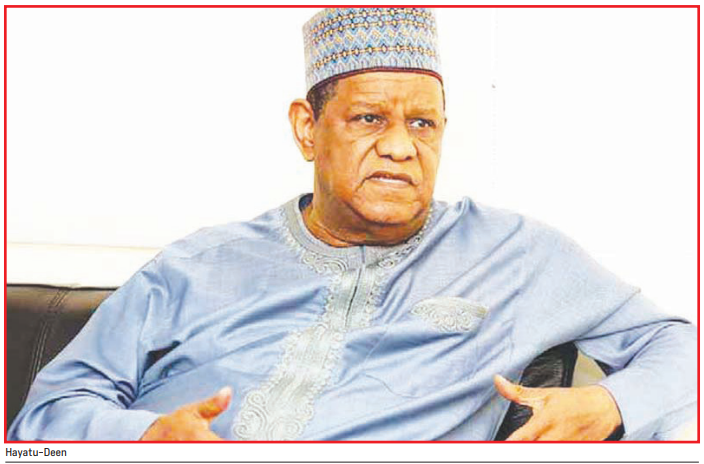
Mohammed Hayatu-Deen is a presidential aspirant under the platform of the African Democratic Congress (ADC). In this interview, he speaks on his agenda to rebuild Nigeria’s economy and its security architecture, and why he wants to be president among other issues, ANAYO EZUGWU reports
You are from Borno State, what is your reaction to the harrowing story of more kidnapping and killings in the state?
I am completely devastated because this has been going on for far too long. There’s so much carnage and bloodshed. And I have a personal story to tell in the sense that my sister was actually kidnapped some years back, taken to Sambisa forest but she was able to escape after two and half years in captivity.
She is a very brave and courageous young lady but that indelible mark still lives with her family. I have a number of other relations and associates who have been killed by Boko Haram. So, it’s something that I can relate to personally.
But I think we need to take a deep breath and get some background. First and foremost, right from the 1990s, we saw signs of this coming in the sense that governance has been a very big problem. So, there are lots of ungoverned spaces. Secondly, the number of those who are creeping into the poverty bucket has been increasing very rapidly.
Approximately 105 million Nigerians are living below the poverty line. And this is what will shock you in the sense that approximately 90 per cent of those who are poor actually live in the northern part of the country.
So, only 10 per cent to 12 per cent reside in the South. But more importantly, when you look at education, you look at health, you look at other social services, you look at employment numbers, the North-East and North-West are far way behind the North Central and the southern part of Nigeria.
So, essentially what has happened is that there are children who are not in their homes, who are not in schools, who are not in employment. They become cannon folder. If you recall, with the fall of Muammar Gaddafi, weapons found themselves into the Sahel region. Very importantly, Lake Chad has received 30 million people between Nigeria, Cameroon, Niger and Chad. And that water table has shrunk by over 95 per cent.
So, people are in very deep trouble and because of that, unemployed people who are working on the streets find it very easy to take on light weapons and fend for themselves. In the process, they actually get completely intoxicated. Human life doesn’t mean anything to them and they go on carnage.
We thought, or I thought, that the Federal Government of Nigeria should have put this on the front burner as something that the president of the country, when he wakes up in the morning, that’s the first kind of data he should look at. When he goes to bed at night, he should spend time thinking about people who are dying, who are getting poorer.
So, that’s more or less the backdrop, but most importantly, when this administration came into office, remember, before the President appointed his ministers, he went to West Africa and consequently imploded a course.
The country today is actually facing an existential threat and you need a very sound person with a very sound record of management of businesses and the economy to actually come and fix this place that is broken
We had the multinational joint task force made up of about four or five countries in West Africa that is supposed to look after security within the region. While they were there, things had worked. Under the Muhammadu Buhari administration, the thing had rolled back. But since that unfortunate decision was taken by the current administration, all the flanks have been wide open. More importantly, if you recall, last year’s budget for the military, only seven per cent of it was actually given to them. So, there are lots of issues concerning intelligence and governance in all of this.
Historically speaking, this country has had more northern leaders than any other part of Nigeria. Why wasn’t the North on the front burner all these years?
Well, two things. One, I do not agree with that premise, simply because the President is only one man. We are dealing with the government. Second of all, there is a time element to this. In 2008, when my daughter got married, there was absolutely no sign of Boko Haram anywhere on the horizon, and this actually happened on the watch of the civilian government in Nigeria. It was building up. And thirdly, the states have a huge responsibility in terms of governing their states very well. That could be partially true, but it’s not completely true in the sense that the poverty is not a static number, it’s dynamic. It has multiplied manifold over the last 25 years. Before then, I think the region was fairly stable. We haven’t seen anything like this. I could go to Maiduguri and sleep in my home with my doors and windows wide open and not have a problem,. So I think we need to put this in context properly.
Why did you choose ADC and why now?
The thing is that the current government has virtually snuffed out the opposition completely. I’m not an interloper. I was in the Peoples Democratic Party (PDP); I’m a loyal and engaging partner of the PDP. But within the last two or three years, I’ve seen the slow undoing of the PDP. And what is left is actually virtually a hollow shell, as far as I can see. It doesn’t mean it cannot be rebuilt in another time. The New Nigeria Peoples Party (NNPP) has been devastated, so also has Labour Party. There are all kinds of crises going on within the parties. And we can see an invisible hand that is actually wading into these conversations and creating a lot of crises. Many of the people in the ADC came from some of these parties.
They are respectable politicians who are experienced. Many of them have been governors for two terms. One of them has been the vice president of this country, people of deep-seated experience.
And most importantly, we also have a very unusual person in the name of Senator David Mark, a calm, cool and rational person with a great deal of experience and a great deal of intellect who is leading the party. Rauf Aregbesola is a man of timber and calibre, or as you call it, caterpillar and juggernaut. He is there as the secretary of the party, enforcing party discipline.
There are others within the party like Liyel Imoke, all of whom have been able to build a fairly robust and resilient vehicle that is quite capable of fighting the next election.
And the numbers clearly show it that the registration within the party is actually expanding in leaps and bounds, despite the fact that the government and the Independent National Electoral Commission (INEC) are doing everything possible to put obstacles on our way.
And let me mention one point, which I think is crucial. As a loyal party member who was deeply engaged, I never thought that the convention would happen because all kinds of obstacles were put on our way. Five or six or seven hotels returned our money. It speaks to the determination and sheer grit of the leadership of the party that it was able to hold that convention successfully despite all of this.
I can only relate to someone who has committed a major state crime that can be subjected to that kind of hardship. We held that convention in an oven. Literally, in a very small place, where we cramped ourselves and said, we must do it and with the timetable actually working against us. I have never seen anything like this in my entire life and it’s not good for this country.
Do you have the political machinery and grassroots connection to compete and win votes in communities dealing with daily survival?
I’ve been in politics all my life. Let me tell you; the secondary schools I went to, the universities I went to, were nationally known. It was a mini United Nations. So, I’ve been able to form relationships with all men drawn from all of the states of the federation.
More importantly, when I went to New Nigeria Development Company [NNDC] and grew through the ranks to become the group chief executive of a major conglomerate, which is the single largest diversified holding company south of the Sahara, with a portfolio of 145 companies, I had to manage huge complexities and many layers of complexity and scope and magnitude.
Remember also that NNDC itself was a public institution empowered to operate based on private sector principles as an investment institution. My governors were the 14 northern state governors at that time. And talking about politics, my goodness, that’s where politics begins.
So, I think I’ve acquired the experience and the network of relations. But more importantly, I’ve also been able to jump on the curve since the 2022-2023 cycle and rapidly understood and assimilated what the Nigerian political terrain is all about. I mean, nobody goes to school to become a politician. You actually acquire it in the course of your experience. So, I’m amply qualified to be president.
You are facing a different type of politics in the ADC, in a field that may include figures like Peter Obi, Atiku Abubakar, Rabiu Kwankwaso, Rotimi Amaechi, perhaps even Aminu Tambawal and Nasir El-Rufai. What makes you a serious contender rather than an outside voice?
It’s not an outside voice. What I’m bringing is deepseated experience. I haven’t held elected office but I can also argue sensibly that all my life, from 1984 when I was a young man, I had one leg in government, one leg in the private sector, on my nine to five job. And remember that I have contributed enormously to the development and growth of this country in the public arena.
I’ve been adviser to three presidential administrations. I’ve been chairman of the privatization committee with the BPE. I’ve held a number of other positions. I was a founding member of the Nigerian Economic Summit Group. But for us, this country would not have made this kind of giant stride forward.
So, we have mixed and mingled with everybody within the Nigerian ecosystem. So, it may not be completely right or correct to say that I’m in a position of complete disadvantage. But on the contrary, the country today is actually facing an existential threat and you need a very sound person with a very sound record of management of businesses and the economy to actually come and fix this place that is broken.
You said you want to rebuild Nigeria’s economy. What is the first painful decision you would take in your first 100 days, assuming you become president of Nigeria?
Essentially, I think there are two things that are intertwined. One is the issue of national security. A lot of people make the mistake and tend to deal with it in isolation but it’s actually related to the economy.
It’s the pains in the economy and the ravaging poverty in the land and the lack of empowerment, lack of jobs that is actually giving rise to this huge tendency towards insecurity. Two, in terms of what I would do, I would like to put national security on the same pedestal as the economy.
And I would like to do exactly what could have happened or what happened in 1995- 96, when we did the Vision 2010 programme. I was a key member of that programme and we were able to draw up a very clear and robust vision for the country in terms of where Nigeria should be as a prosperous and globally competitive economy by the year 2015 at that time.
I would assemble experts and stakeholders from all shades of life put them in the room as a matter of great urgency in order to deal with these twin problems of the economy and national security. That’s my very first action in office.
Do you have a political base or are you relying on your ideas alone to carry you?
I do have a political base, and I’ve developed it and nurtured it over time across the length and breadth of this country. And I’ve run a poll, by the way, an international poll and a domestic poll, and the numbers clearly suggest that Nigerians are aching very badly to see this kind of face with a kind of background that can actually serve the long-term interests of this country.
People have to wonder about what really is motivating you to want to be president, whether it is about national service or unfinished personal ambition?
I have a consuming passion for this country. It’s been burning inside me from childhood. I’m a student of development economics and therefore, what happens to this economy and the society at large is very important to me. And I have no other reason other than to actually rescue my country from the abuse.
The ADC is still consolidating. If you fail to secure the ticket, will you stay and build or move on once more?
I mentioned to you before that I’m not an interloper. That’s why it took me so long to actually leave the PDP and join the ADC. I would have joined since last year but I was studying the trends carefully and noticed that it was a sinking ship.
That’s why I moved. Thirdly, I respect the party leadership tremendously. But for this party leadership in particular, I would not have joined, to be honest with you.
I trust them totally and completely to do the right thing. I’m willing to abide by any decision that the party leadership takes in terms of who they want to be the presidential candidate. It is not for me here to sit down and tell you I prefer consensus or I prefer direct primary. That’s not for me. That’s something that should actually happen in the private chambers.
The government did not give anybody enough time to actually go on that route of the primaries. It’s a very complex undertaking. The direct primary is almost identical to running a general election. Nobody, in my humble opinion, amongst the candidates across the parties, has had some breathing space to actually even organize and begin to travel. Have you seen anybody campaigning around the country?
No. It’s difficult. We are put on a tight leash, which is very unfortunate. And that’s actually one of the major motivating factors in making my decision to actually enter the ADC because we have to get our country back.
This is a time even you will admit that Nigerians are losing faith in both politicians and technocrats. Can you tell Nigerian people how you can restore that trust?
First of all, I’ll run a good government. Second, there is nothing in my antecedents or my record that will remotely suggest that I do not take my assignments and my duties as a citizen and a compatriot seriously.
I take it very seriously. It still doesn’t matter because you can negotiate around the margins, but there are certain core principles that are actually very fundamental to you and the fundamentals to Nigerian people because you are going to run on a platform which you will sell to Nigerian people.
And you had better keep that promise. This country is heading for trouble unless politicians actually pull up their socks and do what is right by the people. I’m beginning to see signs of a class struggle and we’re running out of oxygen.