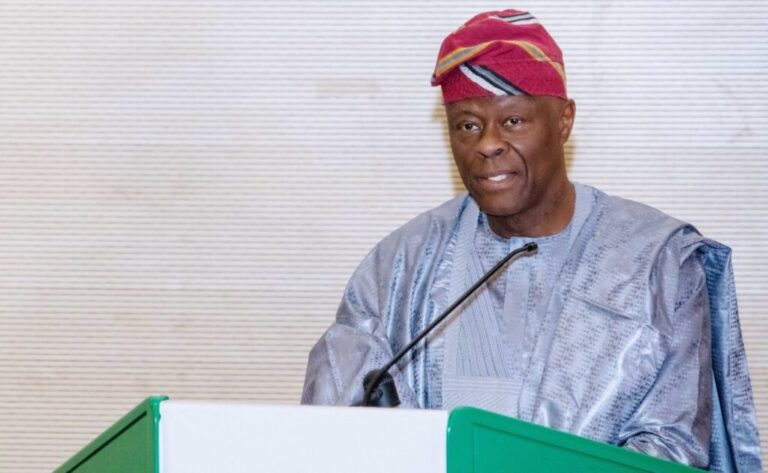

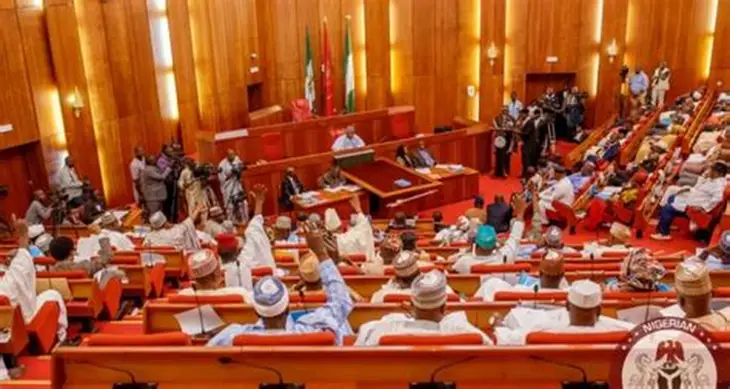
The Chairman of the Senate Committee on Aviation, Senator Abdulfatai Buhari, has described Nigeria’s aviation industry as “very dirty,” alleging deep-seated irregularities that, according to him, cannot be publicly disclosed.
Buhari made the remarks on Thursday while speaking at the 59th anniversary of the National Association of Nigerian Travel Agencies, held alongside its Conference, Annual General Meeting, and Exhibition in Ibadan, Oyo State.
The lawmaker, who has spent about 16 years on the aviation committee in the National Assembly, said his long-standing exposure to the sector has revealed troubling practices.
He further explained that his comments were informed by years of legislative oversight and insider knowledge of the industry, noting that his experience spans about 16 years on the aviation committee, including his current role as chairman.
Buhari, whose declaration drew murmurs from participants at the event, said, “A lot of the things I have seen can’t be said in public; it’s dirty, it is very dirty.
“I have been in the Senate for three years, and each time I have been there, I have been a member of the aviation committee, and now I am the chairman of the committee.”
Buhari’s remarks came in response to earlier submissions by the International Air Transport Association Area Manager for West and Central Africa, Samson Fatoki, who had called for legislative protection for the aviation sector.
Fatoki had lamented that the aviation industry in Nigeria is not as profitable as widely perceived, urging policymakers to create a more supportive regulatory environment.
However, Buhari countered with a sharp critique of industry practices, accusing some international airlines of exploiting Nigerian passengers through dollar-only payment methods for tickets.
“Look at some of the airlines, even though some of you won’t mention names, I’m a legislator, and I will mention names. Look at Emirates, United Airlines, Delta, and I think one more, they charge in dollars to exploit Nigerians. NANTA should write to the National Assembly to say, if other airlines are charging in Nigeria, the mentioned ones too should charge in naira,” Buhari stated.
He argued that the practice of pricing tickets in foreign currency is a major factor driving the high cost of air travel in the country. “This is the reason ticket prices are shooting up, but you never write because you, too, are making your percentage.”
The senator urged stakeholders across the aviation value chain to prioritise national interest and work collaboratively to address systemic challenges. “Let’s try as much as possible to help this country. We in the aviation industry, let’s help this country, and the only way is to collaborate and get ready,” he said.
Earlier, Fatoki noted that for the airlines’ $2.5bn contribution, representing about 0.7 per cent of Nigeria’s Gross Domestic Product, to be sustained and improved, the National Assembly must take more deliberate steps to support the sector.
According to him, the ongoing crisis in the Middle East, driven by tensions involving Israel, the United States, and Iran, has already distorted the aviation industry’s 2026 global projections, stressing that airlines require stronger government backing to maintain seamless operations.
Fatoki explained that structural cost pressures continue to weigh heavily on African carriers, particularly in the area of aviation fuel and other operational expenses across the continent.
He further pointed out that air navigation charges in Africa are about 10 per cent higher than global averages, while airlines also pay between six and 10 per cent more for aircraft maintenance, insurance, and cost of capital.
He stressed, “For instance, Jet A1 price in Africa is about 17 per cent higher than anywhere else in the world, while taxes and charges on the continent are between 12 and 15 per cent higher than the rest of the globe.
“Besides, as of today, African governments still hold back $954m of blocked funds. All these factors contribute to higher air ticket prices in Africa compared to the rest of the world.”
He therefore urged lawmakers to take urgent action, saying, “The National Assembly should take this up with the Nigerian Federal Government. We need to protect our carriers in Nigeria. The airlines are operating with a very thin profit margin.”