



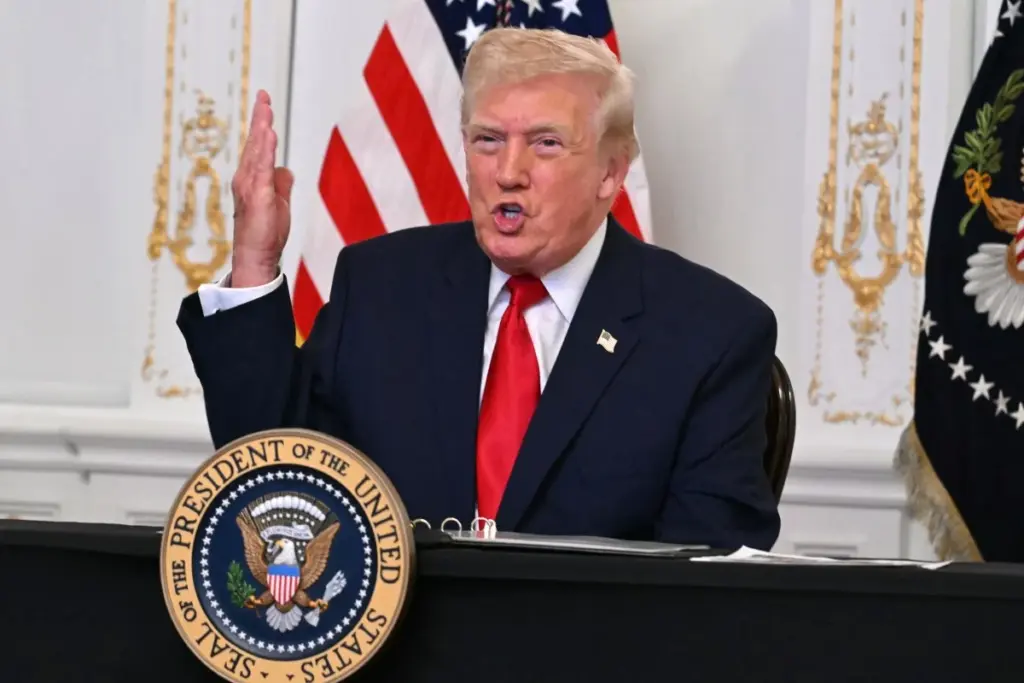
US President Donald Trump warned yesterday that all of Iran could be “taken out” today at the expiry of a deadline he issued for the Islamic republic to reopen the key Strait of Hormuz waterway. “The entire country could be taken out in one night, and that night might be tomorrow night,” Trump told a news conference at the White House yesterday.
Flanked by US Defence Secretary, Pete Hegseth, CIA Director, John Ratcliffe and Chairman of the Joint Chiefs of Staff Dan Caine, Trump said that he’s “not at all” concerned about committing possible war crimes and refused to say whether any civilian targets would be off-limits. The president described the consequences that Iran would face if it doesn’t US President Donald Trump warned yesterday that all of Iran could be “taken out” today at the expiry of a deadline he issued for the Islamic republic to reopen the key Strait of Hormuz waterway.
“The entire country could be taken out in one night, and that night might be tomorrow night,” Trump told a news conference at the White House yesterday. Flanked by US Defence Secretary, Pete Hegseth, CIA Director, John Ratcliffe and Chairman of the Joinreach a deal with the US by Trump’s 8 p.m. today deadline. “We have a plan, because of the power of our military, where every bridge in Iran will be decimated by 12 o’clock tomorrow night,” Trump said during the news conference.
Power plants in Iran, he continued, would be “burning, exploding and never to be used again.” Trump also continued to grumble about NATO allies’ refusal to get involved in re-opening the Strait of Hormuz and their hesitance to assist US offensive operations against Iran. But as he wrapped up his lengthy news conference yesterday, he also fumed about the lack of support from Pacific allies.
“You know who else didn’t help us? South Korea didn’t help us,” Trump said. “You know who else didn’t help us? Australia didn’t help us. You know who else didn’t help us? Japan. We’ve got 50,000 soldiers in Japan to protect them from North Korea.
We have 45,000 soldiers in South Korea to protect us from Kim Jong Un, who I get along with very well.” Earlier, Iran said it had rejected a 45-day ceasefire proposal and said it wants a permanent end to the war. Iran’s state-run IRNA news agency said Tehran conveyed its response through Pakistan, a key mediator.
“We only accept an end of the war with guarantees that we won’t be attacked again,” Mojtaba Ferdousi Pour, head of the Iranian diplomatic mission in Cairo, told the AP yesterday. Israeli Defence Minister, Israel Katz, said yesterday that Israel attacked the South Pars petrochemical plant at Asaluyeh in Iran. He made the announcement after Iran said the facility had been attacked. An Israeli attack on South Pars facilities in March sparked major Iranian attacks targeting oil and gas infrastructure across the Gulf Arab states.
And in another development, Iran has confirmed that the head of intelligence for the country’s paramilitary Revolutionary Guard (IRGC), Maj. Gen. Majid Khademi, has been killed. Israel claimed it was respont Chiefs of Staff Dan Caine, Trump said that he’s “not at all” concerned about committing possible war crimes and refused to say whether any civilian targets would be off-limits. The president described the consequences that Iran would face if it doesn’t sible for the killing yesterday. Israel’s military said it also killed the leader of the IRGC’s undercover unit in its expeditionary Quds Force, Asghar Bakeri.
Also yesterday, Israel and the United States carried out a wave of attacks on Iran, killing more than 25 people. Iran responded with missile fire on Israel and its Gulf Arab neighbours. Iranian missiles hit the northern Israeli city of Haifa, where four people were found dead in the rubble of a residential building. Kuwait, the United Arab Emirates and Saudi Arabia all activated their air defences to intercept incoming Iranian missiles and drones, as Tehran kept up the pressure on its Gulf neighbours.
Iran’s regular attacks on regional energy infrastructure and its stranglehold on the Strait of Hormuz, through which a fifth of the world’s oil is shipped in peacetime, has sent global energy prices soaring. In an effort to stop the fighting, Egyptian, Pakistani and Turkish mediators have sent Iran and the US a proposal calling for a 45-day ceasefire and the reopening of the Strait of Hormuz to give time to try and find a way to end the war, two Mideast officials have told The Associated Press.
European Council President António Costa called for diplomacy to be given a chance, writing on X that “any targeting of civilian infrastructure, namely energy facilities, is illegal and unacceptable.” “Escalation will not achieve a ceasefire and peace,” he said. “Only negotiations will, namely the ongoing efforts led by regional partners.”
War’s death toll in the thousands More than 1,900 people have been killed in Iran since the war began, but its government has not updated the toll for days. More than 1,400 people have been killed in Lebanon and more than 1 million people have been displaced.
Eleven Israeli soldiers have died there while targeting Iranian-backed Hezbollah militants. In Gulf Arab states and the occupied West Bank, more than two dozen people have died, while 23 have been reported dead in Israel and 13 US service members have been killed.








