



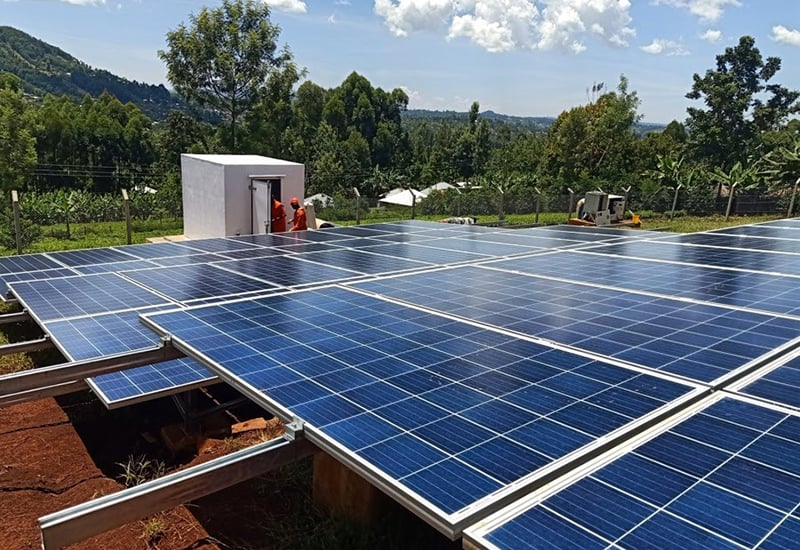
Nigeria’s worsening electricity supply challenges have continued to drive a surge in solar energy adoption, with fresh data showing that the country imported 2.9 million solar panels worth over N435bn in 2025.
The figure also places solar panels among Nigeria’s top imported commodities, even as the Federal Government intensifies efforts to boost local production, according to the latest Foreign Trade Statistics from the National Bureau of Statistics, obtained by The PUNCH on Sunday.
It indicated that solar panel imports remained significant across all four quarters of the year, underscoring a growing shift by households and businesses toward alternative power sources amid persistent blackouts.
A breakdown of the data showed that photovoltaic cells assembled in modules or made up into panels valued at N125.29bn were imported in the first quarter, N117.39bn in the second quarter, N92.00bn in the third quarter, and N100.83bn in the fourth quarter.
Imports declined by 6.3 per cent from N125.29bn in the first quarter to N117.39bn in the second quarter, indicating an early slowdown in demand or possible inventory adjustments. The drop became steeper in the third quarter, falling by 21.6 per cent from N117.39bn in Q2 to N92.00bn, marking the sharpest contraction within the year.
However, the trend reversed in the fourth quarter, as imports rose by 9.6 per cent to N100.83bn, suggesting renewed demand, likely driven by worsening power supply and increased year-end installations.
Overall, the movement reflects a 26.6 per cent decline from the peak in Q1 to the lowest point in Q3, before a partial recovery in Q4. Cumulatively, this brings the total value of solar panel imports in 2025 to approximately N435.52bn.
Analysis of the import figures suggests that an estimated 2.9 million solar panels were brought into the country within the year, assuming an average cost of N150,000 per panel. This price is based on a market survey conducted by our correspondent.
Further analysis of the import data reveals that the estimated volume of solar panels imported into Nigeria in 2025 varies significantly depending on panel capacity and pricing.
At the high end, using an average cost of N150,000 per unit for large panels (400W–600W+), the total import value of N435.52bn translates to about 2.9 million units imported within the year.
However, for smaller capacity panels, which are more affordable and widely used by low-income households, the volume is significantly higher. Based on a market average of about N25,000 per unit for small panels (10W–100W), the same import value suggests that as many as 17.4 million units may have entered the country.
Similarly, for medium-sized panels (150W–300W), which are commonly used by small businesses and residential users, an average price of N66,000 per unit indicates that approximately 6.6 million units were imported during the period.
The wide disparity in estimated volumes highlights the growing penetration of entry-level solar solutions in Nigeria, as households and micro-enterprises increasingly opt for cheaper, scalable alternatives to cushion the impact of persistent electricity shortages.
The Federal Government has recently intensified its campaign to reduce dependence on imported solar panels, maintaining that Nigeria now possesses the capacity to drive local manufacturing.
The Managing Director/CEO of the Rural Electrification Agency, Abba Aliyu, stated that Nigeria’s installed solar module manufacturing capacity had increased to 600 megawatts, up from 110 megawatts previously.
He listed key facilities, including a 100MW plant in Lagos, a 250MW facility in Abuja, and others in Idu and Port Harcourt, as part of the country’s localisation drive. According to him, over 50 renewable energy service companies are now active in Nigeria, compared to just about 10 a few years ago.
“We are changing the narrative,” Aliyu said. “Nigeria now has the capacity to produce solar panels locally and support the transition to clean energy.”
But the domestication drive is yet to yield desired results based on the latest figures.
The report further revealed that solar panels ranked among Nigeria’s top imported products throughout the year. In the first quarter, the product accounted for 0.81 per cent of total imports, ranking 11th. It dropped slightly to 0.77 per cent in the second quarter, placing 12th, and further declined to 0.57 per cent in the third quarter, ranking 13th.
China remained the dominant source of solar panel imports into Nigeria. In the second quarter alone, imports from China were valued at N88.60bn, followed by N75.34bn in the third quarter, while the fourth quarter recorded imports worth N100.83bn from the Asian country.
The PUNCH reports that the steady influx of solar panels reflects growing frustration with the country’s unreliable grid electricity, which has been plagued by frequent system collapses, load shedding, and inadequate generation capacity.
Nigeria has struggled with a persistent power deficit, with generation often hovering below 5,000 megawatts for a population of over 200 million people. This has forced many homes and businesses to rely on alternative energy sources, including generators and, increasingly, solar power systems.
This is further compounded by a series of widespread blackouts in recent weeks, mainly caused by repeated collapses of the national grid and persistent weaknesses across the power value chain. These outages have led to sharp drops in electricity supply nationwide, disrupting homes, businesses, and critical services, and further exposing the fragility of the country’s transmission and generation systems.
Amid growing public frustration, the Minister of Power, Adebayo Adelabu, recently apologised to Nigerians for the persistent outages, describing the situation as regrettable.
He attributed the blackouts to a combination of factors, including grid instability, gas supply constraints, and infrastructure challenges, while assuring that the government is taking steps to stabilise power supply and improve overall performance in the sector.
Adelabu said, “I want to apologise to Nigerians, officially now, coming from me as the Minister of Power, for this temporary issue that is leading to hardship being experienced, especially during this dry season, where there is so much heat everywhere.”
The rising cost of diesel and petrol in recent days has also made solar energy more attractive, particularly for small businesses seeking to cut operating expenses.
While the increasing adoption of solar solutions is a positive development for the clean energy transition, it also highlights deeper structural issues in the power sector that require urgent government intervention.
They argue that without significant investment in grid infrastructure, transmission capacity, and gas supply to power plants, the country may continue to witness a steady migration of consumers away from the national grid.
The surge in solar imports, therefore, not only signals a shift in consumer preference but also reflects a broader vote of no confidence in the reliability of Nigeria’s electricity supply system.