
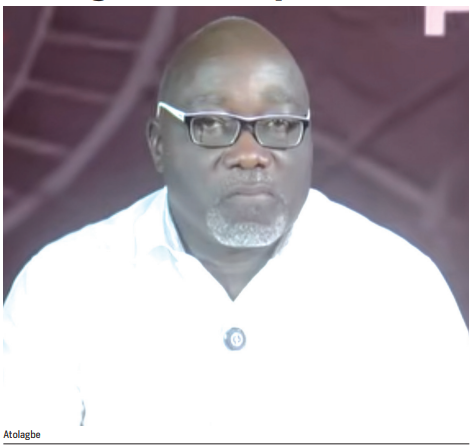
Major General Anthony Atolagbe (rtd) is a former field commander of the Special Task Force, Operation Safe Haven. In this interview, he speaks on how insecurity is now shaping nearly every aspect of Nigeria’s national life, from economic activity and education to politics and public confidence in government, among other issues, ANAYO EZUGWU reports
When you say expand military presence and stronger border control to restore safety, especially in vulnerable communities and unmanned spaces, some would say, what do you even mean?
If I’m to start this from my own perspective, I am aware that there are policy directives emanating from higher or superior offices within the federation, and these directives are supposed to be broken into implementation strategies.
So, when it comes to strategies, you now come and start bringing down to operational directives which go to military commanders, police commanders, and so on. So, you will recall that there have been several policies put in place in the area of generating more troops, training of forest guards, as well as the expansion of the police force on the ground.
And then you talk about also relieving them of the duties that they are doing in the area of doing escorts and so on. So, from the perspective of who is giving the directive that is perhaps from the president’s office, he’s aware that there are going to be more hands that are going to be generated. I’ll give you an example of what the army is doing. For instance, before now, we used to have just one training depot in Nigeria, and that’s still in Zaria. But as I speak, two additional training areas have been added.
Is that additional training depot enough?
It depends on the number of troops that have been trained. We see them turning out about 6,000 from one depot in six months. So, you are looking at, if you put everything together, 18,000. And in one year, you are talking about 36,000. So, you see that some of these directives are also backed by the action that is actually expected of the various services and the security agencies that are carrying out these operations. So, you now see a situation where by the time this training is completed, more of the ungoverned spaces are going to be taken.
The forest guard is already there. They have spread them out into some areas already within the country. We don’t have to start mentioning the locations. And then you now also see a situation where, as it concerns the policing, because what is supposed to happen is that we graduate the battle space in such a way that there are threats that are beyond perhaps what the police can contain, that it’s not just the military that will be able to take on those areas.
And those are the kind of actions that you see taking place in Sambisa right now, in another location called Timbuktu Triangle. And this particular operation that is ongoing provides the avenue for clearance operations. In the process of the clearance operations, a lot of people, like I’m aware that just in the last one week, about six locations have been cleared.
And I also know that about more than 23 strongholds of the Boko Haram elements are also cleared from some of those locations. We used to have a situation before, whereby we clear some places and then we keep moving forward without generally occupying these locations. By the time these troops are inserted now, any place that is cleared is also occupied. So, we now see a situation where, based on the graduation that I talked about, military will continue to move into the tougher spaces.
Then, the counter-terror police also move into perhaps the next level, maybe at level four, where military is at level five. And then you see at level three also, maybe a combined military and police or NSCDC working together. So, these are some of the conditions you start seeing on the ground as soon as these troops are being turned out.
When you paint this picture, it sounds so nice to the ears. But the Nigerian military has lost at least three commanding officers in charge of forward operation spaces at different locations within a seven-day period in Borno State. Nigerians are asking: If soldiers are not safe, who then is?
I think that is from the perspective of a civilian, because we are paid to do this job and anything could also happen. Imagine that without necessarily going into the front to go and confront someone, a bomb just drops at a location where the commanding officer is.
These are some conditions that present itself in such a manner that they are situations you cannot explain because they are just bound to happen. It is true that we have some losses, but still when you look at some of the gains also on the part of the military, you will be able to say, okay, I can consolidate and see how I can do better in some of these situations.
Say for instance, in the last two months, the deputy commander of the Boko Haram was taken out and then there are two other prominent commanders who were also taken out.
So, we now see a situation where, although I will not rule out that there will be some errors, but then you look at a situation where, if you look at a battalion deployment for instance, there could be a situation where, look, we are going on an operation and perhaps you can, we say that the enemies are as trained as ourselves.
You now see a situation where some of these people; we have seen where some of them are trained and where they are coming from to the extent that they know how to conduct ambushes and the rest of them. So, because as you mentioned in the case of the general, those are the type of conditions that are played out. If we start counting as it pertains to casualties, you will see that we may not be able to put the figures together completely.
Because I’m aware that in this clearance operation that is actually ongoing, more than 50 militants or militiamen have been eliminated, bodies recovered. And we are talking about a situation where you are actually going in pursuit of these Boko Haram elements and ISWAP, and then you keep taking them out, and perhaps you are not even able to get all the bodies at the same time. So, you have a situation where the troops are actually gaining ground, the terrorists are being dislodged.
They are moving into other locations, and you now see a situation where even those that are not being reached out to right now are panicking. I will still tell you that there are other areas. You have a place they call Mandarin Mountains. So, that kind of place is actually dominated by some of them. Several efforts have been made to dislodge them, but because of the nature of the terrain around the area, it has been difficult.
Security experts have said that the long term will be to defeat banditry, Boko Haram and terrorism by establishing state police. What do you make of that combination?
Well, from the very last question before this one, which has to do with the involvement of the community people, the experience on the field has been that due to several threats that the people have encountered in the past, they are so scared of voluntary information because they look at a situation where they could be sleeping at night and somebody just bumps into them. So, it’s not as if they are not prepared.
The military has a mechanism which actually makes them to have some interactions with the civilians. We do something we call the quick impact projects, which actually warms the military into the hearts of the populace when they move into a new location.
So, you now see a situation whereby, to some extent, they get some grants with the populace. But because of some of the activities of these guys who loiter or just bump into them, either through ambushes or walk into the village sometimes and take them out, these are some of the things that actually prevent them from voluntary information. Talking about long term, I mean, we are all within the hard space now but we have a president making it point clear about state police.
And I keep saying something; that over the years, a lot of our leaders have failed to take this step. And for the fear that perhaps if you make it possible, then they will be arresting opposition or they will be doing something contrary to what the federal police will be doing. When we look at trends or how it is done in other countries, we can just go and study and borrow from the way some of these things are done and exercise your necessary fear and not actually do what we need to do to make sure that people are secured.
You can bet me that with the number of people that are going to be recruited now, based on perhaps the projections by the security elements within the various states, you now see a situation where this is going to actually help us to cover a lot of open spaces within the communities. And then we will now be able to say, okay, if we’re able to have this level of foot on the ground in the various communities, and these are people that are going to be recruited within the communities anyway.
And then they know the people. They know who to interact with. They are relating with the traditional rulers. They are relating with all the religious leaders and so on. Those who are in authority within the communities, they are able to relate with them. And then we will now see a situation where timely information is gotten and then this information is also shared perhaps with the higher level.








