
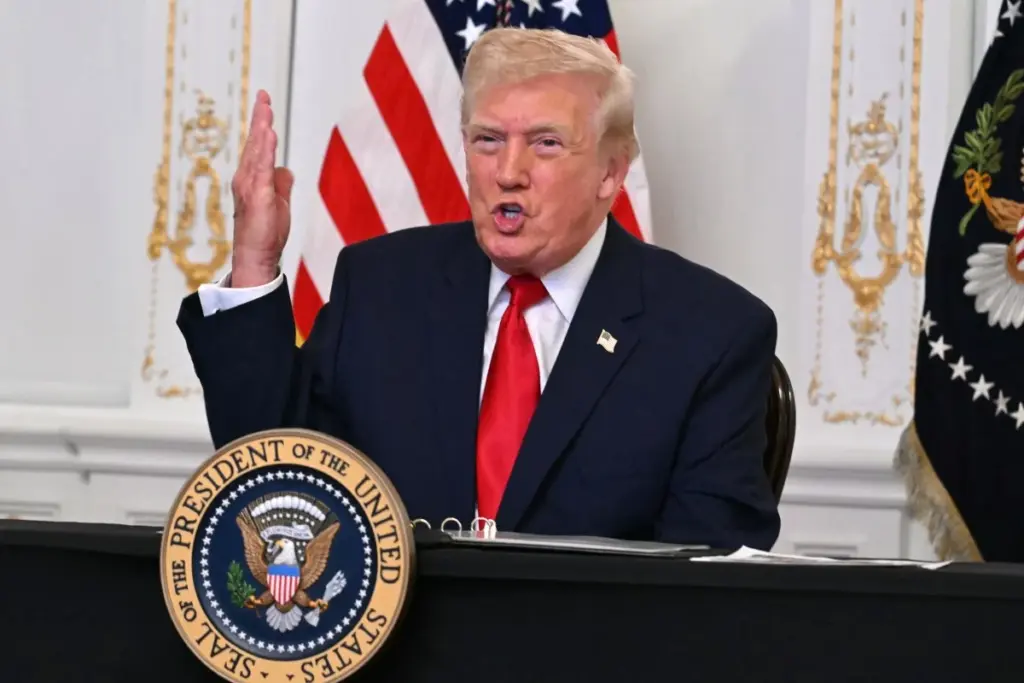
Clearly exasperated by the lukewarm attitude of his western allies to the US/Israel attack on Iran, President Donald Trump said yesterday that US forces “no longer need” military help in the Iran war, after his calls for assistance from allies to reopen the Strait of Hormuz to oil traffic were largely rebuffed.
The American president has spent recent days griping about how world powers have so far declined to send warships to escort tankers through the narrow waterway in and out of the Gulf and key to the transit of crude.
“The United States has been informed by most of our NATO ‘Allies’ that they don’t want to get involved with our Military Operation against the Terrorist Regime of Iran, in the Middle East,” Trump posted on his Truth Social platform. “Because of the fact that we have had such Military Success, we no longer ‘need,’ or desire, the NATO Countries’ assistance — WE NEVER DID! Likewise, Japan, Australia, or South Korea,” Trump said, adding: “WE DO NOT NEED THE HELP OF ANYONE!”
His comments came on the day Israel’s defence minister said its military had killed two senior Iranian security officials while Iran hit the US embassy in Baghdad, Iraq with a drone yesterday. Both security chief, Ali Larijani, and the head of the Revolutionary Guard’s Basij militia were killed in overnight strikes in a blow to the country’s leadership. Both security officials Ali Larijani and Gen. Gholam Reza Soleimani were “eliminated last night,” Israeli Defence Minister Israel Katz said in a statement adding that he and the prime minister had instructed the military to “continue hunting down” Iran’s leadership.
Iran’s 86-year-old Supreme Leader Ayatollah Ali Khamenei died in an airstrike on February 28, the first day of the war launched by the United States and Israel, and other top leaders from the Iranian theocracy have been killed since then, reports The Associated Press. Israeli media are reporting that Ali Larijani was attacked with his son in a hideout apartment.
The announcement came after the Israeli military had earlier said it had carried out a “wide-scale wave of strikes” across Iran’s capital and stepped up strikes on Iran-backed Hezbollah militants in Lebanon. Israel also reported two incoming salvos before dawn from Iran at Tel Aviv and elsewhere, and said Hezbollah targeted Israel’s north.
Incoming Iranian missiles on the United Arab Emirates prompted Dubai, a major transit hub for international travel, to briefly shut its airspace and a man was killed by the debris of a missile intercepted over Abu Dhabi. Iran also kept up the pressure on the energy infrastructure of its Gulf Arab neighbours, hitting an oil facility in Fujairah, a UAE emirate on the country’s east coast with the Gulf of Oman that has been repeatedly targeted. State-run WAM news reported that no one had been injured in the blast from the drone strike.
The man killed by falling debris from an intercepted missile was the eighth person to die in the UAE since the start of the war, authorities said. Iran’s attacks on Gulf nations and its grip on the Strait of Hormuz, through which a fifth of the world’s oil is transported, has given rise to increasing concerns of a global energy crisis.
Early yesterday it hit a tanker anchored off the coast of Fujairah, one of about 20 vessels hit since Israel and the United States started the war with an attack on Iran on February 28. Iran’s parliamentary speaker, Mohammad Bagher Qalibaf, said his country had been given no choice but to keep up its pressure on shipping traffic in the strait. “They are flying, launching missiles, should we just sit back and do nothing in response?” he said in an interview on state television.
With Washington under increasing pressure over rising oil prices, Brent crude, the international standard, remained over $100 a barrel, up more than 40% since the war started. The attack on the US embassy in Baghdad is described as “the most intense assault” since the war broke out while European leaders condemn the escalating conflict between Israel and Hezbollah.
A separate strike targeted a house in the heavily fortified Presidential Compound in Baghdad’s al-Jadriya area, the officials said. It wasn’t clear who carried out either attack but Iran-allied militias have regularly been attacking American targets inside Iraq since the conflict began.
Leaders of the UK, Canada, France, Germany and Italy have issued a joint statement, saying a significant Israeli ground offensive in Lebanon would have “devastating humanitarian consequences” Meanwhile, the United Arab Emirates reopens its airspace after missile and drone threats from Iran forced it to close briefly. British Airways says it is suspending some flights to the Middle East until the end of May “due to the continuing uncertainty of the situation”.
In Qatar, the sounds of explosions boomed over the capital early in the day as defences worked to intercept incoming fire. Qatar’s Defence Ministry said later that it had successfully thwarted a missile attack on the city, though a fire broke out in an industrial area from a downed projectile. More than 1,300 people have been killed in Iran since the start of the conflict, according to the Iranian Red Crescent.
Israel’s strikes have also displaced more than 1 million Lebanese — or roughly 20% of the population — according to the Lebanese government, which says some 850 people have been killed. Israel reported two Iranian salvos early yesterday fired toward Tel Aviv and an area south of the Sea of Galilee. More launches from Lebanon were also reported. In Israel, 12 people have been killed by Iranian missile fire. At least 13 US military members have been killed.








