


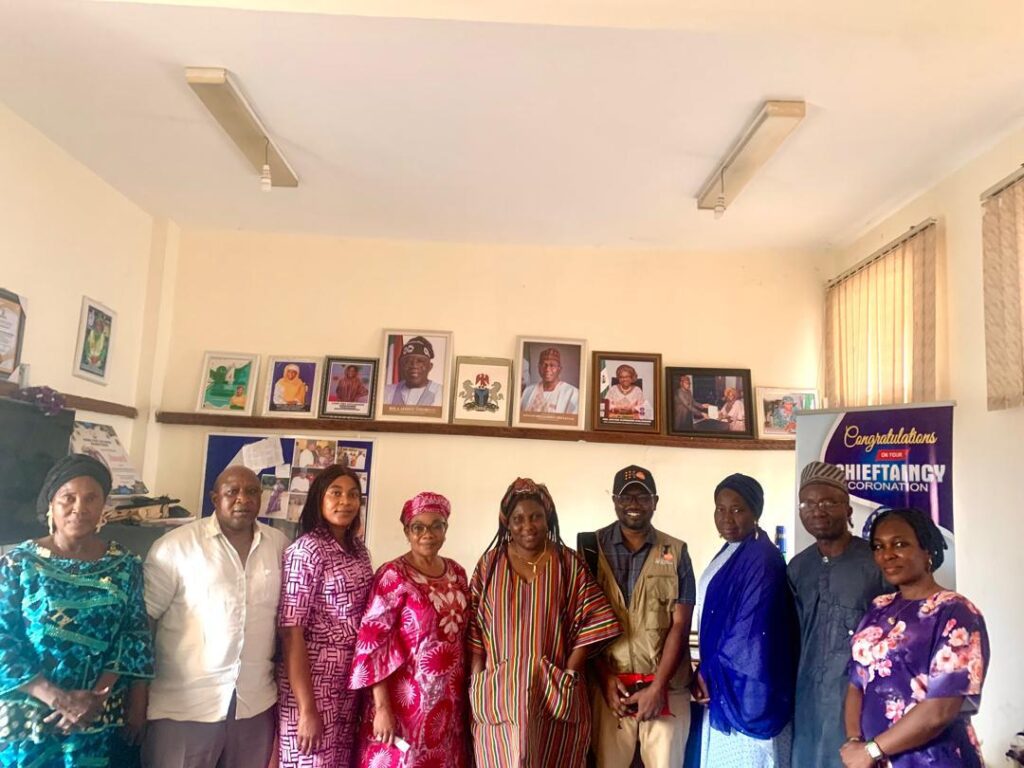
The Kwara State Ministry of Women Affairs is collaborating with the United Nations Population Fund (UNFPA) to provide capacity training for staff of the ministry on gender-based violence (GBV) management using a survivor-centred approach.
UNFPA is an agency of the United Nations that focuses on reproductive health, gender equality, and population issues.
The Commissioner for Women Affairs, Chief (Mrs) Opeyemi Oluwakemi Afolashade, disclosed this during a meeting with UNFPA officials at the ministry.
While commending the UNFPA for its support to the ministry, the commissioner sought further collaboration with the agency to strengthen the capacity of staff in order to improve efficiency in handling GBV cases in the state.
Chief Afolashade affirmed that the state government has put mechanisms in place to handle GBV cases. These include the inauguration of a 21-man committee, the establishment of a Sexual Assault Referral Centre (SARC), the provision of shelters for survivors, and the inauguration of Sexual and Gender-Based Violence Response Teams in Ilorin West, Ifelodun, and Moro Local Government Areas, among others.
She noted the need for continuous capacity building to effectively position the state in line with current global standards.
Reliving the recent bandits’ attack on Woro Community in Kaiama Local Government Area, the commissioner noted that women and children are usually the most vulnerable in such situations, calling for protection and psychosocial support for vulnerable groups in the community.
In her remarks, the Kwara State Sexual and Reproductive Health Specialist, United Nations Population Fund, Mrs Gloria Enueze, appreciated the state government for the work done so far to protect women and children through the ministry.
She assured that UNFPA is on ground to provide support for the survivors of the Woro attack as well as help amplify the voice of the ministry in the global space.
The Humanitarian Analyst, United Nations Population Fund, Dr Danladi Idris, stressed the need to train staff on GBV case management, GBV components, and the mapping and management of social risk factors, stating that applying gender lenses is essential to providing the appropriate support women and children need during times of crisis.