

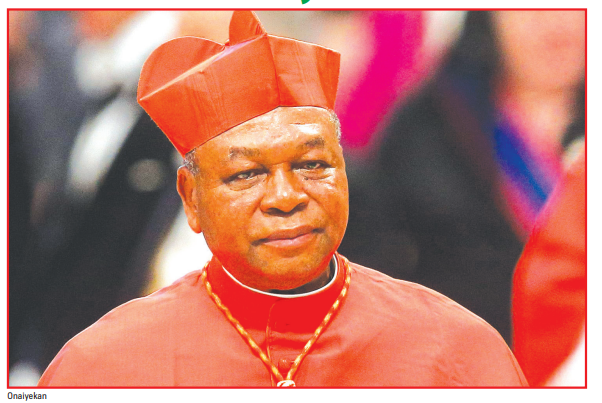
- ‘Let no one tell us there’s no way out of security challenges’
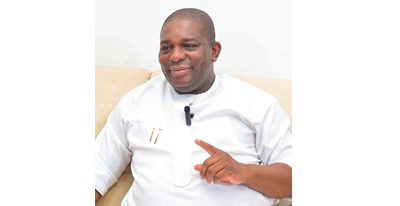
Cardinal John Onaiyekan is the Archbishop Emeritus of the Catholic Diocese of Abuja. In this interview monitored on Arise Television, he speaks on the Catholic Bishops Conference communiqué on collapse of national institutions and rising insecurity in the country, among other issues, ANAYO EZUGWU reports
The Catholic Bishops Conference said Nigeria is drifting into insecurity, economic sabotage and democratic decline. Is this country already mired deep in crisis or approaching one?
Before I answer that question, permit me to remind those in power who may be listening to us that the communiqué is not a political statement. It is a document that was fashioned with a deep love of Nigeria in mind, with honesty, and I also say with deep Christian faith.
Imagine a group of almost 70 prelates from different parts of Nigeria and different ethnic nationalities who came together and were able to endorse this kind of communiqué. And we are reflecting what people are actually saying on the ground because bishops are on ground. I like to say we represent the people in what we say more than what’s happening in the National Assembly, which is supposed to represent the people.
That’s part of our major problem that we’re no longer sure that our representatives in the National Assembly represent us, both in the priorities they set and in the decisions they take. Why I’m stressing this is for the government not to look at what we are saying as the ranting of some political organisations. We have no intention of taking over government; not at all.
So, if anything is driving us, it is purely the love of our nation and we have what we consider like a prophetic role, namely to speak truth to power. We don’t speak carelessly, but we are not afraid to voice out the truth in clear terms, not to pull down anyone, but to let people know this is what is facing us. I’ve been in this country for 82 years; 60 out of these years, I was quite aware of what is happening. And I’m not the only one who is feeling that this is not the country we lived in before.
When we say not the country we lived in before, this country is worse than it was before on many aspects. Of course, there are areas where we seem to see indices of progress but there are other areas too where we are really very sad, and I’m particularly sad in the area of the political institutions and elections. We studied the data of the Independent National Electoral Commission (INEC) from 1999 till date. Every election year, voter apathy is getting worse, and we in terpret that to mean people no longer have trust in the electoral process.
You said this is not a political statement but your communiqué blames bad leadership and what it called a distorted understanding of politics. Tell us more about what you and your fellow bishops believe has gone wrong at the highest level of governance?
It did not happen in one day, and obviously, it did not happen because of President Bola Tinubu. It’s cumulative. This deterioration has been going on. Like I mentioned, if you take the indices of the number of Nigerians who come out to vote, we find that there are less and less people coming out.
Every election year, voter apathy is getting worse, and we interpret that to mean people no longer have trust in the electoral process
In the last elections, 23 per cent of registered voters showed up. That’s what we were told from the Independent National Electoral Commission (INEC) data, which means whoever emerges as winner has been elected by a very small minority of Nigerians.
What kind of democracy is that? I think those in power ought to understand that we have to face how to make sure that elections begin to be acceptable by the people, those who will want to leave their home and go and vote during elections.
Do you believe that the reason why there is such voter apathy is because of a loss of faith in the system?
First of all, some of the people were not even allowed to vote. There were quite a lot of manipulations. I still remember many young people making prig images to the INEC offices for many days to collect these famous voters’ cards and they were not able to get it.
They showed up in a big room full of Permanent Voter’s Cards (PVCs) and they can’t find their own. So many people were disenfranchised simply because of that. Then, there were those, who just felt there’s no point going because even if we vote, they are not going to count our votes, and I think it is not good for us.
If we do not want democracy, maybe we should say it clear and say, look, this system doesn’t work for us, let us look for another system. There are other systems of running government. There are places where government is run by a family. Is that what we want to do? If we say we want democracy, we should be sincere about it.
I think a lot of people will agree with you that when voter turnout becomes low, democracy starts to lose legitimacy at that level…
One would have expected that the National Assembly will be as anxious as, at least we bishops are, and as anxious as the rest of Nigerians are for a review of the electoral law. But we don’t seem to see that but I don’t want to impute any bad feelings on them.
But obviously, they seem to be happy with the status quo. For example, we refer to how an incumbent government that is also a party to the election can conduct a free, fair, and impartial election. It is not rocket science. Other countries have managed it. It also means that we are saying that that when the government in power controls every institution of the state, , then we are not really serious about wanting to allow the will of the people to prevail.
The bishops spoke of senseless killings and communities living in fear, even as you raise questions about whether the government is truly in control of the security situation in this country. And you suggested that there’s a perception of complicity when terrorists are not prosecuted or are reintegrated. So in your assessments, is the government complicit or soft on terror?
For the past three years, we keep hearing government telling us that they are on top of the situation. But what we see doesn’t reflect it. It’s interesting and amazing that we once went to the villa and President Tinubu gave us audience. We raised the issue of security and the roads. But to our surprise, the National Security Adviser started talking, telling us how much progress they have made, how safe the country is now.
As he was talking, we were all looking at each other and asking ourselves: Is it the same country we are in? We thank God and we commend the fact that finally, the government seems to admit that they are really not coping because the moves we are seeing about reaching out to foreign nations to help us means that we need help but that creates its own problem.
You acknowledge some steps by the Tinubu administration, including declaring a security emergency. But you said the results remain grim and you talked about structural failures…
We were expecting when the declaration was made that we were going to see a definite change of attitude, that the terrorists will be hunted down and removed from us, and that we will begin to see some actions. But we didn’t see anything. It’s only a presidential declaration. And we do not think that Nigerians are asking for too much. We ought not to be living in a country where killings are going on, where villagers are not safe, where even the people in power are not safe. I challenge any of them to jump into his car and drive to his village without security. We cannot continue like this and let no one tell us that there is no other way out.
You talked about oil bunkering and illegal mining as funders of insecurity, and you also criticised continued food importation. Is this a failure policy or of political will?
When we were trying to come out with a communiqué, we had to pick and choose the ones we are going to mention. The mining thing, which for a long time we did not even know about, there are people who are doing large business and carting away our natural resources without any government control. Bunkering is even better because at least in bunkering it is understood that the petroleum resources goes through a particular channel, through the Nigerian National Petroleum Company Limited (NNPCL).
We are wondering about what’s happening today. We are just hearing that there are people who have been making billions from our natural resources without any accountability, and certainly not without the complicity of those who ought to stop it. When those who regulate are not doing their duty, where do we stand? It’s not only that illegal mining is depriving Nigerians of their natural resources; it is also destroying our environment. It is destroying communities.
What we know now is that a lot of these attacks which end up displacing villagers are to make room for large-scale mining. How can that be happening in a civilized nation? It is difficult for us as bishops to believe that those who are in charge of our affairs are not aware of this. We are also worried about the issue of food shortage. Many bishops, especially those who came from this North, are saying that farmers are now in trouble. They went out to plant but by the time their crops came to the market, the prices have come down.
And it is alleged that the fall in prices is a political gimmick as government flooded the markets with imported food. If that is true, then it is the wrong decision to take because if government flooded the market with imported food, that means our money has been spent to go and buy imported food from abroad, thereby supporting those who produce those things. That money should have been given to our farmers to reduce the cost of production of their food, reduce the cost of fertilizers and just give them everything that is necessary.
If you had the President’s ear, what are the three immediate actions you would demand that he takes?
One would need to mention things that he should be able to do that are feasible. And of course, for most Nigerians, the major problem now is security. So, he should do whatever it takes to make Nigerians safe. The second point, which is linked to security also, is corruption. You cannot completely eliminate corruption. Corruption is all over the place in the world but Nigeria is different. It seems that corruption thrives.
In other countries, people who want to be corrupt have to be careful because they can be caught. And when they are caught, they pay for it. But here in Nigeria, it seems that those who are corrupt always get away with it. It’s not right. And of course, the third element is our own peaceful relationship among us. In my own opinion, that’s even the greatest thing to help Nigerians to begin to live as brothers and sisters.
We ought not to be living in a country where killings are going on, where villagers are not safe, where even the people in power are not safe… We cannot continue like that
There has been too much polarization. First, it was because of politics because by this very nature, politicians want to say we are better than the other group. And so, the nation was split among. Now, religion has become more problematic than it was 20 years ago and we need to really face it. I have the strong conviction that the vast majority of Nigerians, Christians and Muslims want nothing more but to live together in peace.
But there are those fringe groups that have their own ideas. Thank God, those ideas are not shared by all of us. We should be able to deal with them and I wanted to use the word ruthlessly. But let me say, deal with them decisively. I am informed that even in most Islamic countries like Saudi Arabia, they do not give free reign to Islamic extremists to do whatever they like. Why can’t we do the same here?