
The Republic of Cuba has accused the United States of pursuing a “deliberate asphyxiation policy” aimed at forcing its government to its knees, as Nigerian labour leaders and political figures rallied behind renewed African pressure to end the decades-long blockade.
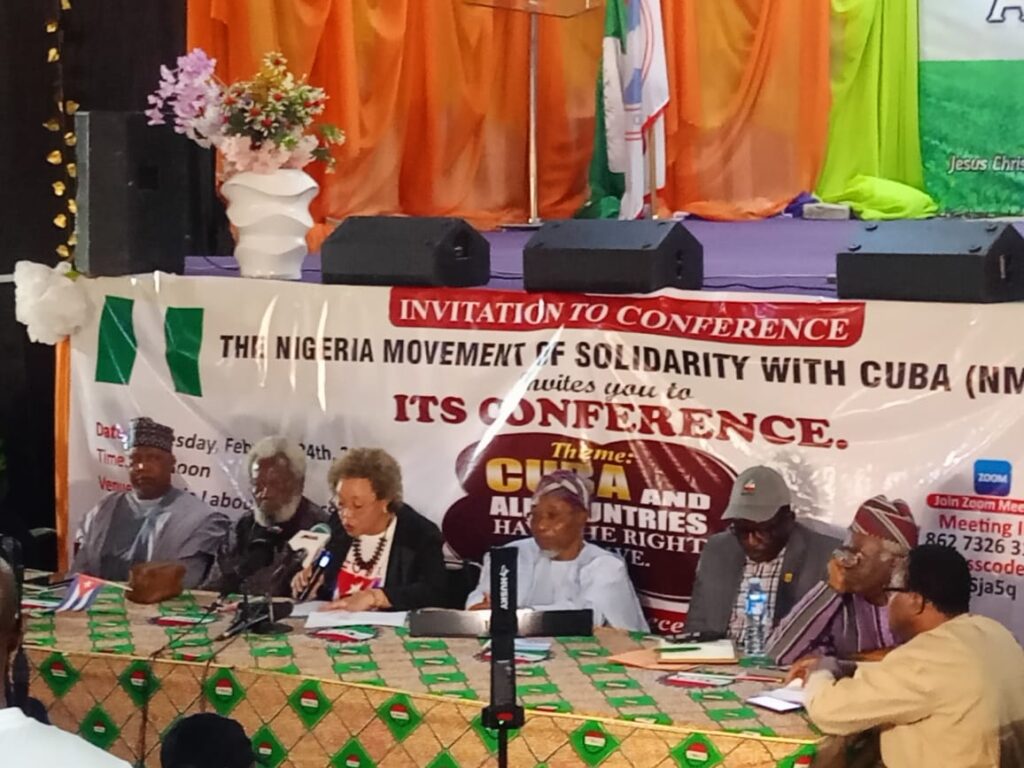
Speaking in Abuja at the Conference of the Nigeria Movement of Solidarity with Cuba (NMSC), Cuba’s Ambassador to Nigeria, Miriam Morales Palmero, described the U.S. embargo as “a silent genocide” and rejected what she termed threats to countries trading with Havana.
She said: “The blockade is not a bilateral dispute; it is a deliberate asphyxiation policy intended to make an entire nation surrender from hunger and calamities.
“Our economy is suffocated to create shortages and hardships with the vile goal of compelling the Revolution to surrender. We do not accept threats. We do not accept blackmail.”
Her remarks come days after the African Union, for the 17th time, adopted a resolution condemning the U.S. economic, commercial and financial embargo on Cuba and calling for its removal from Washington’s State Sponsors of Terrorism list.
Palmero also criticised a recent U.S. executive order threatening sanctions against countries that supply fuel to Cuba, describing it as “a flagrant violation of international law” with “extraterritorial character.”
“It seeks not only to deepen energy, nutrition and health shortages, but to punish legitimate cooperation among sovereign states,” she said.
The Cuban envoy urged Nigerian unions, youth groups, academics and the media to develop a concrete action plan to amplify solidarity campaigns throughout 2026.
“This meeting must strengthen the structure of the Solidarity Movement with Cuba in Nigeria..From here should arise clear initiatives and a roadmap that makes solidarity more visible and more effective.”
Speaking at the conference, Nigeria’s organised labour movement threw its weight behind Havana, framing the sanctions as an assault on workers.
The Nigeria Labour Congress (NLC) represented by Comrade James Eustace, demanded the “immediate and unconditional lifting of the blockade” and called for Cuba’s removal from the terrorism list.
“This is not just a policy; it is collective punishment..We stand with the Cuban people until their right to self-determination is fully respected.”
Similarly, President of the Trade Union Congress of Nigeria (TUC), Comrade Festus Osifo, warned that sanctions disproportionately hurt ordinary citizens.
“Sanctions and external pressures often impact workers the most limiting access to essential goods and opportunities. This runs contrary to the spirit of international solidarity and social justice.”
Represented by the Secretary General of the Union, Comrade Nuhu Toro, he reaffirmed TUC’s “unwavering solidarity with the workers and people of Cuba.”
Former Interior Minister and Honorary President of the NMSC, Rauf Aregbesola, linked Africa’s support for Cuba to history, recalling Havana’s role in the anti-apartheid struggle in Southern Africa.
“We cannot but be historically grateful to a people who lost about four thousand of their youths under African skies fighting for the liberation of our continent.”
Aregbesola described the 64-year blockade as “illegal, punitive and unjust,” arguing that it violates the United Nations Charter and undermines the sovereignty of nations.