



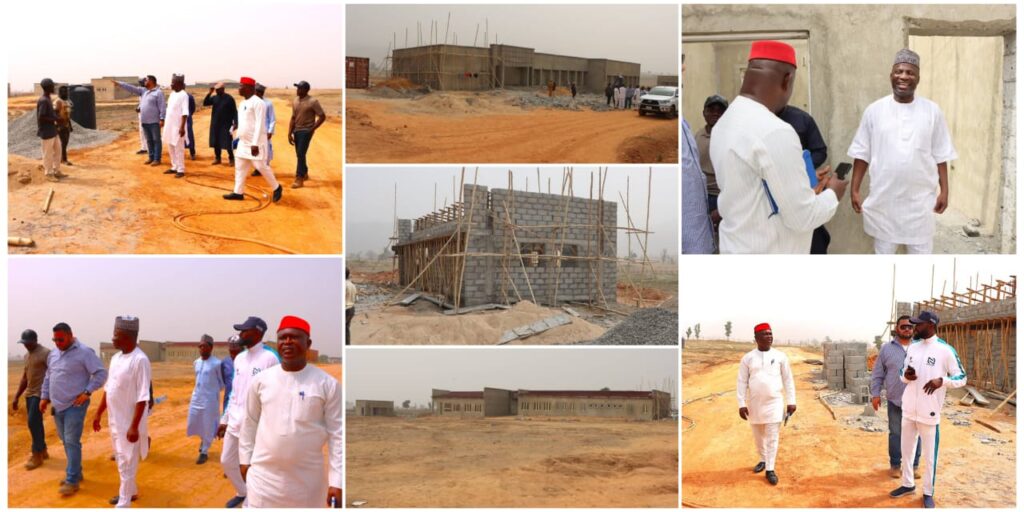
The National Agency for Science and Engineering Infrastructure (NASENI) has commenced construction of a state-of-the-art Agricultural Incubation Centre at the University of Abuja, Gwagwalada, aimed at enhancing food security and fostering agricultural innovation.
The project, situated on a 10-hectare parcel of land within the campus, is designed as a technology-driven, commercial agricultural hub integrating poultry production, aquaculture, crop cultivation, and research-based innovation. Once completed, the centre is expected to serve as a model facility for replication across Nigeria’s six geopolitical zones.
The facility will include an agribusiness training and incubation centre, three commercially sustainable production units for broiler and layer poultry, a high-tunnel greenhouse farm, catfish and tilapia fish farms, a tissue culture laboratory, greenhouses, an administration block, and open-field cultivation supported by drip irrigation and modern agricultural technologies. The initiative aims to increase food production and contribute significantly to Nigeria’s food security agenda.
Speaking on the strategic importance of the initiative, Engr. Dr. Abdulrasheed Agavah, Acting Coordinating Director of NASENI’s Engineering Infrastructure Directorate, said the project aligns with the Renewed Hope Agenda of the Federal Government.
“This agricultural incubation centre, scheduled for commissioning this year, is designed to make food available and affordable through technology-driven farming, breeding, and research. Its location within a university environment is deliberate, as it will strengthen research and development and facilitate knowledge transfer,” he said.
Dr. Agavah also revealed that a similar project is ongoing at Bayero University, Kano (BUK), with plans to replicate it at Abubakar Tafawa Balewa University (ATBU), Bauchi, and other geopolitical zones across the country.
During an on-site inspection, the Project Manager of Onida Agric and Aquaculture Solutions Ltd, Mr. Christian Montano, detailed the facility’s components. The poultry section will include a 5,000-capacity broiler unit and an 8,000-capacity layer unit, while the aquaculture section features three production tanks, each 16 metres in diameter, with an estimated annual output of 25 tonnes of fish.
The crop production segment will comprise 10 greenhouse tunnels of 500 square metres each, a 2.5-hectare net house, and four hectares of open-field farmland. The tissue culture laboratory is designed to accelerate seedling production and improve crop quality by significantly reducing propagation time.
Montano further noted that the Centre will be equipped with six solar-powered boreholes, power store workshops, an irrigation control room, and a gatehouse, with plans underway to construct a water retention structure to ensure uninterrupted supply during both rainy and dry seasons.