


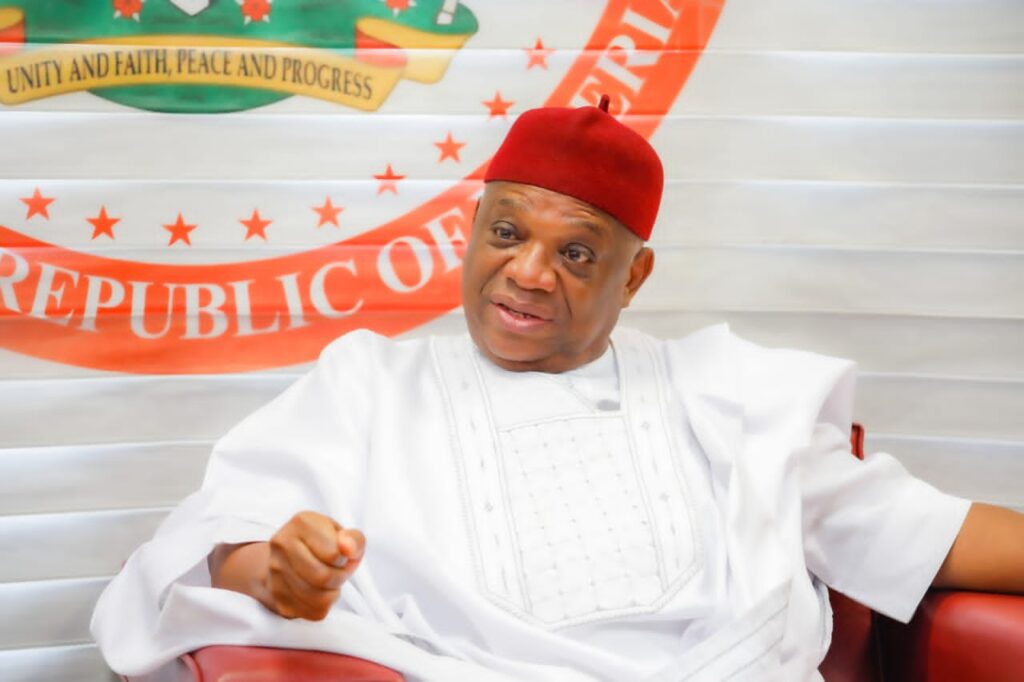
“The money I received in eight years is what Governor Otti is receiving in four months.” — Senator Orji Kalu
This statement is not chest-thumping. It is a call to reflection—a deliberate invitation to interrogate governance beyond slogans and optics.
It asks a timeless question Abians must confront honestly: Is leadership measured by the volume of funds received, or by the scale and durability of transformation achieved with what is available?
To answer this, one must return—not to emotions or partisan narratives—but to history, context, and verifiable outcomes.
Abia Before OUK: A State in Distress, Not Transition
When Orji Uzor Kalu assumed office in 1999, Abia State was not simply underdeveloped;
– it was institutionally broken.
– Infrastructure had largely collapsed.
– Aba—the industrial heartbeat of the South-East—was strangled by impassable roads and declining productivity.
– Public confidence in governance was eroded.
– Salaries, morale, and state credibility were fragile.
Most critically:
– Federal allocations were low in nominal and real terms.
– Internally Generated Revenue (IGR) was weak.
– Nigeria itself was just emerging from military rule, with shallow fiscal capacity and limited subnational autonomy.
Contrast this with 2023, when Governor Alex Otti assumed office:
– A stabilized democratic framework.
– Substantially higher FAAC inflows, driven by higher oil benchmarks and revised revenue frameworks.
– Access to modern development finance instruments.
– Digital governance tools nonexistent in 1999.
– A more mature federal–state fiscal structure.
The truth is unavoidable: The starting points were fundamentally different.
OUK’s First Two Years: Vision Before Resources
What set Orji Uzor Kalu apart was not money—it was intentional leadership.
Within his first two years in office, his administration:
– Designed and executed a clear development blueprint anchored on infrastructure, commerce, and state identity.
– Aggressively rehabilitated and constructed roads across Aba, Umuahia, and major corridors, restoring economic mobility.
– Stabilized civil service morale through engagement and improved welfare.
– Rebranded Abia nationally as a state of action, not excuses.
These were not paper achievements. They were visible, functional, and lived.
So tangible was this transformation that President Olusegun Obasanjo personally visited Abia State, witnessed the scale of infrastructure delivery, and publicly christened Orji Uzor Kalu “The Action Governor.”
That title was not self-conferred. It was earned through performance under constraint.
Transformational Leadership: When Scarcity Tests Capacity
True leadership reveals itself not in abundance, but in scarcity.
OUK governed at a time when:
– Monthly allocations were a fraction of today’s inflows, even after adjusting for inflation.
– Oil prices were significantly lower than post-2010 averages.
– States had limited borrowing capacity and weaker fiscal autonomy.
– There was no social media ecosystem to amplify narratives or mask underperformance.
Yet under those conditions:
– Infrastructure expanded rapidly.
– Aba’s commercial relevance rebounded.
– Youth engagement through sports and enterprise flourished.
– Security coordination improved during a nationally fragile period.
– Education and health facilities received focused attention.
Every naira translated into presence, not press releases.
The Naira–Dollar Argument: A Weak Defense
Supporters of the current administration often argue that:
“You cannot compare today’s funds with OUK’s era because the naira was stronger then.”
This argument collapses under scrutiny.
Why?
1. FAAC allocations today are not just nominally higher—they are structurally higher. Current inflows reflect:
– Higher oil production benchmarks,
– Expanded revenue pools,
– Revised sharing formulas,
– And increased federal transfers to states.
2. Inflation does not erase scale. Even when adjusted for purchasing power:
– Today’s monthly receipts exceed what many states—including Abia—received annually in the early 2000s.
– Capital-intensive projects (roads, schools, hospitals) remain achievable when funds are properly prioritized.
3. Economic context favored today’s administration.
– Nigeria’s GDP today is multiple times larger than it was in 1999.
– Financial markets, contractors, and financing mechanisms are more advanced.
– Technology reduces administrative waste and procurement costs.
In essence:
OUK built aggressively when money was scarce and systems were weak. Today’s government operates with more money, better systems, and fewer excuses.
Today’s Reality: Bigger Inflows, Louder Questions
By official briefings, Abia State today receives record monthly revenues —levels unprecedented in its history.
Naturally, expectations must rise.
And so citizens ask—not maliciously, but responsibly:
– Where are the state-defining infrastructure projects that match these inflows?
– Beyond announcements, how many completed and operational smart schools exist?
– How many sustainable private-sector jobs have been created?
– What industrial clusters are driving Aba’s renaissance at scale?
– How is youth development translating into measurable economic independence?
These are not opposition questions. They are governance questions.
In OUK’s era, results answered critics before debates even began.
Transparency and Accountability: Results Over Rhetoric
Orji Uzor Kalu’s administration was not flawless—but it was grounded in visible accountability.
– Projects were tangible.
– Government presence was felt across all LGAs.
– Performance spoke louder than self-promotion.
Today, many Abians perceive a gap between communication and concrete delivery. Whether fair or not, this perception persists because *people judge governance by impact, not intention.
Leadership is not proven by declaring oneself the best. It is proven by *making life measurably better for the people*.
A Balanced Conclusion: Continuity Requires Honesty
This is not a call to dismantle the present, but a call for truthful comparison and higher standards.
Governor Alex Otti did not inherit a blank slate. He inherited:
– A state whose foundational direction was set by OUK.
– Infrastructure templates still referenced today.
– Administrative structures built through earlier reforms.
– A legacy that current policies often adapt.
Acknowledging this does not weaken the present—it restores historical integrity.
Final Thought: History Rewards Impact, Not Excuses
History is merciless toward explanations, but generous to results.
Orji Uzor Kalu governed Abia State with:
– Less money,
– Fewer tools,
– Weaker institutions,
– And harsher national conditions,
Yet delivered outcomes that remain reference points decades later.
If today’s Abia receives in four months what yesterday’s Abia received in eight years, then the people are right to demand:
– Faster development,
– Deeper impact,
– Broader prosperity.
Because in the final analysis, leadership is not about how much comes in— but how much changes because you were there.
And by that enduring standard, OUK’s transformational leadership remains a benchmark Abia is yet to surpass.
Team OUK