




•Gender parity is not rebellion but an opportunity to rewrite history, says Akiyode-Afolabi
•I was encouraged by legal icons who made a difference in leadership, Lagos NBA branch chair
•‘Genuine inclusion demands influence, participation in decision-making, access to structural power’
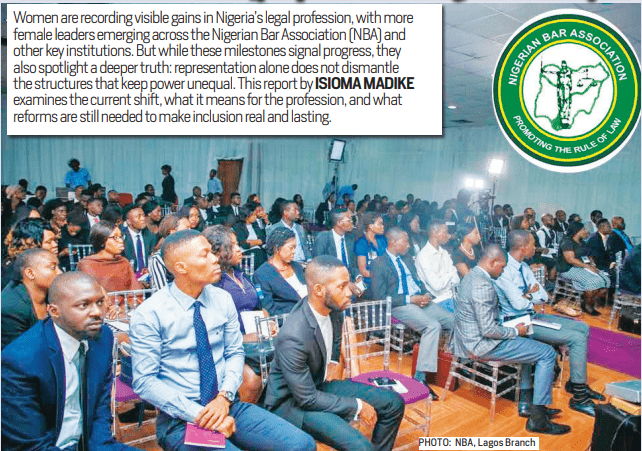
Women are recording visible gains in Nigeria’s legal profession, with more female leaders emerging across the Nigerian Bar Association (NBA) and other key institutions.
But while these milestones signal progress, they also spotlight a deeper truth: representation alone does not dismantle the structures that keep power unequal. This report by ISIOMA MADIKE examines the current shift, what it means for the profession, and what reforms are still needed to make inclusion real and lasting.
The new faces of leadership
Some achievements are too significant to ignore. Across Nigeria’s legal sector, women are increasingly stepping into spaces historically dominated by men, not as symbols, but as leaders shaping decisions and setting agendas.
One of the most notable is Mrs Uchenna Akingbade, Chairman of the Nigerian Bar Association (NBA), Lagos Branch, the first woman to hold the position.
Akingbade described her path to the top as difficult, but defining. According to her, women often hesitate to contest elections, not because they lack ambition, but because the barriers are often informal, entrenched, and discouraging.
“Many women would rather support their male counterparts,” she said. “But I was encouraged by legal icons like Dame Priscilla Kuye, who braved the odds to make a statement in areas historically dominated by men. She gave me strength.”
The power of role models
Akingbade said Dame Priscilla Kuye remains a strong example of what is possible. Kuye served as NBA President from 1991 to 1992, becoming the first and only woman to lead the association.
From National Financial Secretary and later Vice President, Kuye rose to the highest NBA office at a time when female leadership in the profession was rare. Akingbade said Kuye’s success helped her believe a woman could lead without apology.
Inside the Lagos NBA chairmanship Six months into her tenure, Akingbade said the role has been both rewarding and demanding. The hardest part, she noted, is managing competing interests within the branch while staying anchored to the association’s mandate.
That mandate includes promoting the rule of law and improving welfare for members. So far, she says the campaign has been met with broad support across genders, including encouragement from her husband and open backing from male colleagues.
She added that she has not felt treated differently because she is a woman. “To be honest, everybody has been very supportive,” she said. “I cannot point to a time when I felt I was treated differently because I am a woman.”
A broader shift across the NBA

Akingbade’s rise reflects a broader recalibration underway across the Nigerian Bar Association. Women are now chairpersons of several NBA branches across the country, including Sokoto, Port Harcourt and Jos, as well as Ota (Ogun State), Ikorodu (Lagos State), Barnawa (Kaduna State), and Idemili (Anambra State).
This marks a departure from previous years, when men overwhelmingly controlled leadership across the NBA’s 129 branches.
While the shift is increasingly visible, a consolidated national statistic is not currently available. Still, the trend reflects what the Institute for African Women in Law (IAWL) identifies as the profession’s deeper challenge: representation without sustained retention and progression into leadership.
In its multi-country study covering Nigeria, The Institute for African Women in Law (IAWL) cites structural and cultural constraints across the pipeline, including procedural hurdles linked to the Senior Advocate of Nigeria (SAN) pathway, sexual harassment and intimidation, unspoken gender bias, caregiving burdens, limited mentoring opportunities, and entrenched patriarchal workplace norms.
The study used mixed methods, including a nationwide survey of female lawyers that received 449 responses. Progress has also extended beyond branch chairperson roles.
In April 2025, a woman was inaugurated as Chairman of the Nigerian Bar Association Young Lawyers Forum (NBA-YLF), Jos Branch, reinforcing that the leadership pipeline is widening at multiple levels.
Breaking the ceiling beyond the Bar
The shift extends beyond the NBA. Dr Olugbemisola Odusote was recently appointed Director-General of the Nigerian Law School, having previously served as Deputy Director-General and Head of the Lagos Campus. She became the first woman to lead the institution since its establishment in 1962.
Her appointment underscores why leadership representation matters across justice institutions. The Institute for African Women in Law argues that the legal system plays a unique role in ddressing gender-based discrimination, making it crucial for women to be represented not only as partic- ipants in the profession, but also in decision-making roles.
The report adds that women’s presence in legal leadership can help counteract both actual bias and perceptions of bias, while ensuring women’s priorities are reflected in decision-making processes aligned with Sustainable Development Goal (SDG 5) on gender equality.
As Director-General, Odusote is expected to provide academic leadership, administrative management, and strategic direction across the Law School’s campuses, while serving as a key liaison with the Council of Legal Education, the Body of Benchers, and the NBA.
Women leading at the highest levels
FIDA Nigeria, the International Federation of Women Lawyers, noted that Akingbade’s early priorities include engaging state authorities to secure better remuneration and improved working conditions for lawyers in Lagos.
She has also been described as a leader with bold vision and integrity, committed to empowering more women in the profession. At the national level, Justice Kudirat Kekere-Ekun was sworn in as the 23rd substantive Chief Justice of Nigeria on November 30, 2024, after serving in acting capacity from August 23, 2024.
Her tenure has reportedly emphasised account- ability, technology adoption, and reforms aimed at restoring public trust in the judiciary. Former Chief Justice Aloma Mariam Mukhtar, who served from July 2012 to November 2014, remains one of the most prominent female figures in Nigeria’s judicial history. Her leadership is associated with internal reform efforts and judicial discipline.
The legacy of resistance
For many in the legal profession, Dame Priscilla Kuye’s tenure remains one of the most defining examples of courage and activism.
Her leadership was prominent during military rule and focused heavily on defending the rule of law. She notably led the Bar to Kuje Prison to secure the release of the “Kuje 5”, including Femi Falana (SAN), the late Dr Baba Omojola, the late Chief Gani Fawehinmi








