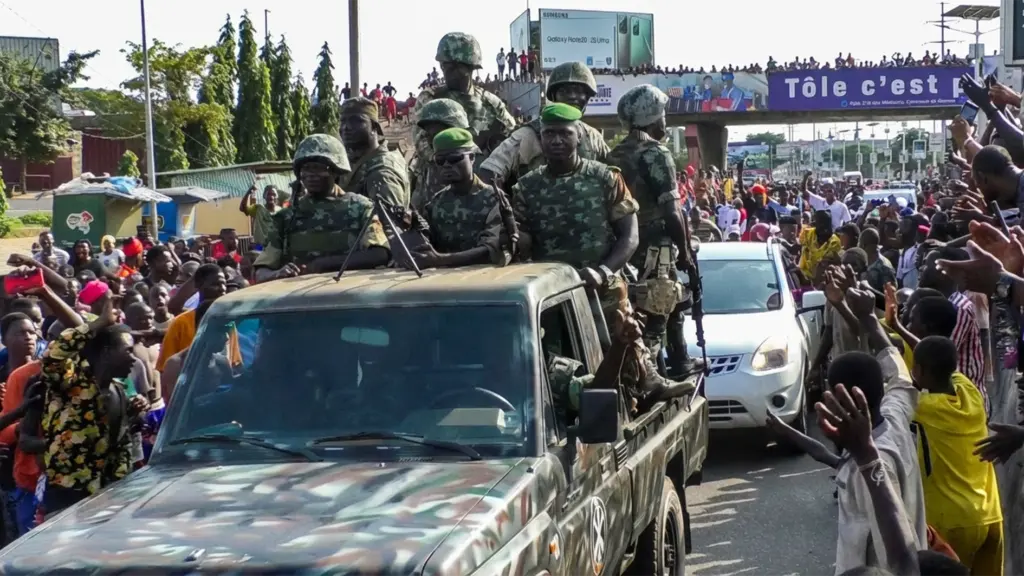
The resurgence of undemocratic change of government across West Africa has been blamed largely on disputed elections and non-compliance with transition norms in many countries.
The development has become a source of concern to security experts, diplomats, and public affairs analysts, following the recent coup in Guinea-Bissau and the failed mutiny in the Republic of Benin a few days ago.
The worrisome development dominated discussions at the 55th Ordinary Session of the ECOWAS Council of Ministers meeting, which took place this week in Abuja.
President of the ECOWAS Commission, Dr Omar Alieu Touray, said the trend where the military has been forcing its way back to power in many West African countries calls for serious introspection on the future of democracy in the subregion.
According to him, elections have become a major trigger of instability in many countries across the region. Touray lamented that despite the best efforts by ECOWAS to establish constitutional convergence principles and to have a support programme for elections in the region in order to safeguard its democratic credentials and stability, the region has continued to witness political practices that violate these principles.
In the coming days and months of next year, we will be witnessing elections in Guinea, the Republic of Benin, The Gambia, and Cape Verde. We will also be managing the post event relating to the Coup in Guinea-Bissau and the coup attempt in the Republic of Benin.
“Ensuring a credible and peaceful transition in Guinea and enforcing constitutional norms in all the elections coming up for the next one year. Addressing candidate exclusion trends region-wide, we must take decisions and actions that will reverse this trend,” he said.
Minister of State, Foreign Affairs, Ambassador Bianca Odumegwu Ojukwu, observed that in recent years, ECOWAS countries had witnessed political instability, including unconstitutional changes of government, due to deliberately prolonged transition programmes, lack of inclusivity, as well as governance uncertainties and deficits in a number of member states.
“These situations challenge not only the democratic values to which we have all subscribed, but also threaten hard-won development gains. They undermine citizen confidence and weaken the regional cohesion that has defined ECOWAS for half a century. “We must therefore remain steadfast in defending constitutional order, promoting inclusive political dialogue, and supporting credible transitions that reinforce stability.
Our unity and collective resolve are essential to navigating these periods of uncertain- ty,” she said. Chairman, ECOWAS Council of Ministers and Sierra Leone’s Minister of Foreign Affairs, Timothy Kabba, said the recent attempt to subvert constitutional order in the Republic of Benin has renewed the commitment of ECOWAS to zero tolerance for unconstitutional takeover of governments.
According to him, the sub-region is not an exclusion from the vibrations that emanate from the contestation of the powers across the world, but said the situation beckons member nations to look back into their governance system and ensure that they make every effort to entrench the tenets of democracy in their country.
“We recommit our- selves to the tenet of democracy, to ensure we put our people at the fore of our political decisions, provide for our people, uphold the requirements of our constitution, and respect the rule of law.
“Our community is challenged, but our leaders have demonstrated the resilience of our people and the resilience of our institutions.
“We are still left with many challenges, but the leaders have committed themselves to ensure returns to constitutional order, that we make every effort to prevent the recurrence of coup d’états in our sovereignty,” he said. Kabba observed that without peace, security, and stability, there will be no development, hence the need for ECOWAS to place a premium on community peace, security, and stability.