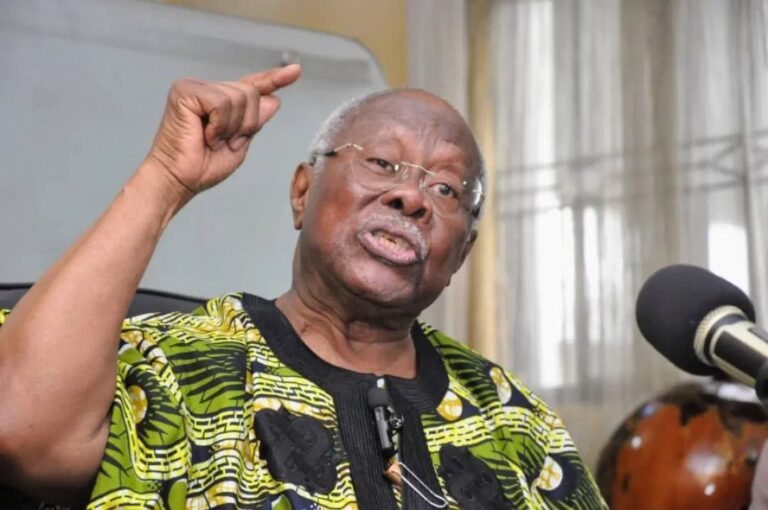
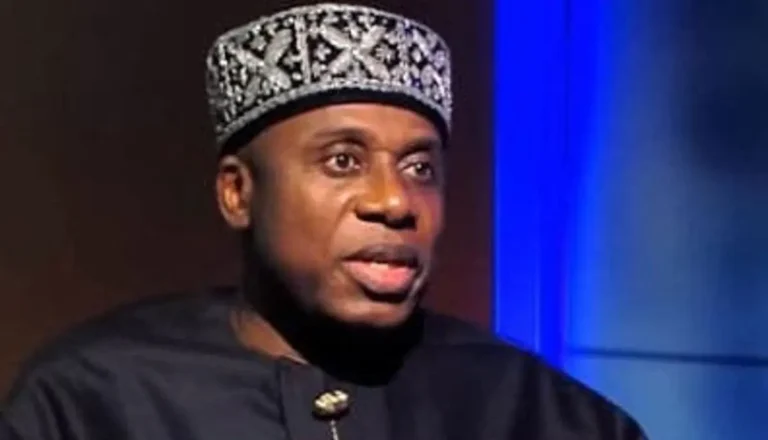

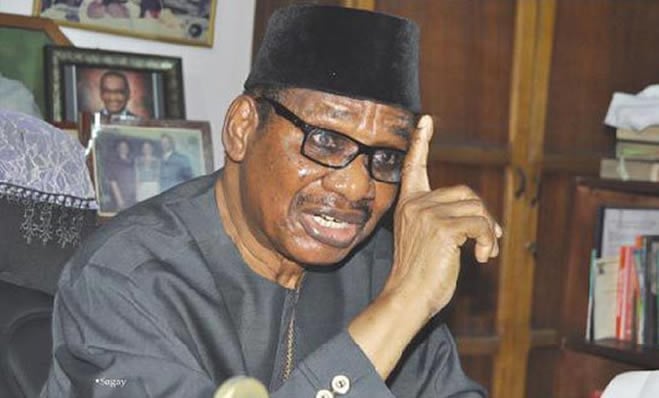
Two prominent Nigerians, Constitutional lawyer and scholar, Professor Itse Sagay and a former National Commissioner in the Independent National Electoral Commission, (INEC)) Mr Festus Okoye, have both reacted to the low voter turnout in the recently concluded Abuja Area Council election.
In separate telephone interview with Saturday Telegraph yesterday, Sagay and Okoye were unanimous in their belief that the situation might have been caused by below par performance of elected officials in office. According to the two, this has come to serve as disincentive for Nigerians to risk their time to come out to elect leaders who would eventual dash their collective wish for good governance.
While Sagay expressed doubt with regards to INEC’s claim that it has over 90 million registered voters in its kitty, Okoye in his remarks however cautioned that it would be hasty to draw any form of conclusion that the same scenario would be repeated next year during the General Elections.
Sagay
The law teacher blamed low voter turnout on growing disenchantment of the citizens with the nation’s leadership whom he de- scribed as underperforming and lacking focus. He further raised concerns with the figures contained in the voter register of the INEC, saying they are suspicious and unreal.
Sagay laid the blame squarely on the door steps of political leaders in the country who he stated have let the people down and are manipulating the data contained in the register to give the false impression of a bloated voter register. On the turn out, Sagay said, “No, certainly it’s not encouraging.
There’s no question about that. Seven per cent is low, but I have a very high suspicion about the number given of our registered voters. I think there’s a lot of over registration and a lot of funny things that happened at that level. I don’t think we’re as many. “I think they say we have over 90 million registered voters, and I don’t think it’s correct.
That’s my impression. All these low voter turnout when we’re having 22 per cent, 25 per cent at elections, I don’t think it’s (voter apathy) as bad as it looks. My suspicion is that there’s a lot of over-registration.” When asked to clarify, Sagay blamed the usual Nigerian corruption on the part of politicians, stating, “Politicians trying to get people registered more than once, registering in more than one place, anything to increase the possibility of people getting double votes.
“That’s my feeling. I don’t trust the number of our registered voters (as contained in the voter register). I think it is over the over bloated beyond what is realistic or what is the word to use? The number of registered voters is far more than those actually people who are eligible to vote. That’s my feeling,” he said.
According to him, the situation is further caused by the fear which may arise out of the fact that government is addressing the problems plaguing the country. “In other words, you take the trouble to go and vote, you put a party in power, and the result of that is almost zero. We have a lot of problems. Like power, for example, seems an unsolvable problem.
“We must still look at security now. It’s just terrible. Those hoodlums and criminals and terrorists are taking over the country,” he concluded.
Okoye
On his part, Okoye who also echoed the sentiments of Professor Sagay on the low voter turnout however cautioned that it would be too early to assume that the same scenario would present itself during the general election.
“Every genuine democrat should be concerned about the growing disengagement of Nigerians from the electoral process. Contrary to some narratives in the public domain, the low voter turnout in the Federal Capital Territory, Abuja Area Council Elections, is not a referendum on democracy and does not signal a vote of no confidence in our democratic system,” Okoye stated.
According to him, Nigerians have come to embrace democracy and have shown good faith in previous elections but added that “Unfortunately, those in charge have displayed outright contempt for the people and their democratic choices. “The elected leaders have failed, refused, and neglected to convert the people’s trust in democracy into tangible improvements such as food on the table, affordable education and healthcare, and good roads and social amenities.
Instead, there has been blatant disregard for the people and their choices.” While stating that Abuja Area Council Elections should not be viewed as a definitive indicator for the 2027 general election, he however maintained that it is however a warning to the political elite that the current democratic order is under threat.
“It also acts as a rallying point to improve people’s living conditions. Furthermore, it is the responsibility of the electoral management body to refine its procedures and restore public trust in the electoral system. “The late arrival of election materials in a place like the FCT harms the electoral management body’s reputation.
The system for result verification, certification, and collation must be improved, and the security of the collated outcomes assured. “Additionally, it urges political parties to justify their existence as entities that genuinely care for the welfare of the people. Lastly, it is vital for the media, civil society groups, and organisations to enhance civic and voter education,” Okoye concluded.