


There was drama and uproar in the Senate on Thursday last week, following the defection of nine senators from different political parties to the African Democratic Congress (ADC), and two others, one each to Nigeria Democratic Congress (NDC) and Accord Party. Five of the senators dumped the Peoples Democratic Party (PDP), three left the Labour Party (LP), while one dumped the All Progressives Grand Alliance (APGA).
The latest development is in line with the wave of defections that have swept through the Senate in recent weeks, marking political realignments ahead of the 2027 general election, with the ruling All Progressives Congress (APC) still maintaining grip on overwhelming majority in the nation’s apex legislative chamber.

As it stands, the latest configuration of the Senate membership indicates that the APC occupies 87 of the 109 seats, which grants the party dominant majority position, and obviously allows it to have significant influence in legislative decision-making whenever a situation calls for votes on the floor of the Red Chamber. The PDP is now reduced to six senators, APGA (one), New Nigeria Peoples Party (NNPP – one), Nigeria Democratic Congress (NDC – one) and Accord Party (one). Labour Party (LP) and Social Democratic Party (SDP) have zero members each.
Three seats are vacant due to the deaths of senators representing Nasarawa North, Enugu North and Rivers South East. Interestingly, following the mass defections, the leadership of the Senate, under Senator Godswill Akpabio, has threatened to declare Senator Enyinnaya Abaribe’s seat vacant for dumping APGA. The Senate leadership hinged its decision on the claim that there was no division in the party to legitimise Abaribe’s cross-carpeting as spelt out in the law book. All the senators, who defected, cited internal crises, intractable leadership disputes, and lack of cohesive direction in their former parties as propelling forces behind their decision to seek membership of other political parties.
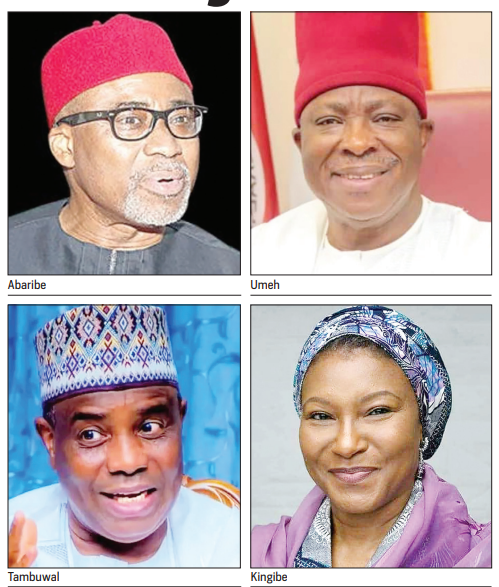
The senators, who formally announced their defections to the ADC during Senate plenary, are Aminu Tambuwal (Sokoto), Eyinnaya Abaribe (Abia), Binos Yaroe (Adamawa), Victor Umeh (Anambra), Tony Nwoye (Anambra), Lawal Usman (Kaduna), Muhammed Onawo (Nasarawa), Augustine Akobundu (Abia) and Ireti Kingibe (Federal Capital Territory). While the defections signal a growing confidence in the ADC as a credible opposition platform even as APC’s dominance remains unshaken, some political analysts suggest that the movements could mark the beginning of a broader realignment in the Senate, with ADC positioned to consolidate influence among legislators, who are aggrieved over developments in their former political parties.
The senator representing Kaduna Central Senatorial District, AdamuUsman, in a letter he submitted to the Senate on his decision, cited prolonged internal rift within the PDP as incompatible with effective representation of his constituents. Part of his letter read: “After careful reflection, it has become evident that the prolonged and irreconcilable divisions within the national leadership structure of the party have created deep-seated functional conflicts that have significantly undermined party cohesion, stability, and functionality.
“I hereby formally resign my membership of the PDP, and after wide consultations with my constituents and political supporters, have resolved to align with the ADC to continue to effectively pursue the democratic aspirations and developmental interests of the people I represent.” Similarly, Senators Onawo (Nasarawa South) and Akobundu (Abia Central), in their respective letters detailing their resignations from the PDP, cited persistent fractionalization, leadership disputes, and the absence of unified direction.
Akobundu, particularly, noted that his decision, though difficult, was necessary to deepen Nigeria’s democratic system and to ensure that representative governance thrives despite party divisions. A former governor of Sokoto State, Waziri Tambuwal, also formerly of the PDP, expressed similar sentiments. He cited internal crisis and leadership disagreements that had made meaningful participation in his former party increasingly difficult. The letter of the Senate Deputy Minority Leader, Olalere, who defected from PDP to Accord, was also read, while Dickson’s letter, announcing his defection to the newly founded NDC, was also presented to the lawmakers on the floor during plenary.
The senator representing the Federal Capital Territory, Kingibe, who dumped the Labour Party, stressed the need for a strong opposition to maintain a vibrant multi-party system. She further explained that her defection was guided by the desire to align with like-minded lawmakers committed to strengthening democratic governance and advancing national development. Also, Senators Umeh, Nwoye and Yaroe of the Labour Party, cited fractured party structures and unresolved leadership conflicts as primary reasons for their decision to join the ADC.
“I wish to tender my resignation amid the ongoing multiple litigations within the Labour Party, which have significantly affected the cohesion and stability of the party. “Please accept, Your Excellency, the assurances of my highest esteem and regards,” Nwoye stated in his letter. When given opportunity to speak on his defection, Abaribe, who moved from APGA to ADC, explained that he was expelled from APGA in September 2025, making it imperative for him to join another political party. However, the Deputy President of the Senate, Barau Jibrin, who pointed out that Abaribe’s defection contravened the constitution, cited the section that states a member shall vacate their seat if they defect from the party that sponsored them without the party having division.
He insisted that Abaribe should reconsider withdrawing his letter of defection and go back to APGA or risk vacating his seat, as it was the party that sponsored him to the Senate during the election. Citing section 68(1) of the 1999 Constitution (as amended), which provides that “A member of the Senate or of the House of Representatives shall vacate his seat in the House of which he is a member if [a] he becomes a member of another legislative house. [b] Any other circumstances arise that, if he were not a member of the Senate or the House of Representatives, would cause him to be disqualified for election as a member,” Barau argued that there was no evidence of crisis within APGA to justify Abaribe’s move.
He suggested that Senator Umeh, a former national chairman of APGA, investigate any internal party division and report back to the Senate President. “I discovered that there isn’t any division in APGA, and there isn’t any in the Labour Party,” Barau said, emphasizing that the Senate must ensure that all defections comply with constitutional requirements.
He added that the reason given by Senator Abaribe, that he is defecting to prevent a one-party system in Nigeria, is not recognised by the constitution, noting that the Abia South senator had cited one point in his letter that might legally cover him, but otherwise, his justification would fall outside the constitutional provisions governing defections. Reacting to Abaribe’s defection, the President of the Senate, Akpabio, stressed that defections are permissible under section 68 of the 1999 Constitution (as amended), which allows lawmakers to switch allegiance when their party has crisis leading to a division.
He, however, cautioned that strict adherence to the provisions of the constitution is critical, directing that all letters of defection be carefully reviewed, and where necessary, investigations initiated to ensure that the affected senators took decisions in full compliance to the provisions of the constitution. “We had to read all these letters carefully. Anyone that is from a party that is intact, we need to check whether their reasons meet the constitutional requirements for defection.
We will investigate to ensure compliance with the law,” the Senate president said.. Also contributing, Senator Adams Oshiomhole (Edo North) argued that there was no crisis in APGA or the Labour Party, noting that both parties maintain functioning leadership structures. He insisted that Abaribe’s defection was a breach of the constitution and urged the Senate to deal with the situation with all sincerity.
“I know for a fact that APGA has one chairman and a National Executive Council that is not in court. There are no issues of division or crisis within the party,” Oshiomhole said, adding that the Labour Party’s leadership had been affirmed by the courts, while emphasizing that pending appeals do not nullify existing judgments.
The Leader of the Senate, Opeyemi Bamidele, argued that Abaribe’s sack from APGA was enough ground to declare his seat vacant, citing section 68(1b) of the constitution. He also drew the attention of his colleagues to a section of the constitution which deals with “election to the Senate and the House of Representatives,” stressing that the issue of sack from a political party is anticipated in the constitution. Bamidele further cited sections 65(2) (b) and 68(1)(g) of the 1999 Constitution (as amended), which stipulate that a lawmaker must be sponsored by a political party and may only defect if the party undergoes a division or merger:
“A member of the Senate or House of Representatives shall vacate his seat if he defects to another political party before the expiration of his tenure, except where the defection results from a division or merger in the original party. There’s no division existing within APGA to justify Abaribe’s defection,” he submitted. Minority Leader of the Senate, Senator Abba Moro, made reflections on the wave of recent defections in the Senate, including Abaribe’s case, acknowledging the complexity of the situation.
He said: “I was given the opportunity to speak on the defections in the minority group, but some of what I intended to say may have already been overtaken by events, particularly regarding a colleague who, by his own account, is now a party-less senator. Your last statement, Mr. President, is duly noted.” Moro highlighted the ongoing debates on party divisions and constitutional interpretation, saying: “This has been a fascinating debate. Previously, when we said the PDP had no division, the existence of factions was considered sufficient.
Today, we see senators moving from APGA and the Labour Party to the ADC. Nearly two hours have passed, and we are yet to reach a conclusion.” He emphasized the broader democratic significance of the controversy trailing Abaribe’s defection, noting: “What we are witnessing today is an important test for our democracy. It challenges our parties, our processes, and our institutions. By the time these matters are resolved, Nigerian democracy will have been strengthened and enriched by the experience.” Akin to politics of pre-election years, the gale of defections is not unexpected as the 2027 general election is months away.
The drift, which started in the National Assembly in October 2024, when the first of legislators of opposition extraction moved to the ruling party, has seen thousands of politicians – office holders and non-office holders – switching camps. Among federal lawmakers of PDP extraction, who have dumped their party for the APC before now are Senators Ned Nwoko (Delta North), Adamu Aliero (Kebbi Central), Yahaya Abdullahi (Kebbi North) and Garba Maidoki (Kebbi South).
Others are Hon. Christian Nkwonta (Ukwa East/Ukwa West federal constituency, Abia State), Hon. Suleiman Abubakar Gumi (Gummi/Bukkuyum federal constituency, Zamfara State) and Erthiatake Ibori-Suene (Ethiope East/ Ethiope West federal constituency, Delta State). Also on the list are Hom. Jallo Hussain Mohammed (Igabi federal constituency of Kaduna State), Hon. Adamu Tanko (Gurara/Suleja/Tafa federal constituency of Niger State) and Hon. Oluwole Oke (Obokun/Oriade federal constituency of Osun State). Labour Party, on its part, has lost Senators Ezenwa Onyewuchi (Imo East), Neda Imasuen (Edo South) and Kelvin Chukwu (Enugu East), among scores of House House of Representatives members to the APC, Senator Kawu Suleiman (Kano South); moved from NNPP to APC.
Chieftains of the main opposition party are also not left out of the defection frenzy. Notable among those who have jumped ship are Anyim Pius Anyim, a former President of the Senate and ex-Secretary to the Government of the Federation (SGF) as well as Ifeanyi Okowa, the immediate past governor of Delta State and vice-presidential candidate of the party in the 2023 elections. Others are the 2023 governorship candidate of the party in Lagos State, Abdulazeez Adediran; immediate past deputy governor of Edo State, Philip Shaibu and a former Edo North senator, Francis Alimikhena.
However, PDP’s loss of 10 of its governors – nine to the APC and one to Accord Party – has driven defections ahead of the 2027 elections to an all-time high. Delta State governor, Sheriff Oborevwori, kickstarted the move in April, when he collapsed the entire structure of the PDP in the state to the APC. Oborevwori, a former speaker of Delta State House of Assembly, moved to the centre’s ruling party with his predecessor and vice-presidential candidate of PDP in the 2023 election, Ifeanyi Okowa; a former senator that represented Delta South Senatorial District for 16 years, James Manager and other major stakeholders in the state chapter of the PDP.
Also defected alongside Oborevwori were his deputy, Monday Onyeme, members of the state Assembly, commissioners, hundreds of political appointees, local government chairmen, PDP leaders and thousands of supporters. While their defection marked an end to the 26-year-old grip of PDP on the oil-rich state, Senator Manager, who announced the move, said they took the decision after a resolution that Delta State “cannot continue to be in a sinking boat.”
The governor of Akwa Ibom State, Umo Eno, followed suit in June, when he officially announced his defection to the APC after a long waiting game. The governor, who attributed his defection to the PDP crisis, also moved to the ruling party with members of his cabinet. Recall that Eno was the first governor of opposition extraction to publicly endorse President Bola Tnubu for a second term. He had while speaking at the flag-off of the Akwa Ibom section of the Lagos to Calabar Costal Road in April, declared that the people of the state are solidly behind the President and that they will support him to remain in power till 2031.
It was another loss for the PDP, when Governor Peter Mbah of Enugu State defected to the APC in October. His move marked PDP’s loss of its major power base – the South-East geopolitical zone – to the ruling party. Mbah, who took along his entire cabinet, state lawmakers, council chairmen, councilors and political appointees as well as over 80 per cent of PDP executives in the state, described his decision as a bold but necessary step to align Enugu’s vision of transformation with the national reform agenda of President Tinubu.
He also noted that the South-East, particularly Enugu, had for decades shown unwavering loyalty to the PDP but had not always been fairly represented when it mattered most. “For decades, the South-East, especially Enugu, has stood firmly behind the PDP, showing loyalty that shaped the party’s success. Yet, despite this history, our voices were too often disregarded when it mattered most. “It has, therefore, become necessary to seek affiliation where our interests as a region are represented in the form of fair partnership. We are not moving from a place of resentment or fear. We are confident of our future.
We have no axe to grind, no personal point to make. But fairness, respect and integrity must guide our choices for that future to be ours,” he said. Other PDP governors, who have so far defected to the APC are Douye Diri of Bayelsa State, who officially joined the APC on November 3 and Siminalyi Fubara of Rivers State, who joined the ruling party on December 9. Governors Agbu Kefas of Taraba State, on his part, dumped the PDP for the APC on December 14, while Plateau State governor, Caleb Mutfwang, joined the ruling party on January 2.
Osun State governor, Ademola Adeleke, who dumped the PDP for Accord Party on December 9, has already emerged the party’s flag bearer for the 2026 gubernatorial election in the state. Other PDP governors, who have defected to the APC are Umaru Fintiri (Adamawa) and Dauda Lawal (Zamfara). The NNPP, on its part, equally lost its only governor, Abba Yusuf of Kano State to the ruling party.








