
Ahead of the departure of the recently appointed Ambassadors and High Commissioners – designate to their countries of assignment, BIYI ADEGOROYE, examines the postings, President Bola Tinubu’s choices and possible intents in conformity with his foreign policy agenda
After a long interregnum, President Bola Ahmed Tinubu finally released the posting of his ambassadors-designate to various countries penultimate week. This came more than two years after the recall in September 2023, of all the nation’s career and non-career ambassadors appointed by his predecessor three years earlier.
Since then, diplomats, diplomatic editors and scholars have argued that the postings not only came rather very late, but have also been considered to be more compensatory and patronizing in outlook, with more attention paid to non-career diplomats at the expense of experts in diplomatic affairs.
They argued that at a period in world history where experience and skills of career diplomats and eggheads are required to meander through the international system to win the best deal for Nigeria in some high-stake countries, non-career diplomats got juicy postings.
Hence, the list, critics said, hardly signposts professionalism, competence and expertise as national interests allegedly suffered on the altar of regime interest, something a robust scrutiny of the list vouchsafed by the passage of time should have been prevented. “It is a departure from what Nigeria is noted for. Nigerians have expected top diplomats on the list,especially to the UN, France and the United States.
Recall that during his tenure, President Olusegun Obasanjo headhunted statesmen like Christopher Kolade as the High Commissioner to the United Kingdom, while Prof George Obiozor, a former Director-General of the NIIA, and Prof Joy Ugwu took the front seats at US and the UN during the same period. But not in this case,” one of the journalists said.
A Foreign Affairs Editor who has covered activities of the AU, UN and EU in the last two decades said the government posited that some of the postings were not well thought out. Though he alluded to the fact that the ambassadors-designate would go through some orientation in the next few days, many of the non-career ambassadors posted to the developed nations have little or no time to learn diplomatic culture and conventions.
“Besides that, most of them have no record of diplomatic language, constructive engagements, negotiations and ability to advance national interests. In fact, it is on record that some of them are highly temperamental, brass and hardly display the required demeanor, tact and intelligence to conduct state affairs in the international arena,” he said. For the records, the posting indicates 31 career ambassadors and 34 noncareer diplomats. With this, former Director-General of the Department of State Services (DSS), Lateef Kayode Are, goes to the United States, former ambassador to South Korea, Aminu Dalhatu moves to the United Kingdom: Lt-Gen. Abdulrahman Dambazau (rtd), China.
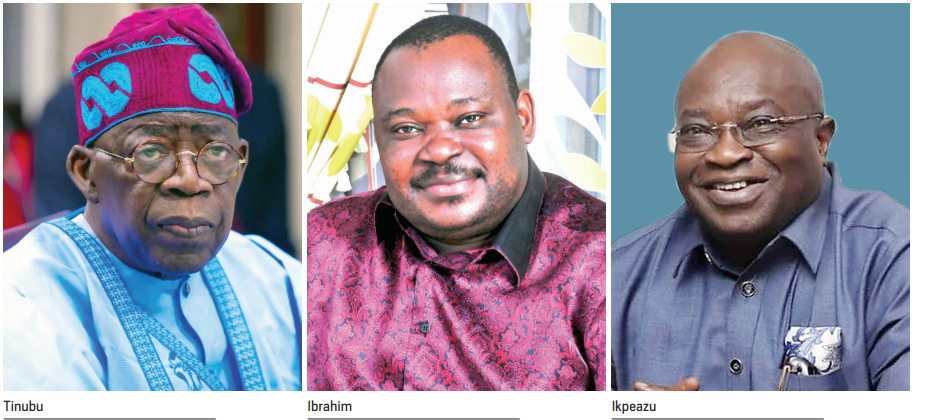
Former Health Minister, Prof. Isaac Adewole, a gynecologist goes to Canada, while the Director General of Nigeria’s National Intelligence Agency (NIA), Ayo Oke heads to France, Barr. Joe-Kyari Okocha, SAN — Ireland, Fatima Florence Ajimobi — Austria, Mrs. Lola Akande — Sweden. Former Senator representing Ondo South in the National Assembly, Dr. Jimoh Ibrahim is Nigeria’s Permanent Representatives at the UN, one-time Aviation Minister, Femi Fani-Kayode is heading to Germany, Mexico: Reno Omokri, South Africa: Sen. Ita Enang, former Abia Governor, Dr. Victor Ikpeazu, a Biochemist, Spain: Mr. Olufemi Pedro, Australia while Barr. Olumilua Oluwayimika Ayotunwa heads to Japan.
However, President Tinubu chose to send most of the career ambassadors what a scholar described as “backwater states.” Fror instance, Ambassador Nwabiola Ezenwa Chukwumeka — Côte d’Ivoire; Besto Maimuna Ibrahim — Niger (Niamey), Monica Okwuchukwu Enebechi — São Tomé and Príncipe and Ambassador Mohammed Mahmud Lele — Algeria (Algiers) Others are Endoni Syndoph Paebi — Burkina Faso, Ahmed Mohammed Monguno — Egypt, Ambassador Jane Adams — Jamaica, Ambassador Clark-Omeru Alexandra — Zambia, Chima Geoffrey Lioma David — Mali, Ambassador Odumah Yvonne Ehinosen — Equatorial Guinea, Ambassador Wasa Segun Ige — Lebanon, Ruben Abimbola Samuel — Italy, Ambassador Onaga Ogechukwu Kingsley — Mozambique, Ambassador Magaji Umar — DR Congo and Ambassador Muhammad Saidu Dahiru — India.
Ambassador Abdussalam Habu Zayyad — Senegal (Dakar), Ambassador Shehu Ilu Barde — Ghana, Ambassador Aminu Nasir — Ethiopia, Abubakar Musa — Chad, Ambassador Haidara Mohammed Idris — Netherlands, Ambassador Bako Adamu Umar — Morocco, Ambassador Sulu Gambari Olatunji Ahmed — Malaysia, Ambassador Romata Mohammed Omobolanle — Tanzania, Ambassador Shaga John Shamah — Botswana, Hamza Mohammed Salau — Iran Ambassador Ibrahim Danlami — Kenya, Ibrahim Adeola Mopelola — Benin, Ambassador Ayeni Adebayo Emmanuel — Belgium, Ambassador Akande Wahab Adekola — Switzerland, Ambassador Arewa Esther — Namibia, Ambassador Gergadi Joseph John — Gabon, Ambassador Luther Ogbomode AyoKalata — Sierra Leone, Danladi Yakubu Nyaku — Sudan (Khartoum) and Bello Dogon-Daji Haliru — Thailand.
Knocks, kudos
One of those not too impressed with the postings is Ambassador Joe Keshi, a former Consul General of Nigeria in Atlanta Georgia. He blamed the posting on the influence of the political class, who he said, displays entitlement mentality in appointments such as Ambassadors and High Commissioners as well as head other missions, even at the expense of career diplomats.
Keshi added that the initial plan was to appoint career diplomats of 30-35 years in foreign is service as Ambassadors and High Commissioners, but the political class was uncomfortable with that “because they wanted to top the list, they wanted to go out or determine who goes out at the expense of the national interest.”
But with the positing, Keshi stressed the need for Nigeria to maintain its policy of good neighbourliness with African countries, especially Niger, stating that diplomacy was missing in the recent face-off between both countries, despite their time-tested cultural affinity. On its part, the African Democratic Congress, (ADC), described the move as a diplomatic blunder, which exposed the country to embarrassment and reflected the government’s incompetence in handling international relations.
The party also questioned what happened to the remaining 44 diplomatic missions without designated envoys, warning that the development could weaken Nigeria’s international presence.
The party’s National Publicity Secretary, Bolaji Abdullahi, said the administration had “put the cart before the horse” by publicly announcing ambassadorial postings before obtaining agrément from host countries, a move that contradicts the provisions of the Vienna Convention on Diplomatic Relations, particularly Article 4, which requires a sending state to secure the consent of the receiving country before announcing the appointment of an ambassador.
“Under the Vienna Convention, a sending state must first obtain the consent of the receiving state before officially appointing or announcing a head of mission,” he said.
Tinubu’s policy thrust
Some have argued, however, that the posting of career diplomats to mainly Africa and developing countries was informed by what the leadership role Nigeria intends to play in the region. To them, this was evidently informed by political and economic developments in many parts of Africa in recent times.
In a recent interview with Sunday Telegraph, Prof Tunde Adeniran, an international relations expert and former Minister, said the President’s choice was in tandem with his foreign policy objectives.
“What the President wants to achieve externally determines who he appoints and sends out, because they are representatives of the country. Those are the calculations that go into such appointments. Besides their backgrounds, there is room for training and orientations of the people he is sending out,” he said.
According to a diplomat who chose to remain anonymous, the posting of former governors, former ministers and top security experts with proven credentials to countries like France, United Kingdom and the United States, was informed by high stakes diplomacy and political pursuit Nigeria wants to play in those countries. He added that “the moves must commence immediately to restore the image, prestige and presence of Nigeria in those countries.”
The task ahead
Ahead of their induction in the next few days, some of the ambassadors-designate are getting ready to resume at their various countries of service. For instance, the United Nations has requested the arrival details of Nigeria’s AmbassadorDesignate and Permanent Representative, Senator Jimoh Ibrahim, ahead of his assumption of duties at the global body’s headquarters in New York City.
Ibrahim, a serving senator, is Nigeria’s Ambassador and Permanent Representative to the United Nations. In an email sent to the Permanent Mission of Nigeria to the United Nations in New York, the UN requested information on Ibrahim’s expected date of arrival in the United States, including his flight details.
The organisation said the information was required to enable its protocol team to arrange a formal courtesy reception for the Nigerian envoy at the airport ahead of the official presentation of his Letter of Credence to the UN Secretary-General.
The presentation of the Letter of Credence is a standard diplomatic procedure through which ambassadors are officially recognised as their country’s representative to an international organisation.
Ibrahim previously played a role in international parliamentary diplomacy, serving in 2023 as President of a session of the Inter-Parliamentary Union in Geneva. Upon completion of the credential presentation ceremony, he is expected to formally assume his role as Nigeria’s Permanent Representative to the United Nations.
Meanwhile, Nigeria is currently addressing India’s decline to accept President Tinubu’s ambassador-designate due to diplomatic policies that discourage receiving envoys from administrations with less than two years remaining in office. Needless to say, the ambassadors-designate have a task ahead of them, especially as the posting is coming at a period of wars and disruptions in the international arena.
Nigerians wants to see how they promote better understanding of the country and its interest to foster economic, cultural and citizen diplomacy and attract FDI. Given Nigeria’s policy shift from Afrocentricity to the 4Ds, as espoused by President Tinubu, it remains to be seen how they align with it. The four Ds – Democracy, Demography, Development and Diaspora are central to Nigeria’s progress.
As articulated by President Tinubu, democracy focuses on defending and reinforcing democratic institutions and good governance, particularly in response to the rise of military coups in the ECOWAS region, while development positions foreign policy as a tool for economic growth, attracting foreign direct investment.
With Demography and Diaspora, the government wants to leverage Nigeria’s large population as diplomatic assets for economic growth while recognizing the massive contribution of Nigerians around the world.