



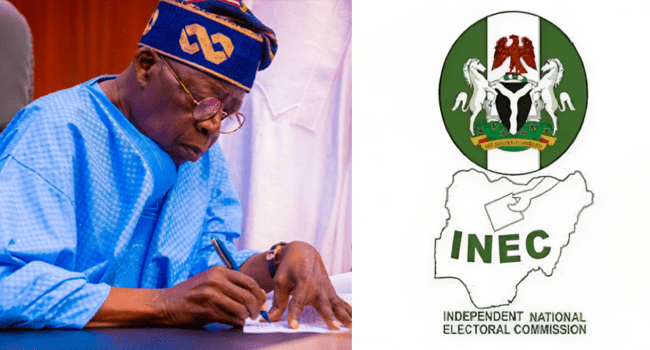
President Bola Ahmed Tinubu has allocated the sum of N1,013,778,401,602 to the Independent National Electoral Commission (INEC) in the 2026 budget presented to the National Assembly.
The allocation, one of the largest in the commission’s history, comes as Nigeria prepares for the 2027 general elections.
New Telegraph reports that the details of the provision were contained in the 2026 Appropriation Bill released by the Budget Office of the Federation.
President Tinubu had earlier presented a N58.18 trillion budget to the National Assembly, tagged the “Budget of Consolidation, Renewed Resilience and Shared Prosperity.”
The proposed budget projects a total revenue of N34.33 trillion and total expenditure of N58.18 trillion, including N15.52 trillion earmarked for debt servicing.
READ ALSO:
While INEC has often stressed the importance of sufficient funding to conduct credible elections, analysts say the commission’s ability to effectively utilise the new allocation will be tested by logistical challenges, including technology procurement, voter education, and the deployment of staff nationwide.
Section 3(3) of the Electoral Act 2022 mandates that election funds must be released to the commission at least one year before the polls.
“The election funds due to the Commission for any general elections are to be released to the Commission not later than one year before the next general election,” the law states.
In 2025, the National Assembly approved a substantial upward revision of INEC’s budget, raising it from the N40 billion initially proposed by the federal government to N140 billion.
The commission spent N313.4 billion for the conduct of the 2023 general elections.
According to INEC’s 2023 General Election Report, only N313.4 billion of the N355 billion approved for that year’s elections had been released as of September 2023.
In comparison, the National Assembly had approved N143 billion for the 2019 polls, while approximately N108.8 billion was spent on the 2015 general elections.
New Telegraph recall that Professor Bolade Eyinla, former Chief Technical Adviser to INEC Chairman Prof. Mahmood Yakubu, projected in October that the 2027 general election could cost the commission around N870 billion ($600 million).
Speaking at the Yiaga Africa 2027 Elections Scenarios and Election Manipulation Risk Index (EMRI) Retreat in Abuja, Eyinla described Nigeria’s elections as “Among the largest peacetime civil operations in the world,” emphasizing that they demand substantial financial, technological, and logistical resources.
Professor Bolade Eyinla explained that the projected N870 billion cost for the 2027 general election reflects the scale of Nigeria’s electoral landscape, which includes over 93 million registered voters, 176,846 polling units, and 1,558 electoral constituencies.
He noted that the estimate is based on historical election expenditures: N109 billion (US$662 million) was spent in 2015, N189 billion (US$619 million) in 2019, and N355 billion (US$628 million) on the 2023 elections.
Accounting for inflation, currency fluctuations, and the expansion of operational requirements, Eyinla said the N870 billion projection is realistic. He further explained that the cost amounts to roughly US$6.72 per voter, which he stated aligns with international standards for emerging democracies.
He said: “In comparative terms, the cost of conducting a general election in Nigeria is among the lowest in Africa. For instance, in Kenya, the cost per voter was US$25.9 in 2017 and US$14.9 in 2022; in Ghana, US$13.1 in 2016 and US$7.7 in 2020; in South Africa, US$5.1 in 2019 and US$7.1 in 2024.
“In the Democratic Republic of Congo, US$22 and US$14.37 per voter in 2023; and in Liberia, US$22 per voter in 2023. This comparison is no less striking with India, the world’s largest democracy, where the cost was US$8.5 per voter in 2019.
“Based on the prevailing US$ to Naira exchange rate at the time of each election, the cost of Nigeria’s previous three general elections was: N109 billion (US$662 million) in 2015, N189 billion (US$619 million) in 2019, and N355 billion (US$628 million) in 2023.
“Considering the current state of the economy, inflation, and the consumer price index from the National Bureau of Statistics (NBS), it is estimated that conducting the 2027 general election will require about US$600 million (approximately N870 billion), assuming INEC manages its resources prudently.