



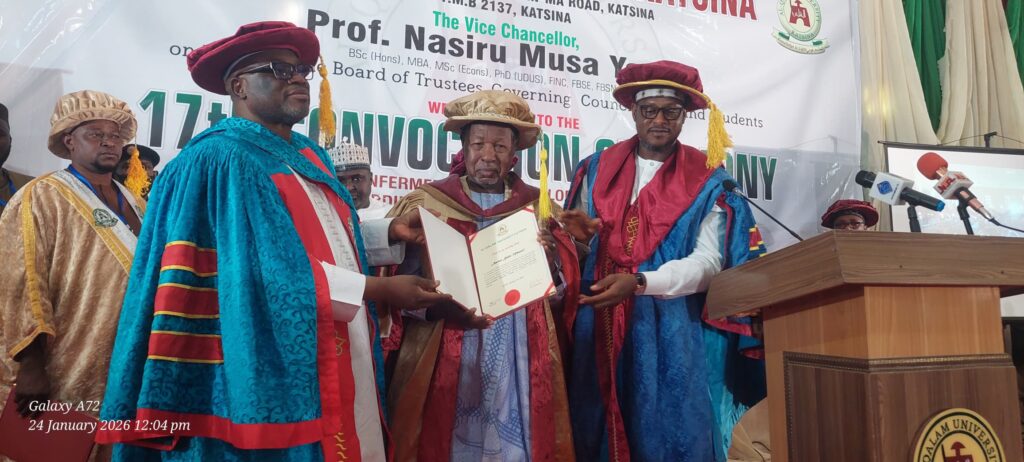
The Chairman of the Board of Trustees of the Tertiary Education Trust Fund (TETFund), Aminu Bello Masari, has charged Nigerian universities to urgently deploy technology-driven learning systems that would equip graduates with globally relevant skills, warning that the future of higher education and national development depends on it.
Masari delivered the charge at the 17th convocation ceremony of Al-Qalam University, Katsina, where he was conferred with an Honorary Doctorate Degree in Public Administration in recognition of his contributions to public service, education, leadership and human capital development.
He said: “In today’s world, a deliberate tilt towards technology is not optional; it is inevitable. The growing population of Nigerian university graduates demands a robust paradigm shift in how knowledge and skills are imparted.”
Masari argued that without intentional investment in technology-based education, universities risk producing graduates ill-prepared for an increasingly interconnected and competitive global economy.
According to him, mastery of modern technology must move beyond theory and be applied to solving Nigeria’s pressing development challenges.
“Our youths must be challenged to embrace modern technology and through its mastery, develop innovative solutions for agriculture, security, service delivery, healthcare, mineral exploration and other critical drivers of national development.”
Beyond technology, the former Katsina State governor underscored moral uprightness and institutional resilience as non-negotiable pillars for sustainable educational and national growth.
He warned that skills without values could undermine societal progress, urging universities to balance innovation with character formation.
Masari also used the platform to comment on Nigeria’s political climate ahead of another cycle of elections, cautioning political leaders against unrestrained competition and self-interest.
Drawing lessons from global trends, he noted that even advanced democracies were vulnerable to destabilisation when political ambition overrides national interest.
He called for leadership “anchored on purpose, patriotism and national development,” as he insisted that patriotism must take precedence over personal political ambition.
Governor of Katsina State, Dikko Radda, described education as the most potent tool for sustainable development, disclosing that his administration has invested over ₦6 billion in scholarship schemes benefiting no fewer than 174,451 students studying in tertiary institutions within and outside Nigeria.
Radda said the investments covering scholarships, school infrastructure and skills development programmes were strategically designed to prepare young people academically, morally and economically for global competitiveness.
“Our focus is to ensure that Katsina youths are not only educated but are also empowered with the skills and values required to thrive anywhere in the world,” the governor said.
Earlier, Vice-Chancellor of Al-Qalam University, Prof. Nasiru Musa Yawuri, announced that the institution graduated 1,109 students across various disciplines during the ceremony.
A breakdown of the results showed that 18 students graduated with First Class honours, 280 with Second Class Upper degrees, while 507 earned Second Class Lower degrees.
Prof. Yawuri said the university remained committed to academic excellence, ethical leadership and innovation, aligning its programmes with national development needs and global best practices.