



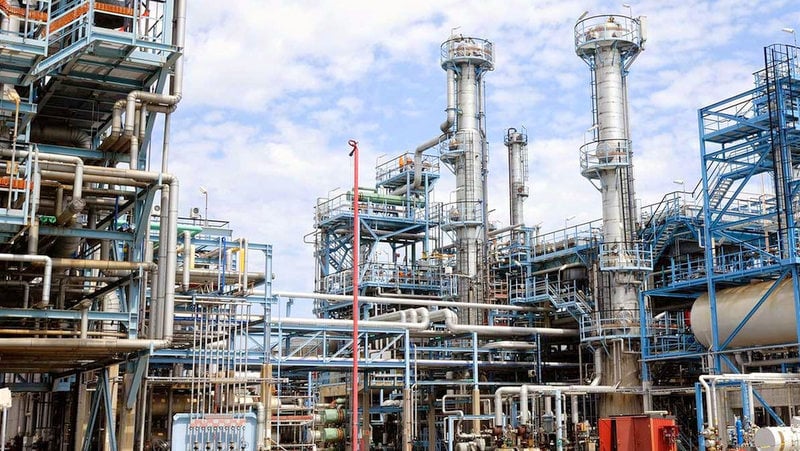
The Lagos Chamber of Commerce and Industry has urged state governments to rehabilitate existing state-owned modular refineries and encourage more refining projects to deepen competition in Nigeria’s downstream petroleum sector.
The chamber stated that increasing the number of operational refineries would help moderate petrol prices naturally and alleviate concerns about market dominance. This follows an earlier report by The PUNCH that the Dangote Petroleum Refinery supplied over 90 per cent of the petrol consumed in the country in February.
According to figures released in the February 2026 fact sheet by the Nigerian Midstream and Downstream Petroleum Regulatory Authority, local refineries supplied approximately 36.5 million litres of Premium Motor Spirit daily in February, while imports accounted for three million litres per day.
This brought the total national daily petrol supply to 39.5 million litres, with domestic refining accounting for about 92 per cent of the volume after the Federal Government paused petrol imports.
In a telephone interview with The PUNCH, the Director-General of the Lagos Chamber of Commerce and Industry, Dr Chinyere Almona, asserted that regulators must maintain strong oversight of the market without introducing price controls that could distort the sector.
The LCCI DG stressed that expanding local refining capacity remained the most sustainable solution to pricing concerns.
“From the Lagos Chamber of Commerce and Industry’s standpoint, the long-term solution is to encourage greater local refining capacity and market participation rather than imposing price caps. Nigeria consumes roughly 50 to 60 million litres of petrol daily, and increasing the number of operational refineries, through modular refinery projects and the rehabilitation of existing state-owned facilities, will deepen competition and naturally moderate prices,” Almona said.
She counselled regulators to focus on ensuring transparency and fair competition in the market, stating, “What is more appropriate is robust market regulation to ensure transparency and fair competition.”
“There is a need for regulatory oversight, but not necessarily direct price control. With the Dangote Refinery reportedly supplying over 90 per cent of petrol in the domestic market in February, concerns about potential market dominance are understandable,” Almona said. “However, Nigeria has already transitioned to a deregulated downstream petroleum market following the 2023 subsidy removal, and reintroducing administrative price controls could distort the market, discourage private investment, and recreate the fuel scarcity and subsidy burdens that historically characterised the sector.”
Almona added that the Nigerian Midstream and Downstream Petroleum Regulatory Authority should closely monitor pricing frameworks to ensure that petrol prices reflect objective market fundamentals such as global crude oil prices, exchange rate dynamics, refining costs, and distribution margins, while also preventing anti-competitive practices. “This kind of regulatory vigilance helps protect consumers without undermining the investment climate,” Almona remarked.
LCCI’s DG added that strengthening competition in the refining space would also help Nigeria achieve long-term energy security.
“In essence, the priority should be competitive market development and transparent regulation, not price-fixing. If Nigeria sustains this approach, the country can strengthen energy security, attract further investment into refining, and ultimately position itself as a petroleum supply hub for West Africa. We need to focus on boosting supply to meet local demand, as market forces will always determine prices,” she said.
Meanwhile, members of the organised private sector and economists have also warned the Federal Government against reintroducing petrol price controls despite rising global energy prices.
The National Vice President of the National Association of Small-Scale Industrialists, Segun Kuti-George, said global geopolitical tensions, rather than domestic market manipulation, were responsible for the recent pressure on petrol prices.
“I am not sure the government should respond by going back to the subsidy era as a result of that. We should not under any guise return to the oil subsidy era,” Kuti-George said.
He added, “It is nothing but the crisis in the Gulf region, the US-Iranian war, which is a temporary thing. This is why crude prices have risen, not Dangote.”
Kuti-George, however, called for measures that could cushion the impact of rising fuel costs on Nigerians, adding, “The most important thing is that we already have a refinery here in the country. The government should encourage others to build more refineries so that we can have more competition.”
Similarly, the Chief Executive Officer of Economic Associates, Dr Ayo Teriba, warned the government against making permanent policy changes in response to a temporary global crisis.
“You cannot, because of short-term crises, then take a long-term policy decision. Whatever the government wants to do to cushion the shock of a war outbreak that may be over in two weeks or one month should be limited to short-term responses,” Teriba said.
Teriba suggested temporary relief measures rather than structural policy reversals. “We can announce a ‘US-Israeli-Iranian war relief’ to cushion the shock of that war on energy. No permanent price changes, no permanent policy changes, perhaps one month’s relief for targeted Nigerians who need protection against the cost shock,” he said.
Also speaking, the Director of the Centre for the Promotion of Private Enterprise, Dr Muda Yusuf, warned that price controls could create distortions in the economy. “Price control is not the way to go. It can be very arbitrary, and it can cause a lot of distortions in the economy,” Yusuf said.
He advised the government to instead reduce regulatory costs imposed on refiners and fuel suppliers. “The best way is for the government to give concessions to those who are either refiners or suppliers or those who are producing the product. The Dangote Refinery management recently said they pay about 46 different charges, and all of these things will end up as part of the price that they will charge at the pump,” he said.
Yusuf also stressed the need for more refineries to ensure competition in the sector.
“We should encourage more refineries to be on the ground so that we have more competition among refineries. If all of them are producing here and subjected to the same conditions, then you can begin to talk about a level playing field,” he added.